

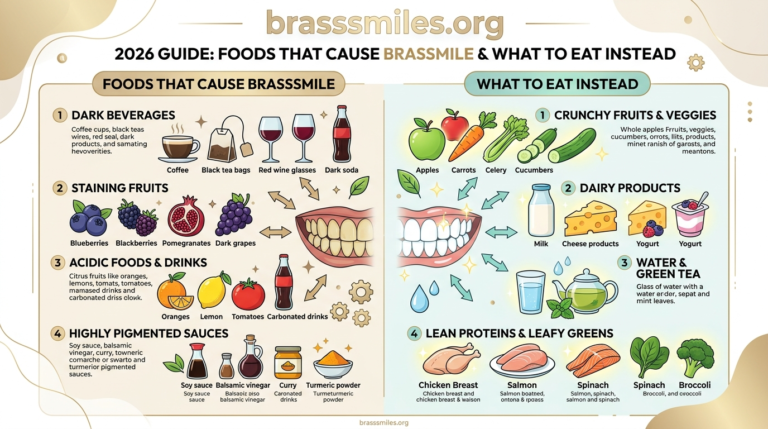
Your diet and your smile have a more direct and ongoing relationship than most people realise. Every meal, every drink, every snack you consume either deposits something onto your tooth enamel, erodes the enamel that protects it, or contributes to the oral environment that determines how readily your teeth stain. For anyone managing brasssmile — that warm, golden, brassy tooth tone that whitening products alone cannot permanently resolve — understanding the dietary dimension is not optional. It is foundational.
The good news is that dietary management of brasssmile does not require extreme restriction or the abandonment of foods you genuinely enjoy. Coffee drinkers do not need to quit. Red wine drinkers do not need to abstain. What makes the difference is understanding the specific mechanism by which each food or drink contributes to brasssmile, so that you can make informed decisions about frequency, pairing, and rinsing habits that reduce the staining impact without eliminating the pleasure.
This guide covers the foods and drinks most consistently implicated in brasssmile formation, the science behind how each one causes discolouration, and — equally importantly — the best foods to eat instead that actively protect enamel, support a brighter smile tone, and slow the dietary contribution to brasssmile. The relationship between what you eat and how your smile looks is one of the most immediately actionable parts of brasssmile management. This is where practical change begins.
Why Certain Foods Cause Brasssmile: Tannins, Chromogens, and Acid Erosion
Foods and drinks cause brasssmile through three primary mechanisms: tannins that bind to enamel pellicle and trap pigmented compounds, chromogens that are strongly pigmented molecules adhering directly to tooth surfaces, and dietary acids that erode enamel — thinning the protective outer layer and exposing more of the naturally yellow dentin beneath. Understanding which mechanism each food uses determines both its staining impact and the most effective countermeasure.
Before examining specific foods, it is worth understanding the three chemical mechanisms that link diet to brasssmile. These mechanisms are distinct, they operate differently, and they respond to different countermeasures. Treating all dietary staining as the same problem leads to ineffective responses.
Tannins: The Staining Binders
Tannins are polyphenolic compounds found naturally in plants — in their bark, leaves, seeds, and fruits. They are what give tea its astringency, red wine its structure, and certain fruits their dryness. In the mouth, tannins bind readily to proteins, including the salivary proteins that form the enamel pellicle — the thin, naturally occurring film that coats teeth.
Once bound to the pellicle, tannins create a sticky, chromogen-trapping surface that accumulates pigment with every subsequent exposure. Research published in Today’s RDH confirms that coffee, red wine, and teas are the most common sources of tannin-driven tooth staining, with different tannin compositions producing different stain colours — black tea and coffee produce yellow-brown staining, red wine produces grey staining, and green tea can produce yellow or green-tinged staining.
Chromogens: The Direct Pigment Depositors
Chromogens are intensely pigmented organic molecules present in many foods and drinks. Unlike tannins, which work primarily through binding to the pellicle and creating conditions for staining, chromogens are themselves the colour-producing agents. They adhere directly to tooth enamel surfaces and resist removal by ordinary brushing. Strongly pigmented fruits — blueberries, blackberries, cherries, pomegranates — contain anthocyanins, which are chromogens responsible for their vivid colours. These same compounds bind to enamel with high affinity, depositing purple-blue pigment that contributes to surface discolouration. Dark sauces, cola beverages, and artificially coloured foods contain chromogens of various types with equivalent staining potential.
Dietary Acids: The Structural Erosion Route to Brasssmile
The third mechanism is fundamentally different from the first two. While tannins and chromogens deposit colour onto the enamel surface, dietary acids erode the enamel itself. Foods and drinks with a pH below 5.5 — citrus fruits, carbonated drinks, vinegar-based dressings, sports and energy drinks, white wine — dissolve enamel minerals through a process called acid erosion.
As enamel thins, two things happen: it becomes more translucent, revealing more of the yellow dentin beneath, and it becomes more porous, absorbing subsequent chromogen and tannin staining more readily. This is the pathway through which dietary acids contribute specifically to brasssmile rather than just surface yellowing — they accelerate the structural dimension of the condition that makes brasssmile harder to treat than simple surface staining.
The most damaging dietary combination for brasssmile is acidic food or drink followed immediately by a tannin or chromogen source. The acid softens and temporarily makes enamel more porous, then the tannins and chromogens penetrate more deeply than they otherwise would. Red wine — which is simultaneously acidic, tannin-rich, and chromogen-loaded — is the clearest example of this triple threat in a single food source.
8 Foods and Drinks That Cause Brasssmile — With Smarter Alternatives
The eight foods and drinks most consistently implicated in brasssmile formation are coffee, black and green tea, red wine, dark berries and their juices, tomato-based sauces, soy sauce and balsamic vinegar, carbonated drinks, and dark chocolate. Each operates through tannins, chromogens, or acid erosion — or a combination. Each has smarter consumption habits that reduce the staining impact without requiring complete elimination.
Coffee — Tannins and Chromogens in Every Cup
Mechanism: Coffee contains tannins that bind to the enamel pellicle, creating a chromogen-trapping surface. It also contains its own chromogens — the pigmented compounds responsible for coffee’s characteristic colour. These chromogens are small enough to penetrate enamel micro-pores, depositing pigment within the enamel matrix itself. Dark roasts contain higher concentrations of pigmented compounds. Enamel’s natural porosity means that frequent coffee consumption without rinsing deposits staining progressively deeper over time.
Staining Impact: High. Daily coffee consumption without rinsing habits is one of the most consistent contributors to brasssmile across all age groups. The combination of tannin-driven pellicle modification and direct chromogen penetration makes coffee staining both surface-level and deeper than many people realise.
Smarter Habit: Drink through a straw when possible. Rinse with water immediately after finishing — not five minutes later. Adding a small amount of milk reduces tannin concentration slightly. Use blue covarine toothpaste in the morning to counteract the daily tonal effect.
Black Tea — Higher Tannin Content Than Coffee
Mechanism: Black tea contains polyphenolic tannins at concentrations that typically exceed coffee. Research confirms that black tea produces yellow-brown staining on tooth enamel, with the tannin-pellicle interaction being the primary mechanism. Green tea, while lower in tannins, still contains enough to contribute to staining with frequent consumption — and can produce yellow or greenish staining in regular drinkers.
Staining Impact: High to Very High. Black tea is consistently ranked among the top two or three tooth-staining beverages in dental research. The high tannin load combined with typical consumption frequency makes it a significant dietary driver of brasssmile in regular tea drinkers.
Smarter Habit: Consider switching from black to white tea, which has significantly lower tannin content and minimal staining potential. If switching is not realistic, add milk — the protein in milk binds with tannins before they reach the enamel, reducing their staining impact. Rinse with water immediately after each cup.
Red Wine — The Triple Threat
Mechanism: Red wine operates through all three brasssmile mechanisms simultaneously. Its tannin content modifies the enamel pellicle to trap chromogens. Its own chromogens — derived from grape skin anthocyanins — have high enamel affinity. Its acidity (typically pH 3.0 to 3.5) temporarily softens and opens enamel pores, allowing deeper penetration of the tannins and chromogens that follow each sip. A PMC-published study confirmed that red wine stained teeth more than white wine in controlled conditions, with higher tannin content identified as the primary driver of staining intensity.
Staining Impact: Very High. Red wine is the single most chemically aggressive common dietary contributor to brasssmile. Its triple mechanism — acid, tannins, chromogens — acting simultaneously makes it disproportionately damaging relative to its consumption volume.
Smarter Habit: Eat cheese before and during wine consumption — the calcium in cheese temporarily remineralises enamel, providing some protective buffering. Rinse with water between glasses. Avoid brushing immediately after — the acid has temporarily softened enamel. Wait 30 minutes before brushing.
Dark Berries and Berry Juices — Anthocyanin Staining
Mechanism: Blueberries, blackberries, cherries, pomegranates, and cranberries contain anthocyanins — a category of chromogen responsible for their deep purple and red colours. These compounds bind strongly to tooth enamel surfaces and leave vivid pigmentation that is difficult to remove through standard brushing. Berry juices concentrate this effect further, as the chromogen content is high relative to contact volume and the liquid format allows full enamel surface coverage. Research from Odontology (2025) assessed the staining potential of common food sources on tooth enamel and confirmed the significant staining impact of dark-pigmented fruits.
Staining Impact: Moderate to High. Regular consumption of dark berries without rinsing contributes meaningfully to brasssmile, particularly in people who eat them daily as part of a health-conscious diet — a population that often does not associate healthy foods with dental staining.
Smarter Habit: Consume berries as part of a meal rather than alone — other foods in the meal dilute the staining effect and stimulate saliva production that buffers the chromogen impact. Rinse immediately after. Lighter-coloured berries — raspberries, strawberries — have lower anthocyanin content and significantly less staining potential.
Tomato-Based Sauces — Acid, Pigment and Enamel Softening
Mechanism: Tomato sauce combines high acidity with vivid red chromogens — the lycopene and other pigments that give tomatoes their colour. The acid in tomato-based sauces softens enamel temporarily, then the chromogens in the sauce penetrate the softened surface more readily than they would otherwise. An in vitro study published in Med Sci Monit Basic Res confirmed the discolouration potential of tomato sauce on both tooth enamel and resin composites, with staining occurring from even short exposure periods.
Staining Impact: Moderate. Tomato-based sauces are a frequent and often unconsidered source of brasssmile-contributing dietary staining, particularly for people who eat pasta, pizza, or curry dishes regularly.
Smarter Habit: Eat a leafy green salad before pasta or pizza — the thin film of plant matter on teeth provides a temporary barrier between the sauce and enamel. Rinse with water after eating. Milk-based pasta sauces offer a non-staining alternative with equivalent culinary satisfaction.
Soy Sauce and Balsamic Vinegar — Dark and Acidic
Mechanism: Soy sauce is one of the most intensely pigmented condiments commonly used in cooking. Its deep brown-black colour comes from high concentrations of chromogens produced during the fermentation and caramelisation processes. Balsamic vinegar combines intense chromogenic pigmentation with high acidity — a dual staining mechanism that makes it particularly problematic for brasssmile despite being used in smaller volumes than other condiments.
Staining Impact: Moderate to High per serving. Because both soy sauce and balsamic vinegar are used as flavouring agents rather than consumed in volume, their staining impact is often underestimated. The chromogen concentration per millilitre is among the highest of any common dietary substance.
Smarter Habit: Use lighter-coloured alternatives where possible — rice vinegar or apple cider vinegar instead of balsamic, coconut aminos instead of soy sauce for occasional use. When using these condiments, rinse with water after eating and avoid pairing them with other high-tannin items in the same meal.
Carbonated Drinks — Enamel Erosion as the Primary Route
Mechanism: Cola beverages combine phosphoric acid (pH approximately 2.5) with artificial colourings — both anionic chromogens that interact with enamel surfaces. The phosphoric acid is aggressive enough to cause measurable enamel dissolution with regular consumption, progressively thinning the enamel layer that masks dentin colour. Even clear carbonated drinks — sparkling water, lemon sodas — are sufficiently acidic to contribute to enamel erosion over time, despite containing no chromogens. This makes them a structural contributor to brasssmile even in the absence of surface staining.
Staining Impact: High for cola and dark sodas (dual mechanism), Moderate for clear carbonated drinks (acid erosion only). The acid erosion route is particularly significant for brasssmile because it accelerates the structural enamel thinning that whitening cannot reverse.
Smarter Habit: Replace carbonated drinks with still water as the default choice. If carbonated drinks are a fixture in your diet, consume them with a meal rather than sipping throughout the day — the meal’s food content buffers the acid impact and saliva production is higher during eating.
Dark Chocolate — Tannin Staining in Small Doses
Mechanism: Dark chocolate contains tannins derived from cocoa — the same class of polyphenolic compounds found in tea and red wine. The tannin content increases proportionally with cocoa percentage, meaning that high-cocoa dark chocolate (70 percent and above) has meaningfully higher staining potential than milk chocolate. The tannins bind to the enamel pellicle in the same way as tea tannins, creating conditions for chromogen accumulation and surface staining. Unlike beverages, dark chocolate also adheres to tooth surfaces, extending the tannin contact time.
Staining Impact: Low to Moderate. Dark chocolate is among the least aggressive common staining foods due to lower typical consumption quantities, but regular high-cocoa chocolate consumption without rinsing contributes to brasssmile over time, particularly in the context of an already tannin-heavy diet.
Smarter Habit: Eat dark chocolate at the end of a meal rather than as a standalone snack — saliva production during meals provides natural buffering and rinsing. Rinse with water after. Milk chocolate, while less beneficial nutritionally, has significantly lower tannin content.
Dietary Staining Reference: Foods Ranked by Brasssmile Impact
Ranking foods by their brasssmile impact helps prioritise which dietary changes will have the greatest effect on your smile. Red wine, black tea, and coffee consistently rank highest due to their combined tannin and chromogen load. Carbonated drinks rank high due to their acid erosion impact on enamel structure. Dark berries are significant but often overlooked because they are considered health foods.
Foods and Drinks Ranked by Brasssmile Contribution
| Food / Drink | Primary Mechanism | Brasssmile Impact | Structural Risk | Best Countermeasure |
| Red wine | Tannins + Chromogens + Acid | Very High | High | Cheese before, water rinse |
| Black tea | Tannins + Chromogens | Very High | Low | Switch to white tea, add milk |
| Coffee | Tannins + Chromogens | High | Low | Straw, immediate water rinse |
| Cola / Dark soda | Chromogens + Acid | High | High | Meal pairing, straw |
| Dark berries | Chromogens (anthocyanins) | Moderate–High | Low | Rinse, eat with meals |
| Tomato sauce | Chromogens + Acid | Moderate | Moderate | Salad first, rinse after |
| Soy sauce | Chromogens | Moderate | Low | Use sparingly, rinse after |
| Balsamic vinegar | Chromogens + Acid | Moderate | Moderate | Use rice vinegar instead |
| Dark chocolate | Tannins | Low–Moderate | Low | Eat with meals, rinse |
| Green tea | Tannins (lower) | Low–Moderate | Low | Rinse, add lemon sparingly |
The table confirms that the highest brasssmile risk comes from beverages rather than solid foods — they have longer enamel contact time and reach every tooth surface uniformly. Among solid foods, highly pigmented sauces and condiments pose the most consistent risk. The structural risk column highlights which foods accelerate enamel thinning — a dimension of brasssmile that surface staining alone cannot explain.
What to Eat Instead: 7 Foods That Protect Enamel and Support a Brighter Smile
Seven food groups actively support enamel health, reduce the rate of brasssmile formation, and create oral conditions that resist staining. These are dairy products for calcium and phosphate remineralisation, crunchy vegetables for natural mechanical cleaning, apples for malic acid surface brightening, cheese for enamel buffering during meals, green tea as a lower-staining tea alternative, water as the universal rinsing and buffering agent, and nuts for saliva stimulation and mineral delivery.
Cheese — The Enamel Buffering Champion
Smile Benefit: Cheese is one of the most powerful foods for enamel protection and brasssmile prevention. It raises oral pH, stimulates saliva production, and delivers calcium and phosphate directly to the tooth surface where they contribute to remineralisation.
Why It Works: Cheese contains a high concentration of calcium and phosphate — the two primary minerals in tooth enamel. When consumed, it raises the pH of the oral environment above 5.5 (the threshold at which enamel begins to dissolve), creating a protective buffering effect that counteracts acid from other foods. A unique protein in cheese called casein also coats tooth surfaces temporarily, providing physical protection against acid and staining. Research in the field of preventive dentistry consistently identifies dairy consumption as a significant protective factor in dental erosion.
How to Use It: Eat a small piece of hard cheese before drinking wine, at the end of a meal to neutralise food acids, or as a standalone snack. Hard cheeses (cheddar, parmesan, gouda) have higher casein and mineral density than soft cheeses.
Crunchy Raw Vegetables — Natural Mechanical Cleaning
Smile Benefit: Celery, carrots, cucumber, and raw broccoli provide a natural mechanical cleaning action as they are chewed. The fibrous texture gently abrades tooth surfaces, removing loose deposits of chromogens and plaque before they have time to bind and deepen into staining.
Why It Works: The mechanical cleaning effect of crunchy vegetables comes from their fibrous cell walls, which act as natural mild abrasives on tooth surfaces. Additionally, chewing stimulates saliva production — saliva is the mouth’s primary natural defence against staining, as it dilutes chromogens, buffers acids, and contains protective proteins that inhibit pellicle modification by tannins.
How to Use It: Eat crunchy raw vegetables as a snack between meals or at the end of a meal as a natural finishing cleanse. Celery is particularly effective because its high water content also hydrates the mouth, supporting saliva flow.
Apples — Malic Acid and Natural Surface Polishing
Smile Benefit: Apples contain malic acid — a mild organic acid that has a natural brightening effect on tooth surfaces, helping to remove surface chromogen deposits. Their fibrous texture also provides a mechanical cleaning action similar to crunchy vegetables.
Why It Works: Malic acid is naturally present in apples at concentrations that are mild enough to be beneficial rather than erosive when consumed as whole fruit rather than juice. Several whitening toothpaste formulations include malic acid as an active brightening ingredient, derived from the same observation that apple consumption has a natural surface-cleaning effect on teeth. The fibre in apple flesh also mechanically removes surface deposits as it is chewed.
How to Use It: Eat whole apples rather than drinking apple juice — juice concentrates the acid without the mechanical cleaning benefit of the fibre. A whole apple as a snack is a genuinely useful addition to a brasssmile management diet, particularly as an afternoon snack that provides natural cleaning between lunch and the evening meal.
Water — The Most Important Dietary Tool for Brasssmile
Smile Benefit: Water is the single most useful dietary choice available for brasssmile management. It dilutes chromogens and tannins before they can bind to enamel, neutralises oral acids, stimulates salivary clearance, and maintains the hydration of enamel tissue.
Why It Works: Water with a neutral pH buffers the acidic environment created by staining foods and drinks. Drinking water immediately after staining beverages — coffee, tea, wine — significantly reduces the concentration of tannins and chromogens remaining on tooth surfaces. Fluoridated tap water provides the additional benefit of delivering fluoride directly to tooth enamel during each rinse, supporting remineralisation.
How to Use It: Keep a glass of water next to every hot drink and rinse with it immediately after finishing. Make still water your default beverage throughout the day. When choosing between sparkling and still water, still water is preferable — sparkling water’s acidity, while mild, still contributes to enamel erosion with very frequent consumption.
Dairy — Calcium and Phosphate for Enamel Remineralisation
Smile Benefit: Milk, yoghurt, and other dairy products provide calcium and phosphate in a bioavailable form that directly supports enamel remineralisation — the process by which slightly dissolved enamel repairs itself using minerals from saliva.
Why It Works: Enamel remineralisation is the primary natural defence against acid erosion-driven brasssmile. When oral pH drops below 5.5, enamel begins to lose mineral content. When pH rises above 5.5, remineralisation can occur using calcium and phosphate ions available in saliva and from dietary sources. Dairy products raise both the calcium and phosphate concentration in saliva after consumption, creating conditions strongly favourable to enamel repair. Yoghurt also provides probiotic bacteria that support a healthier oral microbiome, reducing the acid-producing bacterial populations that accelerate enamel erosion.
How to Use It: Drink a small glass of milk at the end of a meal with high staining potential, or eat yoghurt as a morning or afternoon snack. Plain yoghurt is preferable to flavoured varieties, which contain added sugar that feeds acid-producing bacteria.
Nuts — Saliva Stimulation and Mineral Delivery
Smile Benefit: Almonds, cashews, and other nuts are low in sugar and high in calcium and phosphorus. Their texture requires significant chewing, which stimulates saliva production — one of the most valuable processes for brasssmile prevention.
Why It Works: Saliva serves multiple protective functions for tooth enamel: it dilutes and washes away food acids, delivers calcium and phosphate ions for remineralisation, and contains proteins that bind with tannins before they reach the enamel pellicle — neutralising part of their staining potential. Foods that require prolonged chewing — nuts being a prime example — stimulate sustained saliva flow for significantly longer than soft foods. The calcium and phosphate in nuts contribute directly to the remineralisation process.
How to Use It: Eat a small handful of plain nuts as an afternoon snack, particularly on days that include high-tannin drinks. Unsalted almonds are among the most enamel-friendly nut options. Avoid sugar-coated or honey-roasted varieties, which add dietary sugar to the mix.
Oily Fish — Vitamin D for Enamel Integrity
Smile Benefit: Oily fish — salmon, mackerel, sardines — provide Vitamin D, a fat-soluble vitamin essential for calcium absorption and enamel mineralisation. Without adequate Vitamin D, dietary calcium intake does not translate fully into enamel support.
Why It Works: Vitamin D’s role in dental health is often overlooked in the context of brasssmile, but it is a foundational element. Calcium contributes to enamel strength and density only when Vitamin D is present to facilitate its absorption and metabolism. Research in preventive dentistry has linked low Vitamin D status to reduced enamel mineralisation and increased susceptibility to acid erosion — both of which accelerate the structural dimension of brasssmile. Oily fish is one of the most bioavailable dietary sources of Vitamin D, alongside sunlight exposure.
How to Use It: Include oily fish two to three times per week as a primary protein source. Canned sardines and mackerel are cost-effective and nutritionally equivalent to fresh options for this purpose.
Smarter Dietary Habits That Reduce Brasssmile Without Eliminating Favourite Foods
The most practical dietary approach to brasssmile management is not elimination but modification — changing how, when, and with what foods and drinks are consumed. Rinsing immediately after staining drinks, pairing staining foods with protective ones, using a straw for cold staining beverages, and ending meals with enamel-protective foods are the four habits with the greatest cumulative impact on brasssmile from dietary causes.
The idea of dramatically changing your diet to manage brasssmile is both unnecessary and unrealistic for most people. Coffee is a daily pleasure for hundreds of millions of people. Red wine is a consistent part of social and culinary life for many. Berries are genuinely good for you. The goal of dietary brasssmile management is not to eliminate these foods but to consume them in ways that reduce their impact on tooth enamel.
The Rinse Habit: Most Impactful, Least Effort
Rinsing with plain water immediately after consuming any staining food or drink is the single most effective dietary habit for brasssmile prevention. It removes tannins and chromogens from tooth surfaces before they have time to bind to the enamel pellicle. The timing is critical — the binding process begins within minutes of exposure. Rinsing five minutes after finishing a coffee is meaningfully less effective than rinsing within 60 seconds. Building this habit takes two to three weeks to feel automatic but costs nothing and delivers compounding benefits over months.
Meal Pairing: Using Food Structure to Your Advantage
Consuming staining foods as part of a balanced meal rather than alone significantly reduces their brasssmile impact. The chewing required for a full meal stimulates saliva production throughout the meal, which buffers acids and dilutes chromogens. Other foods in the meal — particularly dairy, crunchy vegetables, and proteins — contribute protective mechanisms that partially offset the staining impact of the problematic items. A glass of red wine with a meal that includes cheese and crunchy vegetables is meaningfully less damaging to enamel than the same wine consumed alone.
Sequencing: Protective Foods Last
The order in which you eat foods within a meal matters more than most people realise. Ending a meal with cheese, plain yoghurt, or a crunchy raw vegetable creates a more protective oral environment than ending with something acidic or staining. The enamel buffering effect of cheese, the mechanical cleaning of crunchy vegetables, and the pH-neutralising effect of dairy create conditions in which the enamel enters the post-meal period with better mineralisation and lower chromogen burden than if the meal ended with coffee or dessert.
The Straw Strategy for Cold Drinks
For cold staining beverages — iced coffee, iced tea, dark sodas, fruit juices — drinking through a straw reduces direct contact between the liquid and the front tooth surfaces where brasssmile is most visible. The straw directs the flow past the enamel rather than across it. This is particularly effective for drinks consumed slowly over a prolonged period, where the extended contact time between enamel and chromogens without a straw is disproportionately damaging.
The four habits — rinse immediately, pair with protective foods, end meals with enamel-friendly choices, and use a straw for cold staining drinks — require no dietary restriction and no additional products. They cost nothing and take seconds. Implemented consistently over six weeks, they produce a measurable reduction in the rate of brasssmile formation from dietary causes.
Common Dietary Mistakes That Worsen Brasssmile
The most common dietary mistakes that worsen brasssmile are brushing immediately after acidic foods or drinks, avoiding all staining foods without addressing rinsing habits, consuming staining beverages slowly over extended periods, and assuming that healthy foods cannot contribute to brasssmile. Each of these mistakes either directly damages enamel or fails to address the actual mechanism of dietary staining.
Mistake 1: Brushing Immediately After Acidic Foods
This is one of the most widely made dental hygiene errors and has particular relevance to brasssmile. Acidic foods and drinks — citrus fruits, carbonated drinks, wine, coffee — temporarily soften enamel through acid demineralisation. Brushing during this window of softened enamel physically removes enamel particles rather than just cleaning the surface. Over time, this accelerates enamel thinning and worsens the structural dimension of brasssmile. The correct approach is to rinse with water immediately after acidic foods or drinks, then wait 30 minutes before brushing to allow enamel to reharden through salivary remineralisation.
Mistake 2: Treating Dark-Coloured Equals High Staining Risk
Not all dark foods are equal in their brasssmile impact. Dark chocolate has lower staining potential than black tea despite its colour. Balsamic vinegar’s impact comes more from its acid content than its colour. Beetroot — intensely purple — stains teeth but the chromogens wash away relatively easily. Conversely, some lighter-coloured foods — white wine, sparkling water, citrus fruits — cause structural enamel damage through acid erosion without any surface colouring. The colour of a food is not a reliable proxy for its brasssmile risk. Mechanism and frequency matter more than appearance.
Mistake 3: Slow-Sipping Staining Drinks Over Extended Periods
Sipping a coffee, tea, or soda over 45 to 60 minutes creates an extended window of tannin and chromogen exposure that is significantly more damaging than consuming the same drink quickly. The prolonged contact time allows more complete pellicle modification and deeper chromogen penetration. People who nurse a single cup of coffee throughout a morning meeting are exposing their enamel to sustained staining input for far longer than those who drink the same cup in ten minutes. If complete speed-drinking is impractical, rinsing with water every 15 to 20 minutes during extended drink consumption significantly reduces the cumulative impact.
Never substitute white wine for red wine as a brasssmile-prevention strategy based on colour alone. While red wine has higher chromogen content, white wine is typically more acidic and can cause equivalent or greater enamel erosion over time. Both contribute to brasssmile through different mechanisms — the choice between them should be based on overall dietary balance, not colour.
Experience Perspective: How Dietary Awareness Changes Your Relationship With Brasssmile
The practical experience of learning which foods drive brasssmile and making small, targeted changes to how they are consumed — rather than eliminating them — produces a shift that is both physiologically and psychologically significant. People who make these changes consistently report that their whitening results last longer and their baseline smile tone improves gradually without dramatic restriction.
There is a particular moment that many people describe when they first understand the dietary dimension of their brasssmile. It usually comes after they have tried whitening treatments, been initially pleased, and then watched the brassy tone return faster than they expected. When they learn that the two coffees and the glass of wine consumed in the days immediately after whitening — during the vulnerable post-treatment window — were depositing staining more deeply and rapidly than usual, something clicks. The brasssmile was not winning. They were accidentally giving it a head start.
What changes after that realisation is not the foods people eat — it is the habits surrounding them. The glass of water placed next to the coffee mug. The piece of cheese eaten before the wine. The apple at the end of lunch. The straw kept in the desk drawer for iced drinks. None of these changes are sacrifices. They are additions and slight modifications that reduce the staining burden on enamel without changing the pleasure of the foods themselves.
The cumulative effect of these habits over six to eight weeks is typically a noticeably slower return of brasssmile between whitening cycles, a better maintained baseline smile tone, and — for many people — a genuine improvement in the settled colour of their teeth even without more frequent whitening. Diet does not replace treatment. But it creates the conditions in which treatment works better and lasts longer. That is one of the most genuinely useful things you can understand about your own brasssmile journey.
A 2025 study published in Odontology assessed the staining potential of common sauces on tooth enamel surfaces, confirming that contact time and frequency are as significant as concentration in determining dietary staining impact. Foods consumed daily at low volume can accumulate comparable staining to foods consumed occasionally at higher volume — which is why daily coffee habits matter as much as occasional wine consumption for brasssmile management.
Foods That Cause Brasssmile — Frequently Asked Questions
These FAQs address the most commonly searched dietary questions about brasssmile, providing direct answers based on published dental research and practical oral health guidance. Each answer is structured for featured snippet and AEO targeting.
Does coffee always cause brasssmile?
Coffee is a consistent contributor to surface staining that can develop into brasssmile over time, but its impact depends on frequency, contact time, and rinsing habits. Someone who drinks one cup of coffee daily and rinses with water immediately afterward will accumulate far less enamel staining than someone who sips coffee throughout the morning without rinsing. The tannins and chromogens in coffee cause brasssmile through cumulative exposure — not through any single cup. Modifying the habit around coffee consumption (rinsing, straw use, pairing with milk) significantly reduces its contribution to brasssmile without requiring elimination.
Is green tea better than black tea for brasssmile?
Yes, meaningfully so. Black tea has a higher concentration of tannins than green tea, and research confirms it produces more intense tooth staining. Green tea can produce yellow or greenish-tinted staining in frequent drinkers due to its own chromogen content, but its overall staining potential is lower. White tea has the lowest staining potential of the major tea varieties. For anyone managing brasssmile who drinks several cups of tea daily, switching from black to green or white tea is one of the most straightforward dietary changes with a clear impact on staining accumulation.
Can eating cheese really protect teeth from brasssmile?
Yes, and the mechanism is well-established. Cheese raises oral pH, stimulates saliva production, and delivers calcium and phosphate to tooth surfaces — all of which support enamel protection. The protein casein in cheese provides additional surface protection by coating enamel temporarily. Eating a small amount of hard cheese before wine consumption — a recommendation supported by dental nutritionists — partially offsets wine’s acid and chromogen impact by creating a protective enamel environment before exposure begins.
Do berries cause brasssmile even though they are healthy?
Yes, dark berries cause surface staining through their anthocyanin chromogens — the same compounds responsible for their health benefits. This does not mean they should be avoided. Berries are nutritionally valuable and their staining impact is manageable with rinsing habits and meal pairing. Consuming berries as part of a meal rather than alone, rinsing with water afterward, and choosing lighter-coloured berries (raspberries, strawberries) where appropriate reduces the brasssmile contribution without eliminating their nutritional value. Healthy and smile-protective are not mutually exclusive.
What single dietary change would have the biggest impact on brasssmile?
Based on the mechanisms and frequency data, establishing the immediate water-rinsing habit after every staining drink would have the greatest single impact on brasssmile for most people. It intercepts tannins and chromogens before they bind to the enamel pellicle — the foundational step in staining formation — and it addresses all dietary staining sources simultaneously rather than targeting any single food. It costs nothing, takes less than 30 seconds, and compounds in impact over months of consistent practice.
Building Your Brasssmile-Protective Diet: Starting Today
The most effective dietary approach to brasssmile combines four elements: limiting the frequency of the highest-staining foods, building the rinsing habit after every staining exposure, increasing the protective foods that support enamel remineralisation, and modifying how staining foods are consumed rather than eliminating them. This approach is sustainable, requires no specialist products, and compounds in its impact on brasssmile over weeks and months.
Diet is the dimension of brasssmile management that is most fully within your daily control. Unlike genetic factors or age-related enamel thinning — both of which you cannot change — what you eat, drink, and how you manage the aftermath of each meal is entirely adaptable. The changes required to meaningfully reduce dietary brasssmile formation are modest, practical, and compatible with a normal, enjoyable relationship with food.
Start with the three highest-impact changes: place a glass of water next to every hot drink you consume, eat a small piece of cheese before your next glass of wine, and build the rinsing habit immediately after meals. These three shifts take zero additional time in your day and collectively address the three most common dietary pathways to brasssmile. From that foundation, the additional habits and protective food choices in this guide layer on progressively, creating a dietary approach to brasssmile management that becomes more effective the longer it is maintained.
BrassSmiles.org covers the full complement of brasssmile management strategies — from dietary habits through at-home treatment routines and professional options for cases where the structural dimension requires direct intervention. Use the links throughout this guide to explore whichever area of your brasssmile journey needs the most attention right now.
