

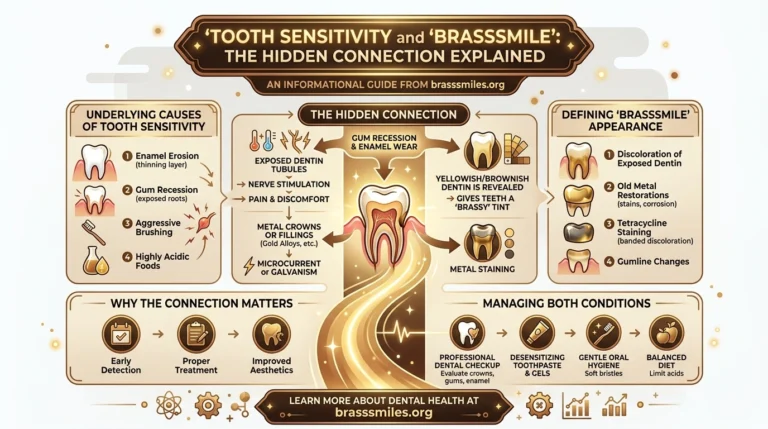
Two of the most common dental complaints people bring to a search engine — tooth sensitivity and brasssmile — are most often treated as separate concerns. Someone managing brasssmile reaches for whitening products. Someone managing sensitivity reaches for sensitivity toothpaste. The two groups rarely overlap in the product aisle, and their conditions are rarely discussed in the same article. But for a significant proportion of people, these two conditions share a single underlying cause — and treating them separately, without understanding their connection, consistently produces worse outcomes than addressing them together.
The connection is enamel. Specifically, enamel that is thinning — through ageing, acid erosion, genetic predisposition, or overuse of abrasive products — produces two consequences that are experienced as distinct problems but originate from the same structural reality. Thinned enamel allows the naturally yellow dentin beneath to show through, creating the warm, brassy tone of brasssmile. The same thinned enamel exposes dentinal tubules — microscopic channels that lead from the tooth surface to the nerve — making teeth reactive to temperature changes, sweet foods, and acidic substances. Same cause. Two different experiences. And a treatment approach that must account for both simultaneously.
This article explains the shared biology behind tooth sensitivity and brasssmile, maps the specific scenarios where they coexist, and provides practical guidance on how to manage brasssmile whitening treatment safely and effectively in the presence of sensitivity — without either abandoning whitening or worsening the conditions that produce it.
The Shared Root Cause: What Enamel Thinning Does to Both Sensitivity and Brasssmile
Tooth sensitivity and brasssmile are both downstream consequences of enamel thinning. Enamel acts as both a colour mask — hiding the yellow dentin beneath — and a sensory barrier — protecting the dentinal tubules that connect the tooth surface to its nerve supply. When enamel thins, both protective functions are compromised simultaneously: dentin colour becomes visible as brasssmile, and dentin sensitivity becomes accessible as tooth sensitivity. Managing one without addressing the other treats a symptom while the shared cause progresses.
To understand why enamel thinning produces both brasssmile and sensitivity, it helps to understand what enamel is actually doing in a healthy tooth. Enamel is a semi-translucent, mineralised tissue approximately two millimetres thick at the cusp tips of a healthy tooth. It serves two simultaneous functions: optical and sensory. Optically, its opacity masks the yellow dentin beneath — the thicker and more opaque the enamel, the whiter and less brassy the smile. Sensorially, it insulates the dentinal tubules — microscopic channels approximately 1 to 4 micrometres in diameter that run from the outer enamel surface through to the dental pulp, where the tooth’s nerve supply resides.
When enamel thins — through any combination of acid erosion, mechanical wear, genetic predisposition, or excessive use of abrasive dental products — both functions are progressively compromised. As the enamel layer above the dentin becomes thinner, the dentin’s yellow colour becomes more visible through the increasingly translucent enamel: this is the structural dimension of brasssmile. Simultaneously, the dentinal tubules that were previously insulated by the full enamel thickness become accessible to external stimuli. Temperature changes, sweet foods, and acidic substances can now trigger fluid movement within the tubules — and according to the hydrodynamic theory of dentinal hypersensitivity, this fluid movement stimulates the nerve endings associated with the tubules, producing the sharp, brief sensitivity response that characterises dentine hypersensitivity.
The hydrodynamic theory of dentinal hypersensitivity — first proposed by Brannstrom in the 1960s and now the most widely accepted explanation for tooth sensitivity — describes how external stimuli cause fluid movement within dentinal tubules, which mechanically stimulates the A-delta nerve fibres associated with the inner pulp. The same enamel thinning that allows dentin colour to show through as brasssmile is the structural precondition for this hydrodynamic mechanism to become active.
Section Summary: Enamel thinning is the shared root cause of both brasssmile and tooth sensitivity. Thin enamel reveals yellow dentin (brasssmile) and exposes dentinal tubules to external stimuli (sensitivity). Understanding this shared origin is essential — treatment approaches that address enamel health benefit both conditions simultaneously rather than managing them as separate problems.
5 Specific Connections Between Tooth Sensitivity and Brasssmile
Beyond the shared root cause of enamel thinning, five specific scenarios produce the coexistence of tooth sensitivity and brasssmile. These are: enamel erosion from dietary acid, aggressive brushing technique causing enamel and cementum wear, whitening product-induced sensitivity during brasssmile treatment, gum recession exposing root dentin, and the temporary sensitivity produced by peroxide dehydration during whitening. Each has a distinct mechanism and a distinct management response.
1 Dietary Acid Erosion — The Most Common Shared Driver
The Connection: Dietary acid erodes enamel progressively, thinning the layer that protects both dentin colour and dentinal tubule insulation. As enamel thins, brasssmile worsens and sensitivity increases — often simultaneously.
Detail: Foods and drinks with pH below 5.5 — coffee, citrus, carbonated drinks, wine, vinegar — dissolve enamel minerals through acid demineralisation. This produces enamel that is both thinner (more brasssmile-visible dentin) and more porous (more accessible dentinal tubules). People with high-acid diets often experience both conditions accelerating in parallel, creating a situation where brasssmile treatment is both more needed and more complicated by the sensitivity that accompanies it.
What to Do: Reduce acid input frequency. Rinse with water immediately after acidic foods or drinks. Wait 30 minutes before brushing after acid exposure. Use a hydroxyapatite or fluoride remineralisation toothpaste in the evening to support enamel repair.
2 Aggressive Brushing — The Mechanical Erosion Route
The Connection: Over-brushing with a hard-bristled toothbrush wears enamel and cementum through mechanical abrasion, exposing dentin at both the enamel-covered facial surface and the gum margin — producing sensitivity and contributing to brasssmile near the gumline.
Detail: The gumline is where aggressive brushing most commonly causes visible damage. As gum tissue is pushed back through repeated mechanical trauma, the cementum-covered root surface is exposed. Cementum is significantly thinner than enamel and provides much less protection for the dentinal tubules beneath — making root sensitivity sharp and immediate. The same area of exposed root dentin also appears noticeably more yellow or brassy than the enamel-covered crown, creating a distinctive brasssmile pattern concentrated at the gumline.
What to Do: Switch to a soft-bristled toothbrush. Use the modified Bass technique — a gentle circular motion at the gumline rather than a scrubbing back-and-forth action. Avoid pressing hard against the teeth. Consider an electric toothbrush with a pressure sensor if manual technique is consistently too aggressive.
3 Whitening Product-Induced Sensitivity During Brasssmile Treatment
The Connection: Peroxide-based whitening products can cause temporary tooth sensitivity by penetrating enamel and reaching dentinal tubules. For brasssmile patients with already-compromised enamel, this sensitivity is more pronounced and requires a modified whitening protocol.
Detail: Hydrogen peroxide and carbamide peroxide molecules are small enough to penetrate enamel and reach dentin during whitening treatment. In teeth with healthy, full-thickness enamel, this produces minimal sensitivity in most users. In teeth where enamel is already thinned from erosion or genetic factors — the same structural condition that drives structural brasssmile — the peroxide reaches dentinal tubules more readily and produces stronger sensitivity responses. This is why people with structural brasssmile often report more sensitivity during whitening than people with primarily extrinsic surface staining.
What to Do: Use a lower-concentration peroxide product and extend treatment duration rather than using high-concentration products for fewer sessions. Apply sensitivity toothpaste with potassium nitrate or arginine for two weeks before beginning whitening. Use a remineralisation product on non-whitening days throughout the treatment cycle.
4 Gum Recession Exposing Root Dentin
The Connection: Gum recession — from aggressive brushing, periodontal disease, or natural ageing — exposes root surfaces that lack enamel protection. The exposed cementum and dentin are both more sensitive to stimuli and more visibly yellow or brassy than the enamel-covered crown.
Detail: Root surfaces are covered by cementum, a calcified tissue that is thinner and less protective than enamel. When gum recession exposes root surfaces, the dentinal tubules in the root dentin are accessible to external stimuli with minimal protection — producing sharp, often severe sensitivity to cold, sweet, and acidic inputs. The same exposed root surface appears noticeably more yellow than the adjacent crown enamel, creating a brasssmile pattern that is concentrated at and below the gum margin. Standard whitening products are generally not effective on root dentin — this type of structural brasssmile near the gumline requires professional assessment.
What to Do: Have a dentist assess the extent of gum recession. Use a sensitivity-formulated toothpaste containing potassium nitrate or arginine consistently. Adjust brushing technique to stop the mechanical cause of recession. If recession is significant, ask about gum grafting or other professional interventions.
5 Post-Whitening Peroxide Dehydration Sensitivity
The Connection: After a whitening treatment session, enamel is temporarily dehydrated — both more opaque (the brief whitening enhancement) and more sensitive. This post-whitening sensitivity window typically lasts 24 to 72 hours and represents an important management phase for brasssmile patients.
Detail: Peroxide dehydrates enamel tissue during the whitening process — drawing water out of the enamel matrix and temporarily making it more opaque (which enhances the whitening appearance) but also more sensitive. As enamel rehydrates in the 24 to 72 hours following treatment, the sensitivity resolves and some of the optical whitening enhancement fades as enamel becomes more translucent again. For brasssmile patients with already-compromised enamel, this post-whitening sensitivity window is more intense and lasts longer — making post-whitening care protocol particularly important.
What to Do: Avoid all acidic food and drink for 48 hours post-whitening. Use a sensitivity toothpaste with potassium nitrate or arginine immediately after completing each whitening session. Apply blue covarine toothpaste during the rehydration window to manage the tonal appearance as enamel rehydrates. Do not apply additional whitening during the sensitivity recovery window.
Section Summary: Five specific scenarios connect sensitivity and brasssmile — dietary acid erosion, aggressive brushing, whitening-induced sensitivity, gum recession, and post-whitening dehydration. Each has a distinct management approach, but all share the common thread of compromised enamel integrity as the mechanism linking the two conditions.
How to Whiten Brasssmile Safely When You Have Tooth Sensitivity
Whitening brasssmile in the presence of tooth sensitivity requires a modified protocol that manages sensitivity before, during, and after treatment. The core adjustments are: a two-week sensitivity preparation period before starting whitening, using lower-concentration products over longer treatment periods, applying sensitivity management products on non-whitening days, and strictly following post-whitening recovery protocols. These adjustments allow effective brasssmile treatment without worsening the underlying enamel condition.
For many people with brasssmile and concurrent tooth sensitivity, the sensitivity is the reason they have not started whitening — or the reason they abandoned a previous whitening attempt. The concern is understandable. Peroxide whitening in the presence of exposed dentinal tubules can produce sharp, uncomfortable sensitivity responses. But avoiding whitening entirely because of sensitivity means accepting a permanent visual compromise that modified protocols can actually overcome.
The key insight is that sensitivity during whitening is manageable — but it requires adjusting the protocol rather than simply pushing through. The protocol adjustments below are based on published dental research into sensitivity management during whitening treatment and are designed to allow effective brasssmile whitening without causing or worsening the enamel damage that drives both conditions.
Phase 1: Sensitivity Preparation — Two Weeks Before Whitening
The single most effective pre-whitening intervention for sensitivity is two weeks of twice-daily use of a sensitivity-formulated toothpaste containing potassium nitrate or arginine before beginning any whitening treatment. Potassium nitrate works by depolarising the nerve endings associated with dentinal tubules, reducing their reactivity to stimuli. Arginine, a naturally occurring amino acid, works by physically occluding the openings of dentinal tubules with a calcium-rich deposit, directly blocking the fluid movement that produces sensitivity. Both mechanisms reduce sensitivity before whitening begins, making the treatment itself more comfortable and less likely to produce post-application pain.
Phase 2: Modified Whitening Protocol — Lower Concentration, Longer Duration
For brasssmile patients with sensitivity, the approach of using the highest available peroxide concentration for the fastest results is inappropriate. The correct modification is to use a lower concentration product — 6% to 10% hydrogen peroxide strips rather than 14%, or 10% carbamide peroxide gel rather than 20% — and extend the treatment duration from 14 days to 21 to 28 days. This produces comparable final results to high-concentration shorter-duration approaches but distributes the peroxide exposure more gradually, giving enamel time to partially remineralise between applications and reducing the cumulative sensitivity load. Applying strips every other day rather than daily during the treatment cycle is a further modification appropriate for sensitive brasssmile cases.
Phase 3: Sensitivity Management During Treatment
On days when whitening is being applied, complete the whitening session as planned. On non-whitening days, use a hydroxyapatite or fluoride remineralisation toothpaste in the evening to support enamel repair and tubule occlusion during the recovery period between applications. If sensitivity becomes uncomfortable during a whitening session, the correct response is to remove the strips or rinse out the gel early and apply sensitivity toothpaste rather than discontinuing the treatment entirely. A single uncomfortable session does not indicate that the protocol is wrong — it indicates that the pace should be moderated.
Phase 4: Post-Whitening Recovery
The 24 to 72 hours following a whitening treatment are the highest-sensitivity window. Avoid all acidic food and drink, maintain water as the primary beverage, apply sensitivity toothpaste twice daily during this period, and use blue covarine toothpaste to manage the tonal appearance of brasssmile as enamel rehydrates. Do not apply additional whitening during the sensitivity recovery window regardless of how the colour is appearing — this is the period when further peroxide exposure would compound the sensitivity rather than improve the whitening result.
If sensitivity during brasssmile whitening treatment is severe — producing pain that persists for more than a few hours after application — stop treatment immediately and consult a dental professional before resuming. Persistent post-whitening pain can indicate pulp inflammation or enamel damage that requires clinical assessment before any further whitening is appropriate.
Section Summary: Whitening brasssmile safely with sensitive teeth requires four phases: a two-week sensitivity preparation with potassium nitrate or arginine toothpaste, a modified lower-concentration longer-duration whitening protocol, active remineralisation support on non-whitening days, and strict post-whitening recovery care. These adjustments allow effective treatment without worsening sensitivity.
Best Products for Managing Both Tooth Sensitivity and Brasssmile Simultaneously
The most effective products for managing both tooth sensitivity and brasssmile address the shared root cause — enamel integrity — rather than each condition in isolation. Hydroxyapatite toothpaste combines enamel remineralisation with mild stain removal. Potassium nitrate toothpaste with blue covarine addresses sensitivity nerve desensitisation alongside daily tonal correction for brasssmile. These dual-action products outperform single-condition products for patients managing both conditions concurrently.
Products Compared — Sensitivity Management and Brasssmile Benefit
| Product Category | Sensitivity Benefit | Brasssmile Benefit | Best Used |
| Potassium Nitrate Toothpaste | ★★★★★ Nerve desensitisation | ★★☆☆☆ Mild abrasion only | Pre-whitening and during treatment |
| Arginine Toothpaste | ★★★★★ Tubule occlusion | ★★☆☆☆ Surface cleaning | Pre-whitening preparation |
| Hydroxyapatite Toothpaste | ★★★★☆ Tubule occlusion via mineralisation | ★★★★☆ Stain removal + remineralisation | Daily evening use — ongoing |
| Blue Covarine Toothpaste | ★★☆☆☆ Minimal sensitivity effect | ★★★★★ Daily tonal correction | Daily morning use — ongoing |
| Fluoride Toothpaste (standard) | ★★★☆☆ Remineralisation support | ★★☆☆☆ Maintenance only | Daily use throughout |
| Whitening Strips (6–10% HP) | ★★☆☆☆ Low-concentration reduces risk | ★★★★☆ Effective brasssmile treatment | Modified protocol — every other day |
| Desensitising Gel (in-office) | ★★★★★ Immediate professional relief | ★☆☆☆☆ No whitening benefit | Before professional whitening session |
The table shows that hydroxyapatite toothpaste is the strongest dual-action product for sensitivity and brasssmile — providing both tubule occlusion for sensitivity and genuine stain removal and remineralisation for enamel support. Combined with blue covarine in the morning and modified low-concentration whitening strips, it forms the most complete routine for managing both conditions together.
Section Summary: Hydroxyapatite toothpaste stands out as the strongest product for managing both sensitivity and brasssmile simultaneously — supporting enamel remineralisation, occluding tubules, and providing mild stain removal. Combined with blue covarine in the morning and a modified whitening protocol, it addresses the shared enamel cause of both conditions.
The Recommended Dual-Condition Routine: Managing Sensitivity and Brasssmile Together
Managing tooth sensitivity and brasssmile simultaneously requires a routine that separates the sensitivity management phase from the active whitening phase while maintaining enamel support throughout both. The recommended structure is a two-week sensitivity preparation period followed by a modified whitening cycle with daily remineralisation support, then an ongoing maintenance phase combining optical correction and enamel protection. This produces brasssmile improvement without worsening sensitivity.
Weeks 1–2: Sensitivity Preparation Phase
- Morning: Potassium nitrate or arginine sensitivity toothpaste — twice daily
- Evening: Hydroxyapatite toothpaste — twice daily
- No whitening products during this phase
- Continue rinsing with water after staining drinks
- Assess sensitivity level at end of Week 2 — if significantly reduced, begin whitening phase
Weeks 3–5: Modified Whitening Phase
- Morning: Blue covarine toothpaste — daily tonal correction
- Whitening: Low-concentration strips (6–10% HP) every other evening for 3–4 weeks
- Non-whitening evenings: Hydroxyapatite toothpaste — remineralisation support
- Sensitivity check: if sensitivity increases significantly, extend non-whitening days to two between each strip application
- Post-strip: apply sensitivity toothpaste immediately after each session
Weeks 6+: Ongoing Maintenance Phase
- Morning: Blue covarine toothpaste — daily
- Evening: Hydroxyapatite toothpaste — daily
- Whitening: low-concentration strips once every two weeks for maintenance
- Continue rinsing habit after all staining drinks
- Review sensitivity every four weeks — if it worsens, pause whitening and extend remineralisation phase
The key to managing both conditions is never allowing the whitening phase to outpace the remineralisation phase. Think of hydroxyapatite and fluoride toothpaste as the safety net beneath your whitening routine — they are what allows continued whitening without progressive enamel damage. As long as the remineralisation support is consistent, modified whitening can continue safely even in sensitive teeth.
Section Summary: The dual-condition routine separates sensitivity preparation from active whitening and maintains enamel support throughout. Two weeks of sensitivity preparation followed by every-other-day low-concentration strips with daily hydroxyapatite evening use allows effective brasssmile whitening without worsening the enamel condition that drives both sensitivity and brasssmile.
When to See a Professional: Signs That Sensitivity and Brasssmile Need Clinical Assessment
Professional dental assessment is warranted when tooth sensitivity is severe, persistent, or increasing despite consistent sensitivity product use; when sensitivity during whitening produces pain lasting more than a few hours; when brasssmile is concentrated near the gumline in a pattern suggesting significant gum recession or root exposure; or when sensitivity affects teeth that have recently had dental work such as fillings or crowns. These signals indicate causes requiring clinical diagnosis rather than home management.
Home management of both tooth sensitivity and brasssmile is appropriate for the majority of cases where both conditions are mild to moderate and share the enamel thinning cause described in this article. However, there are clear clinical signals that indicate when professional assessment will produce better outcomes than continued home management.
Signs That Sensitivity Needs Professional Attention
- Sharp, severe sensitivity that lingers for more than 30 seconds after a stimulus — this pattern suggests pulp involvement rather than simple dentinal hypersensitivity
- Sensitivity that has developed suddenly on a tooth that was previously comfortable — possible sign of a cracked tooth, failing restoration, or exposed root from acute gum recession
- Sensitivity that has not improved after four to six weeks of consistent twice-daily sensitivity toothpaste use
- Sensitivity accompanied by swelling, prolonged pain, or discolouration of the tooth — these patterns require prompt dental assessment
- Sensitivity following recent dental work — possible sign of a restoration issue requiring adjustment
Signs That Brasssmile Needs Professional Assessment
- Brasssmile that is concentrated at the gumline in a pattern suggesting significant gum recession — professional cleaning, gum health assessment, and potentially gum grafting may be appropriate
- Whitening has produced minimal improvement despite two complete treatment cycles using correctly-concentrated products
- Brasssmile appears to be worsening despite reduced staining inputs and consistent whitening — possible sign of accelerating enamel erosion
- Brasssmile accompanied by visible surface changes such as pitting, grooves, or unusual translucency at the incisal edges — possible enamel erosion requiring assessment
At any dental appointment — routine or otherwise — mention that you are managing both tooth sensitivity and brasssmile. A dental professional who knows both are present can check for shared structural causes, recommend the most appropriate remineralisation products for your specific enamel condition, and identify whether any professional intervention would be more appropriate than continued home management.
Section Summary: Professional assessment is needed for severe or persistent sensitivity, sensitivity that develops suddenly, sensitivity not responding to home products after six weeks, or brasssmile concentrated near the gumline suggesting gum recession. When both conditions are present and either is worsening, professional diagnosis produces better outcomes than continued solo home management.
Experience Perspective: Living With Both Conditions and Finding the Right Approach
The experience of managing both tooth sensitivity and brasssmile is one of the more frustrating dental journeys — because the products most commonly associated with brasssmile (whitening strips, stronger peroxide treatments) are precisely the products most likely to aggravate the sensitivity that shares its cause. The clarity that transforms this frustration into progress is understanding that both conditions are caused by the same structural reality, and that addressing enamel health serves both simultaneously.
There is a specific pattern of experience that characterises many people dealing with both sensitivity and brasssmile. They notice the brassy tone in their smile and reach for whitening strips. Within a few days they experience sensitivity that ranges from mildly uncomfortable to genuinely painful. They stop the strips. The sensitivity fades. They notice the brasssmile again. They try strips again. Sensitivity returns. They conclude that whitening is not suitable for their teeth and resign themselves to the brassy baseline they have been managing with ordinary toothpaste.
What is missing in that cycle is the understanding that the sensitivity and the brasssmile are telling them the same thing: their enamel needs support before and during whitening, not instead of it. The strips were not wrong for them. The concentration was too high, the preparation phase was absent, and the remineralisation support between sessions was not there. Modified with lower concentration, preceded by two weeks of sensitivity preparation, and supported by hydroxyapatite remineralisation throughout, the same strips that produced unbearable sensitivity in an unmodified protocol produce manageable and gradually decreasing sensitivity in a properly structured one.
The first time this adjusted approach produces a whitening result that holds — that does not come with three days of sensitivity that makes eating uncomfortable — people often describe it as both a practical and psychological relief. The practical side is obvious: the brasssmile is visibly improving and the discomfort is manageable. The psychological side is more subtle: they have stopped feeling like their teeth are working against them. With the right approach, sensitivity and brasssmile are not incompatible with whitening — they are conditions that require a more careful protocol and a longer timeline. The outcome, managed correctly, is the same: a genuinely brighter, less brassy smile.
The most important thing any person managing both tooth sensitivity and brasssmile can do is share both conditions with a dental professional at their next check-up. Not as separate complaints but as a connected picture. A dentist who understands that both are present can assess the enamel condition that drives them, recommend the most appropriate clinical interventions, and help calibrate the home management protocol in a way that generic product advice cannot match.
Section Summary: The frustrating cycle of strips causing sensitivity causing abandonment is the most common experience pattern for people managing both conditions. The solution is a modified protocol — lower concentration, longer duration, preceded by sensitivity preparation — not abandonment of whitening. Both conditions improve when enamel is supported consistently alongside the whitening approach.
Tooth Sensitivity and Brasssmile — Frequently Asked Questions
These FAQs address the most commonly searched questions about managing tooth sensitivity alongside brasssmile. Each answer is direct, evidence-based, and designed to resolve the specific concerns that arise when both conditions coexist.
Can I use whitening strips if I have sensitive teeth and brasssmile?
Yes, with a modified protocol. The key modifications are a two-week sensitivity preparation phase using potassium nitrate or arginine toothpaste before starting whitening, using lower-concentration strips (6 to 10 percent hydrogen peroxide rather than 14 percent), applying strips every other day rather than daily, and using a remineralising toothpaste on non-whitening days. These adjustments allow effective brasssmile whitening without causing or worsening sensitivity in the majority of cases with mild to moderate sensitivity.
Does brasssmile cause tooth sensitivity, or does sensitivity cause brasssmile?
Neither directly causes the other — they share a common underlying cause. Enamel thinning from acid erosion, ageing, genetic factors, or mechanical wear compromises both the optical masking of dentin colour (producing brasssmile) and the sensory insulation of dentinal tubules (producing sensitivity). Both conditions develop in parallel as enamel thins, rather than one causing the other. This shared origin is why addressing enamel health through remineralisation supports both conditions simultaneously.
Is hydroxyapatite toothpaste better than fluoride for people with both sensitivity and brasssmile?
Hydroxyapatite and fluoride serve complementary functions for people managing both conditions. Hydroxyapatite directly deposits mineral onto enamel surfaces and has been shown to occlude dentinal tubules through a physical blockage mechanism — providing both remineralisation support and sensitivity reduction through the same mechanism. Fluoride promotes remineralisation by attracting calcium and phosphate to demineralised zones and provides established caries protection. For people managing both sensitivity and brasssmile, using hydroxyapatite in the evening for remineralisation and sensitivity support, alongside fluoride through other sources in the daily routine, provides a more complete approach than either alone.
How long does whitening sensitivity last when treating brasssmile?
Post-whitening sensitivity in enamel-compromised brasssmile cases typically peaks in the 24 to 48 hours immediately following a whitening session and resolves within 72 hours for most users following the modified protocol. Without proper preparation and remineralisation support, sensitivity can last longer — three to five days is commonly reported by people who whiten without sensitivity management. If sensitivity from a whitening session persists beyond five days, the concentration is likely too high for the individual’s enamel condition and a further reduction in concentration or frequency is appropriate.
What is the fastest way to reduce sensitivity before starting brasssmile whitening?
The most evidence-based rapid sensitivity reduction approach before starting brasssmile whitening is twice-daily use of arginine-containing toothpaste for two weeks prior to the first whitening session. Arginine works by physically occluding dentinal tubule openings with a calcium-rich deposit, directly blocking the fluid movement that produces sensitivity. Research published in the Journal of Dentistry confirmed that arginine-based toothpastes produced significant sensitivity relief within two weeks of consistent use. Potassium nitrate toothpaste provides a complementary approach through nerve desensitisation rather than tubule occlusion and is well-established as the most widely recommended pre-whitening sensitivity management product.
The Integrated Approach: Treating the Shared Cause, Not the Separate Symptoms
The most effective response to both tooth sensitivity and brasssmile is an integrated one that addresses their shared root cause — enamel integrity — rather than managing each condition with isolated products and protocols. Remineralisation support, modified whitening parameters, and consistent enamel-protective habits serve both conditions simultaneously and produce better outcomes than managing them as separate dental problems requiring separate solutions.
Tooth sensitivity and brasssmile appearing together in the same mouth is not a coincidence and not bad luck. It is a signal from the same structural reality: enamel that needs support. The treatments that address this shared cause — hydroxyapatite remineralisation, consistent rinsing habits to reduce acid exposure, modified whitening protocols that respect the enamel’s current integrity, and regular professional monitoring of enamel condition — create the conditions in which both brasssmile improves and sensitivity reduces over time.
The articles across BrassSmiles.org cover every dimension of this journey — from understanding the causes of brasssmile and the specific role of enamel health, through at-home treatment options and post-whitening care, to professional treatment when home management has reached its appropriate limit. Use the internal links throughout this article to build the complete picture of your specific situation and find the approach that is most appropriate for where you are right now.
