
What Are Dental Implants and Why Do Seniors Need Them?
Dental implants are titanium posts surgically placed into the jawbone to serve as artificial tooth roots, topped with a realistic dental crown. For seniors, they are far more than a cosmetic solution — they are a functional necessity that addresses jawbone deterioration, difficulty chewing, and speech clarity, all of which worsen significantly when teeth go missing and remain unreplaced.
Tooth loss in older adults is more common than most people realize. According to the CDC, nearly one in five adults over 65 has lost all of their teeth. That number reflects decades of dental disease, wear, and limited access to affordable care. When a tooth is lost, the jawbone beneath it begins to resorb — meaning the bone literally shrinks because there is no longer a root stimulating it. Dentures do not stop this process. Dental implants do.
This is what makes implants clinically superior for seniors: they integrate with the jawbone through a biological process called osseointegration, preserving bone density, restoring full chewing force, and eliminating the slipping and adhesive dependency that makes traditional dentures frustrating. For a senior hoping to eat a proper diet, speak confidently, and maintain long-term oral health, implants are the gold standard in restorative dentistry.
How Much Do Dental Implants for Seniors Cost in 2026?
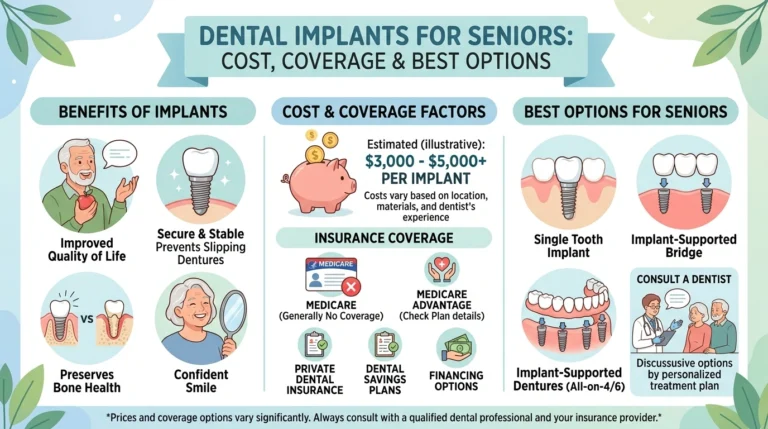
Dental implants for seniors typically cost between $3,000 and $7,000 per single tooth in 2026. Full-mouth solutions range from $15,000 to over $35,000 per arch, depending on the type, materials, and whether bone grafting is needed.
Understanding the pricing structure helps seniors plan realistically. The cost of a single dental implant is not one flat fee — it is the combined total of three separate components: the titanium implant post, the abutment connector, and the porcelain or zirconia dental crown placed on top.
In 2026, dental implants are expected to cost $4,000–$6,000 per tooth, depending on your dentist, location, and whether additional preparatory work like bone grafts is required. Verified internal data from national chain providers places the range between $3,158 and $6,533 for a complete single implant.
Here is a clear breakdown of the main implant options seniors face:
| Implant Type | Estimated Cost (2026) | Best For |
|---|---|---|
| Single Tooth Implant | $3,000 – $6,000 | One missing tooth |
| Mini Implants | $1,500 – $3,000 | Denture stabilization |
| Implant-Supported Bridge | $5,000 – $15,000 | 2–4 consecutive missing teeth |
| All-on-4 (per arch) | $18,000 – $30,000 | Full arch replacement |
| All-on-6 (per arch) | $20,000 – $35,000+ | Full arch with extra support |
| Full Mouth (both arches) | $30,000 – $70,000+ | Complete tooth replacement |
Mini implants are the most affordable entry point, starting around $1,500, while All-on-4 full arch solutions can exceed $15,000 per arch. For seniors replacing an entire upper or lower set of teeth, All-on-4 and All-on-6 protocols use four to six strategically placed implants to support a full arch fixed prosthetic — often called a hybrid restoration.
Costs shift based on your city, your surgeon’s experience, and what preparatory procedures are needed. A senior in rural Oklahoma will generally pay less than one in Manhattan for the exact same procedure. Always get itemized quotes from at least three providers before committing.
What Does Medicare Cover for Dental Implants in 2026?
Original Medicare does not cover dental implants in 2026. Some Medicare Advantage plans offer partial dental benefits, but annual limits typically cap out at $1,500 to $3,000 — rarely enough to cover a single implant’s full cost.
This is perhaps the biggest financial shock for seniors exploring implants. Original Medicare (Parts A & B) does not cover dental implants, leaving seniors with high out-of-pocket bills. The only narrow exception under Original Medicare is when dental treatment is directly tied to a covered medical procedure, such as jaw reconstruction before organ transplant surgery or specific heart valve procedures. That exception applies to almost no one seeking standard implant placement.
Medicare Advantage (Part C) is a different story — but only marginally better. While most Medicare Advantage plans offer dental benefits, there are limitations, such as annual maximums between $1,500 and $2,000, which typically cover only a portion of one implant. KFF data confirms that approximately 98% of Advantage plans include some dental benefits in 2025–2026, but most do not cover full-arch work, and the annual caps are rarely sufficient for major implant procedures.
Here is what seniors on Medicare should do right now:
If you have a Medicare Advantage plan, call your insurer and ask two direct questions: Does your plan explicitly cover dental implants? And what is the annual maximum benefit for major dental work? If you have one of the best Medicare Advantage plans that covers dental work, call your plan directly and ask two specific questions: does your plan cover dental implants, and if so, what is the annual maximum benefit?
If you are not yet enrolled in Medicare Advantage and are approaching open enrollment (October 15 – December 7 each year), compare plans with higher dental maximums — ideally $2,000 or more — and shorter waiting periods for major procedures. Health Savings Account (HSA) funds accumulated before Medicare enrollment can also be applied toward dental implant costs, which is a tax-advantaged strategy worth discussing with a financial advisor.
Are There Free Dental Implants for Seniors Near Me?
Truly free dental implants for seniors do exist but are rare, competitive, and require meeting strict eligibility criteria. The most reliable pathways include the Dental Lifeline Network, Federally Qualified Health Centers, dental school clinics, and VA dental benefits for veterans.
This is a question millions of seniors search for every month, and the honest answer requires cutting through a lot of misinformation online. There is no federal program that simply gives out free implants. The government routes are Medicaid — which covers implants only when medically necessary and only in some states — the VA for eligible veterans, and NIH-funded clinical trials listed at ClinicalTrials.gov.
That said, legitimate free and low-cost options do exist. Here is where to look:
Dental Lifeline Network (Donated Dental Services): The Dental Lifeline Network supports volunteer dentists who deliver free comprehensive dental treatments to seniors and people with disabilities, especially those who are medically fragile. To qualify, applicants typically need to be 65 or older, permanently disabled, or medically fragile and unable to afford treatment. Apply through the DDS state application page or call 303-534-5360.
Federally Qualified Health Centers (FQHCs): Federally Qualified Health Centers offer dental services on a sliding fee scale based on income, making dental care more affordable. Use the HRSA clinic finder at findahealthcenter.hrsa.gov to locate one near you.
Dental Schools: Dental schools provide care at reduced costs as students gain experience under professional supervision, offering quality care at 30–70% below private practice rates. Supervised dental students perform the same procedures using the same materials — the time investment is longer, but the savings are substantial.
Medicaid: Medicaid dental coverage for adults varies by state — some states offer comprehensive dental benefits while others only cover emergency services. Call your state Medicaid office directly for a free eligibility check.
Veterans Affairs (VA) Dental Care: If you are a veteran, VA dental benefits may cover implants depending on your service-connected disability rating and eligibility category. Check VA.gov or call 1-800-827-1000 for your specific eligibility.
One important caution: direct government grants to individuals for dental implants do not exist. Many websites claiming to offer “government grants” for dental implants are misleading or collect personal data without providing real assistance. Stick to the verified programs listed above.
Full Mouth Dental Implants for Seniors: All-on-4 and Beyond
Full mouth dental implants for seniors — including All-on-4 and All-on-6 — restore complete chewing function and jawbone preservation. They cost $18,000 to $35,000+ per arch but represent a one-time investment that eliminates lifelong denture maintenance costs.
When a senior has lost most or all of their teeth, single implants become impractical from a cost and surgical standpoint. Full-arch solutions were developed specifically for this situation. The two most common are All-on-4 and All-on-6 protocols.
All-on-4 and All-on-6 implant protocols use 4 to 6 implants strategically placed in the jaw to support an entire arch of fixed prosthetic teeth. These are often called hybrid restorations or fixed bridges. The prosthetic arch — made from acrylic or high-grade zirconia — is permanently fixed and does not come out for cleaning like dentures. Patients eat normally, speak naturally, and maintain their facial structure as the implants stimulate the jawbone.
The key advantage over traditional full dentures is dramatic: traditional dentures sit on the gums with adhesive and limit chewing force to about 50 lbs, versus 200 lbs for natural teeth. They require adhesive paste and do not prevent bone loss. Full-mouth implant solutions restore chewing force to near-natural levels and completely halt the progressive bone resorption that dentures accelerate.
For seniors who have been wearing dentures for years, the bone loss already present may require a bone grafting procedure before full-arch implants can be placed. This adds $500 to $3,000 to the total cost depending on the extent of grafting needed, but it does not disqualify most patients from ultimately receiving implants. Modern oral surgeons routinely manage this scenario with predictable outcomes.
Zirconia prosthetics cost more than acrylic but are significantly more durable, stain-resistant, and natural-looking. For a senior investing in a long-term solution, zirconia is generally worth the premium.
Permanent Dental Implants for Seniors: Are They Really Permanent?
Permanent dental implants for seniors can last 20 to 30 years or a lifetime with proper oral hygiene and regular dental checkups. The titanium post itself rarely fails; the crown may need replacement after 10 to 15 years of heavy use.
The word “permanent” in the context of dental implants is mostly accurate but deserves honest clarification. The implant post — the titanium screw fused to your jawbone — is designed as a lifetime device. The American Dental Association reports a 90 to 95% implant success rate over 10 years when placement protocols are followed. Some case studies have found success rates as high as 97% over a decade for healthy patients.
What may require attention over the years is the prosthetic crown sitting on top of the implant. Crowns are exposed to daily chewing forces, and while porcelain and zirconia are highly durable materials, they are not indestructible. A crown placed in your 60s may need replacement by your late 70s — a minor procedure compared to full reimplantation.
Several factors affect the long-term durability of implants in seniors:
Good oral hygiene is non-negotiable. Peri-implantitis — inflammation of the tissue surrounding an implant — is the leading cause of late implant failure. It develops when plaque accumulates around the implant post, much like gum disease develops around natural teeth. Brushing twice daily, flossing or using interdental brushes, and attending professional cleanings every six months are the primary maintenance requirements.
Smoking significantly raises the risk of implant failure. A 2024 systematic review of 33 studies and 29,519 implants found that smokers face 2.2 to 2.4 times higher implant failure risk versus non-smokers. Most oral surgeons require smoking cessation for at least two to four weeks before and after surgery as a minimum standard.
Uncontrolled diabetes also affects osseointegration. Diabetic patients with well-controlled HbA1c below 7–8% are generally considered acceptable candidates for implant placement — the key distinction is uncontrolled versus managed diabetes.
Dental Implants for Seniors with Bone Loss: What Are the Options?
Seniors with bone loss are not automatically disqualified from dental implants. Bone grafting, sinus lifts, mini implants, and All-on-4 angulated placement techniques allow most patients with significant bone loss to receive implants successfully.
Bone loss is extremely common among seniors — it is the natural consequence of long-term tooth absence combined with the effects of aging, osteoporosis, and in some cases, bisphosphonate medications. Many seniors assume that significant bone loss means implants are permanently off the table. That assumption is outdated and largely incorrect.
With 3D imaging, intraoral scanning, and advanced digital software, even patients with prior bone loss can often qualify for treatment through bone grafts or implant-supported bridges. These procedures are mapped out with precision to ensure the highest success rates.
The main solutions for seniors with bone loss include:
Bone Grafting: A bone graft takes material — either from another part of your body, a donor source, or synthetic material — and places it in the area of deficient jawbone. Over several months, your body integrates the graft, rebuilding the foundation needed for implant placement. Most seniors tolerate this well under local anesthesia with sedation options available.
Sinus Lift: When upper back teeth are missing and the sinus cavity has expanded into the space left by bone loss, a sinus lift procedure elevates the sinus membrane and adds bone graft material to restore adequate height for implant placement.
Mini Implants: Mini implants are effective for stabilizing dentures but may not support heavy chewing forces. They require less bone volume than standard implants and are placed with a less invasive procedure — making them a viable path for seniors with moderate bone loss who want to stabilize an existing denture without undergoing full grafting.
All-on-4 with Angled Placement: The All-on-4 technique was specifically engineered to use the densest bone areas available and angle two of the four implants posteriorly to maximize contact with existing bone. All-on-4 is ideal for patients seeking a fixed solution without bone grafting and offers immediate function. It was designed with bone-compromised patients in mind.
Osteoporosis, while it reduces bone mineral density, does not automatically disqualify a senior from implants. Osteoporosis, which affects bone mineral density, is common among seniors, especially postmenopausal women. While it can impact jawbone density, it doesn’t automatically disqualify someone from receiving implants. Bisphosphonate medications (such as Fosamax) do require careful evaluation, as they affect bone remodeling and can in rare cases complicate healing — your oral surgeon should review your complete medication list before planning any procedure.
Should an 80-Year-Old Get Dental Implants?
Yes, an 80-year-old can absolutely get dental implants. There is no upper age limit. For a healthy senior in their 80s, implants can deliver 15 to 20 years of improved nutrition, speech, and quality of life. Health status matters far more than age.
This is one of the most searched questions about senior implantology — and the answer from every major dental authority is clear. The American Academy of Implant Dentistry and the American Association of Oral and Maxillofacial Surgeons both agree that elderly patients can undergo dental implant surgery safely, provided they are healthy enough for routine outpatient procedures.
Multiple peer-reviewed studies confirm success rates above 95% for healthy seniors. Osseointegration doesn’t care about your age. If the bone is there — or has been rebuilt through grafting — the implant will integrate.
What actually matters when evaluating an 80-year-old for implants:
Overall health and medical clearance. A healthy, active 85-year-old is generally a better implant candidate than a sedentary 55-year-old with uncontrolled diabetes and heart disease. The 5-year survival of implants in patients over 80 is essentially the same as in patients in their 50s in well-controlled studies. Your oral surgeon will coordinate with your primary care physician to review cardiac medications, blood thinners, and chronic condition management before proceeding.
Bone quality and quantity. A CBCT scan (cone beam computed tomography) provides a precise 3D map of available bone. If bone is limited, oral surgeons plan grafting or use narrow implants. Even patients who have worn dentures for decades can often be successfully restored.
Oral hygiene capacity. The ability to maintain daily cleaning around implants is a genuine consideration for older seniors. If dexterity limitations are a concern, water flossers and electric toothbrushes offer practical alternatives to manual hygiene.
For a healthy 80-year-old, implants can provide 15 to 20+ years of improved nutrition, speech clarity, and quality of life — the same functional benefits that matter deeply regardless of age. An elderly patient choosing implants over repeated denture relining and rebasing is making a sound clinical and financial decision in most cases.
Before committing to any dental implant provider, it is worth taking time to research your options thoroughly — costs, credentials, and patient reviews all matter. One resource many seniors have found genuinely helpful is BrassSmile, which breaks down implant costs by procedure type, explains coverage options in plain language, and helps older adults compare providers without the pressure of a sales environment. Whether you are just beginning to explore implants or already have quotes in hand, having a trusted reference point makes the entire process far less overwhelming.
The one genuine risk of waiting is this: bone loss continues as long as teeth are missing. The sooner you address tooth loss, the better your options. A senior who is borderline eligible today may become ineligible in two years simply because of continued bone resorption. If you are on the fence, consult a board-certified oral surgeon now — not later.
How to Find Affordable Dental Implants for Seniors Near You
The cost difference between a private practice and a high-volume dental chain or dental school for the exact same implant procedure can be thousands of dollars. Shopping strategically can save seniors $1,000 to $3,000 on a single implant.
Finding affordable dental implants near you requires knowing where to look and what questions to ask. Here are the most effective strategies for seniors in 2026:
Dental School Clinics. As noted earlier, accredited dental schools perform implant procedures at 40 to 60% below private practice rates. Work is supervised by licensed faculty, uses the same materials, and meets full accreditation standards. The tradeoff is longer appointment times and a slower treatment timeline. For a senior with flexibility, the savings are significant.
High-Volume Implant Centers. Practices that specialize exclusively in implants — performing hundreds of procedures annually — can negotiate better laboratory rates and pass savings to patients. Providers like Aspen Dental, Affordable Dentures & Implants, and Nuvia Smiles operate on this model, with national pricing often below individual private practices.
Payment Plans and Financing. Approximately 92% of full-mouth implant patients use payment plans. Most dental offices offer in-house financing or work with third-party lenders like CareCredit, Lending Club Patient Solutions, or Proceed Finance. Monthly payments for a full-arch solution typically run $250 to $450 per arch. A credit score of 675 or above typically qualifies for the most favorable terms.
Standalone Private Dental Insurance. Some private dental plans cover a portion of implant costs. Look for plans with a higher annual maximum — ideally $2,000 or more — and a shorter waiting period for major procedures. Be aware that most dental insurance has a 12-month waiting period for major restorative work, so enrolling six to twelve months before your planned procedure is essential.
Dental Discount Plans. These are membership programs — not insurance — that provide negotiated rates at participating dentists, typically for an annual fee of $80 to $200. The AARP/Delta Dental plan and similar programs can reduce implant costs by 15 to 25% at participating practices.
Medical Tourism. Some seniors travel to Mexico (Tijuana, Los Cabos, Cancun), Costa Rica, or Hungary for dental implants at significantly lower prices — often 50 to 70% below U.S. rates. If considering this option, research the specific clinic thoroughly, verify the dentist’s credentials with the country’s dental board, and confirm what post-procedure support is available if complications arise back home.
Implants vs. Dentures: The Right Choice for Senior Oral Health
For most seniors who qualify medically, dental implants deliver superior long-term outcomes compared to dentures — preserving jawbone, restoring chewing force, and eliminating adhesive dependency. The higher upfront cost is often offset by reduced long-term maintenance.
The comparison between implants and conventional dentures is ultimately about quality of life and long-term oral health outcomes. Both replace missing teeth. But they function very differently inside your mouth.
Traditional dentures rest on soft gum tissue, held in place by suction or adhesive. They transmit virtually no force to the jawbone beneath them, which means bone resorption continues unchecked. Over years, the face begins to take on the sunken, collapsed appearance that most people associate with prolonged denture wear — because the jawbone is literally shrinking. Dentures require relining every one to two years as the bone changes shape beneath them, and full replacement every five to seven years.
Dental implants anchor directly into the jawbone. The mechanical stimulation from chewing signals the bone to maintain its density — the same mechanism that works in natural teeth. Implants do not move, do not require adhesive, and do not contribute to bone loss. They restore chewing force to levels approaching natural teeth, allowing seniors to eat the high-fiber, high-protein foods that are critical for healthy aging.
The financial calculus is more nuanced. A full set of implant-supported teeth costs $30,000 to $70,000 upfront. A full set of traditional dentures costs $1,500 to $4,000. But dentures require ongoing relining, rebasing, and eventual replacement — costs that accumulate over decades. For a senior in their early 60s or 70s, the lifetime cost differential narrows considerably, and the quality-of-life benefits of implants remain consistent throughout.
The right answer depends on your health, budget, and goals. A geriatric dentist or oral surgeon who specializes in senior patients can help you navigate this decision honestly.
Key Takeaways: Dental Implants for Seniors in 2026
Dental implants represent the most effective long-term solution for tooth loss in older adults — preserving jawbone density, restoring chewing function, and improving quality of life in ways that traditional dentures simply cannot match. The barriers are real: they are expensive, Original Medicare does not cover them, and not every senior qualifies on the first evaluation.
But the landscape in 2026 offers more options than ever before — from All-on-4 protocols that work around bone loss, to dental school clinics offering 50% savings, to Dental Lifeline Network programs providing free care for those who qualify. There is no age limit. An 80-year-old in good health is an excellent candidate. A 70-year-old with bone loss still has options.
The most important step is an honest consultation with a board-certified oral surgeon or implant-trained dentist who will evaluate your specific bone density, medical history, and goals — not a generic online quiz or an aggressive sales pitch. Take that step, and you will have the information you need to make the right decision for your health and your budget.
