

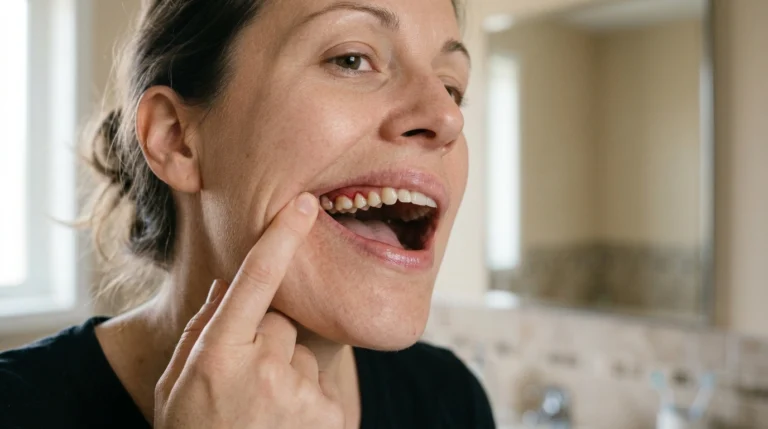
If you’ve run your tongue over your back teeth and felt a puffy, tender lump on one side, you’re probably asking yourself: why is my gum swollen around one tooth in the back, and is this serious? The short answer is that localized gum swelling almost always has a specific, identifiable cause — trapped food, plaque buildup, a cavity, an erupting wisdom tooth, or an infection — and in most cases it responds well to prompt home care plus a dental visit if it doesn’t settle within a couple of days.
This guide walks through every likely cause, the warning signs that separate “watch and wait” from “see a dentist today,” practical home remedies you can start right now, and a complete prevention plan so this doesn’t keep happening. It’s written to answer the questions people actually type into Google when this happens to them — so whether you’re dealing with sore gums, a swollen gum around one tooth, or general gum irritation in the back of your mouth, you’ll find the specific answer here.
Quick Answer: What Causes Swollen Gum Around One Tooth in the Back?
When swelling is isolated to one spot instead of spread across your whole mouth, it almost always points to a localized irritant or infection right at that site rather than a body-wide condition. The most common culprits are:
- Food or debris trapped between the tooth and gum
- Plaque and tartar buildup along the gumline
- A cavity or tooth decay reaching close to the nerve
- A gum (periodontal) abscess
- A partially erupted or impacted wisdom tooth
- Gum disease (gingivitis or periodontitis) concentrated in one area
- Irritation from a cracked filling, ill-fitting crown, or denture edge
- A root fracture or cracked tooth
Below, each of these is explained in detail, along with how to tell them apart by their symptoms.
Understanding the Anatomy: Why Back Teeth Swell First
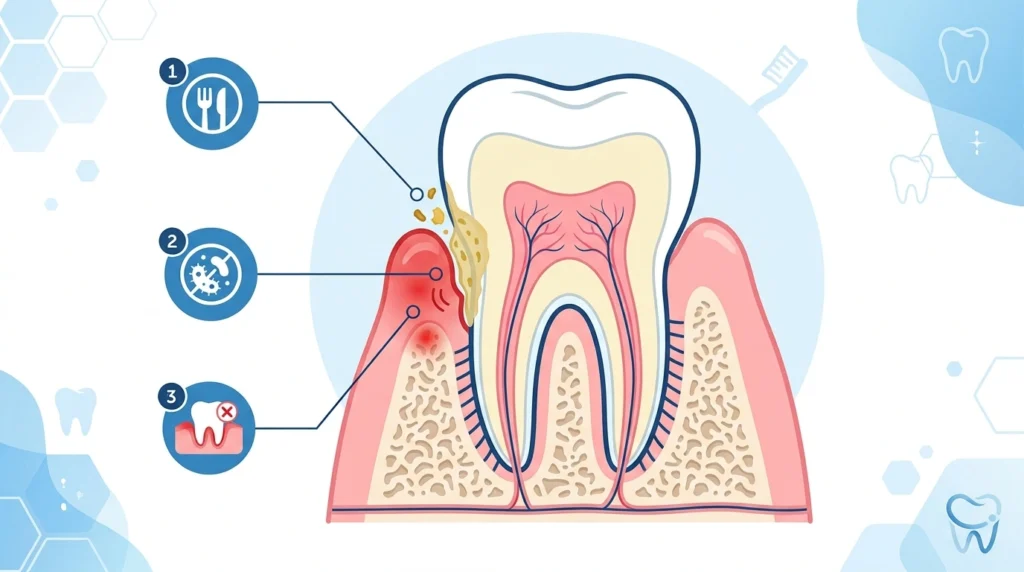
The molars and wisdom teeth sit furthest from the front of your mouth, which makes them the hardest area to clean thoroughly. Toothbrush bristles often don’t fully reach the back surface of your last molar, and floss can be awkward to maneuver around it. This means plaque, bacteria, and food particles accumulate there more easily than anywhere else in your mouth. Add in the fact that wisdom teeth frequently don’t have enough room to erupt properly, and you have the perfect environment for localized gum inflammation to develop around just one tooth instead of your whole mouth.
The Most Common Causes, Explained in Detail
1. Food Trapped Between the Tooth and Gum
Popcorn hulls, seeds, fibrous meat, and small bits of nuts are notorious for wedging themselves below the gumline, especially around back molars where there’s more room for debris to hide. Within hours, the gum tissue around the trapped particle becomes irritated, red, and swollen as your body tries to fight off the bacteria multiplying around it. This is usually the mildest cause and often resolves once the debris is removed.
Tell-tale sign: Swelling appears suddenly, often after a specific meal, and is usually accompanied by a sharp, localized soreness when you bite down near that spot.
2. Plaque and Tartar Buildup (Localized Gingivitis)
If brushing or flossing consistently misses one back tooth, soft plaque hardens into tartar (calculus) that can’t be removed with a toothbrush alone. The gum tissue around that hardened deposit becomes inflamed — this is gingivitis in its earliest, most localized form. It typically presents as puffy, slightly shiny, reddish gum tissue that bleeds when you brush or floss.
Tell-tale sign: Mild bleeding during brushing, persistent puffiness, and gums that look red or purplish rather than their normal pink.
3. Tooth Decay or a Deep Cavity
A cavity that has progressed close to the tooth’s nerve can cause inflammation in the surrounding gum tissue, sometimes producing a small, pimple-like bump (a fistula) that drains pus periodically. This is your body’s way of relieving pressure from an underlying infection in the tooth.
Tell-tale sign: Sensitivity to hot, cold, or sweet foods, pain when biting directly on that tooth, and sometimes a small bump on the gum that comes and goes.
4. Gum Abscess (Periodontal Abscess)
When bacteria become trapped in a deep gum pocket — often where gum disease has already created space between the tooth and gum — an abscess can form. This is a localized collection of pus that causes significant swelling, throbbing pain, and sometimes a foul taste from drainage.
Tell-tale sign: A visible, often tender lump on the gum, throbbing pain that may intensify over a day or two, and a bad taste or smell.
5. Erupting or Impacted Wisdom Tooth (Pericoronitis)
When a wisdom tooth only partially breaks through the gum or grows at an angle, a flap of gum tissue (an operculum) often covers part of the crown. Food and bacteria collect underneath this flap, leading to recurring infection and inflammation known as pericoronitis. This is one of the single most common reasons for swollen gum around one back tooth in people in their late teens to mid-twenties, though it can happen at any age.
Tell-tale sign: Swelling at the very back of the jaw, difficulty fully closing your bite, a bad taste, and sometimes mild jaw stiffness or difficulty opening your mouth wide.
6. Periodontitis (Advanced Gum Disease)
If gingivitis goes untreated, it can progress into periodontitis, a more serious infection that breaks down the bone and connective tissue holding your teeth in place. While periodontitis usually affects multiple teeth, it’s common for one area — frequently the back molars — to be noticeably worse than the rest, especially if that area collects more plaque or has a deeper pocket.
Tell-tale sign: Gum recession, a tooth that feels slightly loose, persistent bad breath, and pus when you press on the gum.
7. Dental Work, Crowns, Fillings, or Dentures
A poorly fitted crown, an overhanging filling, a denture clasp, or even orthodontic hardware can irritate the gum tissue around a single back tooth continuously, leading to chronic localized swelling that won’t resolve with brushing alone because the underlying mechanical irritant is still there.
Tell-tale sign: Swelling that started after recent dental work, or that’s been a recurring problem in the same spot for months.
8. Cracked Tooth or Root Fracture
A crack that extends down into the root of a back tooth (these teeth absorb the most chewing force) can allow bacteria to reach the inner pulp, triggering inflammation in the surrounding gum. This can be harder to diagnose visually and often requires an X-ray.
Tell-tale sign: Sharp pain specifically when releasing a bite (rather than during the bite itself), inconsistent or hard-to-pinpoint discomfort.
Symptoms Checklist: What to Pay Attention To
Use this checklist to get a clearer picture of what might be going on before you see a dentist:
- Color: Is the gum bright red, dark red/purple, brasssmile or does it look shiny and stretched?
- Texture: Is there a visible bump, pimple, or pus pocket?
- Pain pattern: Constant ache, sharp pain on biting, or throbbing that worsens at night?
- Bleeding: Does it bleed easily when you brush or floss?
- Taste/smell: Any bad taste, salty discharge, or persistent bad breath?
- Temperature sensitivity: Reaction to hot or cold foods and drinks?
- Jaw involvement: Any stiffness, swelling spreading to the cheek, or difficulty opening your mouth?
- Fever or feeling unwell: This signals a more serious, possibly spreading infection.
At-Home Care: What You Can Safely Do Right Now
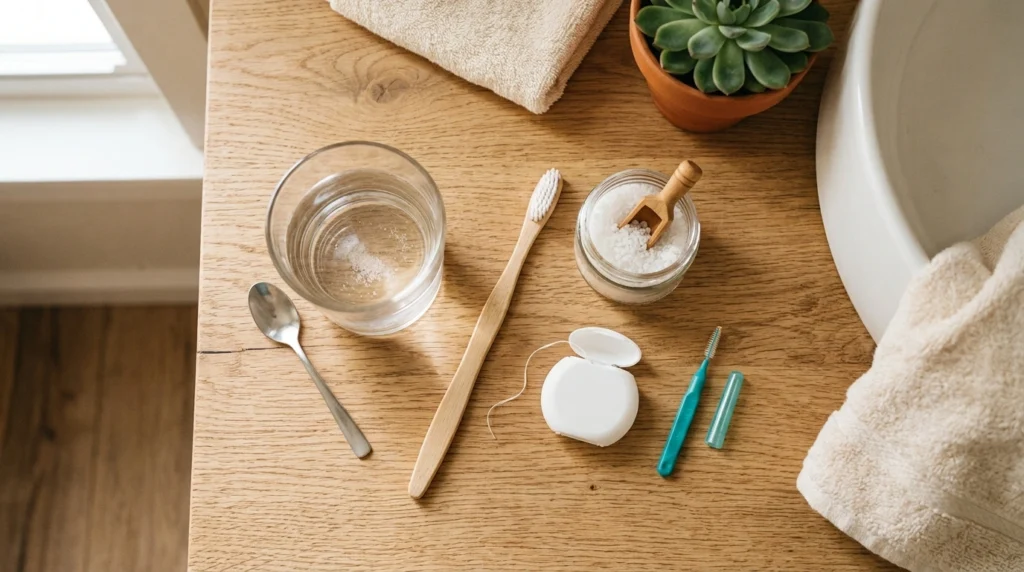
While home care is not a substitute for professional treatment when there’s an underlying infection, decay, or abscess, the following steps can ease discomfort, reduce swelling, and in mild cases (like trapped food or early gingivitis) resolve the problem entirely.
1. Warm Salt Water Rinse
Dissolve about half a teaspoon of salt in a cup of warm (not hot) water and swish gently for 30 seconds, several times a day. Salt water is a natural antiseptic that reduces bacteria, soothes irritated tissue, and can help draw out minor infection.
2. Gentle, Targeted Brushing
Use a soft-bristled toothbrush and angle the bristles at roughly 45 degrees toward the gumline. Spend extra time on the back tooth in question, using small, gentle circular motions rather than aggressive scrubbing, which can worsen irritation.
3. Careful Flossing or Interdental Cleaning
If trapped food or plaque is the suspected cause, gently floss around the affected tooth using a C-shape motion that hugs the tooth surface and slides slightly under the gumline. A soft interdental brush or water flosser can be especially effective for hard-to-reach back teeth.
4. Cold Compress
Applying a cold pack to the outside of your cheek near the swollen area for 10–15 minutes at a time can reduce swelling and numb discomfort, particularly useful if the area is also tender to the touch externally.
5. Over-the-Counter Pain Relief
Standard doses of ibuprofen or acetaminophen, taken as directed, can reduce both pain and inflammation while you arrange a dental visit. Avoid placing aspirin directly on the gum — this is a common myth, but it can actually burn and damage gum tissue.
6. Antimicrobial or Alcohol-Free Mouthwash
An antimicrobial rinse can help reduce the bacterial load around the irritated area. If your gums are already sensitive, choose an alcohol-free formula, since alcohol-based rinses can sting and dry out inflamed tissue further.
7. Avoid Irritants Temporarily
Skip very hot, very cold, spicy, acidic, or hard/crunchy foods on that side of your mouth until the swelling improves. Chewing on the opposite side gives the area a chance to calm down.
8. Stay Hydrated and Eat Soft Foods
Good hydration supports saliva production, which naturally helps control bacteria. Softer foods reduce mechanical irritation while you heal.
Important: these home measures are appropriate for mild, recent-onset swelling. They are not a fix for a genuine abscess, a deep cavity, or pericoronitis from a wisdom tooth — those need professional treatment, and home care alone risks letting the infection spread.
When to See a Dentist: Don’t Wait If You Notice These Signs
Schedule a routine but prompt dental visit if:
- Swelling persists more than 2–3 days despite good home care
- The area bleeds frequently or easily
- You notice a small bump, pimple, or pus pocket on the gum
- Pain is consistently triggered by biting or chewing on that tooth
- Over-the-counter pain relief only helps briefly before discomfort returns
Seek urgent or same-day dental or medical care if:
- Swelling spreads to your cheek, jaw, or neck
- You develop a fever, chills, or generally feel unwell
- You have difficulty opening your mouth fully or swallowing
- Pain becomes severe, throbbing, or keeps you awake at night
- You notice swelling under your jaw or difficulty breathing (this is a medical emergency — go to an ER)
A dentist will typically examine the area visually, may take an X-ray to check for decay, abscess, or impaction beneath the surface, and recommend a treatment plan based on the root cause — which might include a deep cleaning (scaling and root planing), draining an abscess, a filling, a root canal, antibiotics, or, in the case of a problematic wisdom tooth, extraction or removal of the overlying gum flap (operculectomy).
Prevention: Stopping This From Happening Again
Because back teeth are the hardest to clean, prevention requires a bit more intentional effort in that specific area:
- Brush for the full two minutes, deliberately spending extra time angling the brush toward your last molars on both sides.
- Floss daily, using a gentle C-shape around each tooth, including the very back ones — consider a floss pick or interdental brush if traditional floss is hard to maneuver that far back.
- Use an antimicrobial or fluoride mouthwash to reach bacteria that brushing and flossing miss.
- Schedule regular dental cleanings (typically every six months) so plaque and tartar are professionally removed before they cause inflammation.
- Monitor wisdom teeth with periodic dental X-rays, especially in your late teens and twenties, since early intervention on a problematic wisdom tooth prevents recurring infections.
- Address dental work promptly — if a filling, crown, or denture feels off or irritates your gum, have it checked rather than waiting.
- Eat a balanced diet rich in vitamin C and vitamin B, since deficiencies in these nutrients are linked to weaker, more easily inflamed gum tissue.
- Avoid tobacco products, which significantly increase the risk of gum disease and slow healing.
- Stay consistent even when nothing hurts — gum disease in its early stages is often painless, which is why routine hygiene matters more than reactive care.
Frequently Asked Questions
Is it normal for only one gum to be swollen? Yes. Localized swelling around a single tooth is actually more common than full-mouth gum swelling, because it usually points to a specific local cause — trapped food, a cavity, or a wisdom tooth — rather than a widespread condition.
Can a swollen gum around one tooth go away on its own? Mild cases caused by trapped food or very early plaque irritation can improve within a day or two with good cleaning and a salt water rinse. Swelling caused by infection, decay, or an erupting wisdom tooth typically will not resolve on its own and tends to recur or worsen without treatment.
Is swollen gum around a back tooth an emergency? It becomes an emergency if swelling spreads to your face or neck, you develop a fever, you can’t fully open your mouth, or you’re in severe, escalating pain. Otherwise, it’s generally a “see a dentist within a few days” situation rather than an ER visit.
Why does it hurt more when I bite down? Pain specifically triggered by biting often points to a cavity reaching the nerve, a cracked tooth, or a localized abscess putting pressure on the area when force is applied.
Can stress cause swollen gums? Indirectly, yes. Stress can weaken immune response and is also linked to teeth grinding (bruxism), which can irritate gum tissue and worsen existing inflammation.
Should I pop a bump on my gum? No. A bump on the gum is often a sign of an abscess or fistula draining infection. Attempting to pop or squeeze it yourself can push bacteria deeper into the tissue and worsen the infection. Have it evaluated by a dentist instead.
Will antibiotics alone fix a swollen gum? Antibiotics can control an active bacterial infection, but they don’t address the underlying cause — a cavity, trapped debris, or a wisdom tooth issue still needs to be treated directly, or the swelling is likely to return.
Does pregnancy cause swollen gums around one tooth? Pregnancy hormones (rising estrogen and progesterone) increase blood flow to gum tissue and can make it more sensitive and prone to swelling generally, including localized “pregnancy tumors” (pyogenic granulomas) that can form around a single tooth. These are usually harmless and often resolve after delivery but should still be monitored by a dentist.
The Bottom Line
A swollen gum around one tooth in the back is your body’s localized response to irritation, plaque, decay, or infection in that specific spot. Most cases trace back to one of a handful of clear causes — trapped food, gingivitis, a cavity, an abscess, or a wisdom tooth that hasn’t fully erupted. Gentle home care, including warm salt water rinses, careful brushing and flossing, and temporarily avoiding irritants, can ease mild cases within a couple of days. But if swelling persists, worsens, or comes with bleeding, a bump, fever, or spreading pain, a dental visit is the safest and fastest path to relief — catching the underlying cause early almost always means simpler, more comfortable treatment.
