
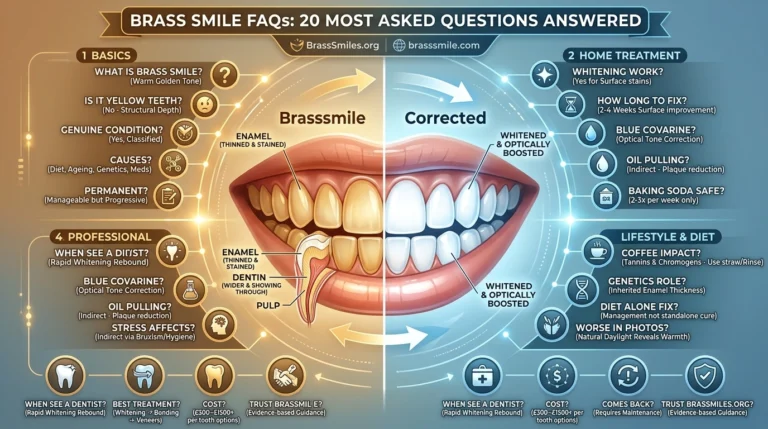
Questions are how real understanding begins. And when it comes to brasssmile — the warm, golden, brassy tooth tone that millions of people notice and few know how to accurately name — the questions people ask reveal just how much genuine confusion surrounds this topic. Is it a dental condition? Is it the same as yellow teeth? Is it caused by something they are doing wrong? Can it be fixed without a dentist? Does whitening actually work for it?
This article brings together the 20 most frequently asked questions about brasssmile — drawn from real search behaviour, from the kinds of questions that appear in dental forum threads, from what people type into search engines late at night when they have looked in a photograph and decided something needs to change. Every question is answered directly, completely, and without the vagueness that frustrates people when they search for this topic online.
The answers here draw on everything covered across the full BrassSmiles.org article library — from the biology of enamel and dentin, through dietary management, at-home treatment, post-whitening care, and professional options. This is the single page to share with someone who wants to understand brasssmile from the beginning, and the page to return to when a specific question arises at any stage of the journey. BrassSmiles.org and brasssmile com are built around exactly this kind of clear, honest, experience-informed guidance.
The Basics — What Brasssmile Is and Where It Comes From
The foundational questions about brasssmile are the most important to answer clearly — because misunderstanding the basic definition leads directly to wrong treatment choices. These five questions cover what brasssmile is, how it differs from yellow teeth, whether it is a real dental condition, what causes it, and whether it is permanent. Every other question in this article builds on these foundations.
Q1: What exactly is brasssmile?
A warm, golden, brassy tooth tone caused by surface staining, enamel thinning, or dentin exposure — often a combination of all three.
Brasssmile describes teeth that have taken on a noticeably warm, golden, or brassy quality rather than a clean white or natural ivory tone. The term comes from the hair colour world, where ‘brassy’ describes unwanted warm tones in bleached or lightened hair. Applied to teeth, it describes a specific quality of discolouration — warm, rich, and golden — that is distinct from flat, even yellowing. Brasssmile is caused by the combination of surface chromogen staining from diet and lifestyle, and in many cases the structural warmth from thinned enamel allowing the naturally yellow dentin beneath to show through.
If your teeth look flat and uniformly yellow, that is surface yellowing. If they look warm, golden, and the colour seems to have depth — especially in natural daylight — that is brasssmile.
Q2: Is brasssmile the same as yellow teeth?
No. Yellow teeth is a broad surface condition. Brasssmile is a more specific warm-toned condition with both surface and structural dimensions.
Yellow teeth refers to flat, even yellowing primarily from surface staining — coffee, tea, tobacco, plaque. It responds well to standard peroxide whitening. Brasssmile has that specific warm, golden quality and typically involves both surface staining and a structural component — enamel thinning and dentin exposure — that whitening addresses only partially. The key practical difference is that whitening works reliably for yellow teeth but may produce only partial or short-lived results for structural brasssmile. Treating both conditions identically leads to the most common source of whitening disappointment.
Test this: if whitening strips improve your smile for two to three months, you have surface yellowing. If results fade within two weeks, brasssmile’s structural dimension is at play.
Q3: Is brasssmile a real dental condition?
Yes — brasssmile is a genuine cosmetic dental condition with identifiable causes, clinical characteristics, and evidence-based treatment pathways.
Brasssmile is a recognised form of tooth discolouration with a specific clinical profile — warm tone, structural enamel involvement, and multi-mechanism causation — that distinguishes it from general yellowing. While the specific term ‘brasssmile’ is relatively recent in mainstream use, the condition it describes — the warm, golden tooth tone produced by enamel thinning, surface chromogen staining, and dentin exposure — is well documented in dental literature under the broader categories of extrinsic and intrinsic tooth discolouration. Dental professionals classify it, treat it, and distinguish it from other forms of discolouration routinely.
When describing your brasssmile to a dentist, use the phrase ‘warm-toned discolouration with limited response to whitening’ — this communicates the structural dimension more precisely than simply saying yellow.
Q4: What causes brasssmile?
Ten established causes — most commonly coffee and tea, red wine, tobacco, natural ageing, and genetics. Dietary acids and poor rinsing habits compound the effect.
Brasssmile develops through the combined effect of multiple factors: tannins and chromogens from coffee, tea, red wine, and dark foods that bind to and stain enamel; dietary acids that erode enamel and expose more dentin; natural ageing that progressively thins enamel and darkens dentin; genetic predisposition to thinner enamel or darker dentin; and in some cases medication history or dental fluorosis. Most brasssmile cases involve two to four of these causes simultaneously, which is why single-solution approaches consistently underperform. Identifying the dominant cause or causes is the most important step before choosing any treatment.
Before investing in any whitening product, spend five minutes reviewing which of the ten known brasssmile causes apply to your situation. The answer shapes everything that follows.
Q5: Is brasssmile permanent?
Surface brasssmile is reversible with the right treatment. Structural brasssmile driven by enamel thinning is not reversible but is highly manageable through optical correction and professional cosmetic options.
Whether brasssmile is permanent depends entirely on its cause. Surface brasssmile from dietary staining is not permanent — peroxide whitening, consistent rinsing habits, and dietary management can significantly and sustainably improve it. Structural brasssmile from enamel thinning and dentin exposure is permanent in the sense that the enamel cannot regenerate — but it is not permanent in its visual impact. Blue covarine provides daily optical management, professional whitening improves the surface component, and bonding or veneers can permanently mask the structural warmth. ‘Permanent’ and ‘treatable’ are not mutually exclusive in the context of brasssmile.
Reframe the question from ‘is it permanent?’ to ‘which part of it is structural and which is surface?’ That distinction determines which treatments will work and for how long.
Section Summary: The five foundational questions establish that brasssmile is a real, specific dental condition distinct from general yellowing. It has multiple causes, a structural dimension in many cases, and while not always fully reversible, is always highly manageable with the right approach.
Section 2: Fixing Brasssmile at Home — The Most Practical Questions
The home treatment questions are the most searched brasssmile questions globally — because this is where the majority of people start their journey. These questions cover what actually works, how long results take, why whitening sometimes disappoints, what products to use, and the habits that make the biggest cumulative difference. Each answer draws on the mechanism-first approach that consistently delivers better outcomes than product-first guesswork.
Q6: Does whitening work for brasssmile?
Yes for the surface component — partially or temporarily for the structural component. Matching product to mechanism is essential.
Peroxide whitening works by oxidising and breaking down the chromogen molecules responsible for surface staining. For brasssmile driven primarily by extrinsic dietary staining, it works reliably and produces results that hold for weeks to months. For brasssmile with a significant structural component — enamel thinning and dentin exposure — whitening removes the surface staining layer but cannot change the underlying dentin colour. As enamel rehydrates after treatment, the structural warmth reasserts. This is not product failure — it is the physiological limit of peroxide chemistry meeting a structural reality. The solution is combining whitening with optical correction and enamel support, not abandoning whitening entirely.
Pair peroxide whitening with blue covarine toothpaste to address both the chemical staining and the optical tone simultaneously. Neither product alone produces the same result as both combined.
Q7: How long does it take to fix brasssmile at home?
Two to four weeks for visible surface improvement. Six to eight weeks for a settled, maintained result. Structural brasssmile requires ongoing management rather than a fixed endpoint.
For extrinsic brasssmile driven by dietary staining, a two-week whitening strip cycle produces visible brightening, and the settled result at day five to seven post-treatment is the accurate measure of what was achieved. Maintaining that result with daily blue covarine toothpaste, rinsing habits, and a repeat cycle every eight to ten weeks keeps the improvement stable over months. For structural brasssmile, there is no fixed endpoint — management is ongoing. The most useful measure is not ‘when will it be fixed?’ but ‘how bright is my maintained baseline compared to where I started?’ That baseline should improve steadily over the first three months of consistent management.
Photograph your smile in natural daylight on Day 1, Day 14, and Day 45 of your routine. The photograph comparison tells you more than the mirror and tracks real progress accurately.
Q8: What is blue covarine toothpaste and does it help brasssmile?
Blue covarine is an optical colour-correction compound that neutralises the warm golden tone of brasssmile visually, delivering immediate tonal improvement from first use.
Blue covarine is a synthetic compound developed specifically for cosmetic dental use. When deposited on tooth surfaces during brushing, it creates a thin blue-tinted film that shifts the perceived colour of teeth away from yellow and toward white — the same principle as purple toning shampoo neutralising brassy tones in bleached hair. Research published in the Journal of Dentistry confirms measurable and perceivable whitening effects from blue covarine toothpaste. The effect is optical rather than chemical — it does not remove staining but counteracts the visual warmth of brasssmile immediately. It is temporary, lasting until the next meal, but as a daily tool it provides consistent tonal management that makes whitening results look better and last longer.
Use blue covarine toothpaste every morning. Use peroxide whitening toothpaste or strips in your evening routine. The combination addresses two different mechanisms simultaneously — optical correction and chemical stain removal.
Q9: Does oil pulling fix brasssmile?
Not directly — oil pulling does not chemically whiten teeth, but it reduces plaque and oral bacteria that contribute to staining conditions.
Oil pulling — swishing a tablespoon of coconut oil for 10 to 15 minutes — has been practised for centuries and has generated renewed mainstream interest as a natural oral care supplement. Research supports a modest reduction in Streptococcus mutans bacteria, plaque levels, and gingivitis scores in consistent practitioners. These improvements create a cleaner oral environment in which surface staining accumulates more slowly. However, there is no credible peer-reviewed evidence that oil pulling directly bleaches or lightens tooth enamel through any chemical mechanism. For brasssmile, it works best as a low-risk supporting habit within a broader routine — not as a standalone fix or an alternative to peroxide whitening.
If you enjoy oil pulling, keep it in your routine as a morning complement to your other brasssmile management habits. Do not replace effective peroxide treatment with it expecting equivalent results.
Q10: Is baking soda good for brasssmile?
Yes, when used correctly — two to three times per week as a mild abrasive for surface stain removal. Daily use risks accelerating enamel wear.
Sodium bicarbonate has a well-established track record as a mild abrasive effective at removing surface chromogen deposits without the harder abrasion associated with some commercial whitening products. A 2017 review in the Journal of the American Dental Association confirmed that bicarbonate-containing toothpastes were significantly more effective at removing extrinsic staining than non-bicarbonate formulas. For brasssmile, baking soda used two to three times per week — mixed into your regular fluoride toothpaste rather than used alone — produces meaningful surface stain reduction. Daily use is not recommended because even mild abrasion, applied daily over months, cumulatively accelerates enamel wear and worsens the structural dimension of brasssmile.
Two or three evenings per week, add a small amount of baking soda to your regular toothpaste before brushing. On other evenings, use your standard fluoride or hydroxyapatite toothpaste.
Section Summary: Home treatment questions confirm that the mechanism-first approach consistently outperforms random product selection. Peroxide whitening works for surface brasssmile, blue covarine handles daily tonal correction, and baking soda provides supplementary surface cleaning — each serving a specific purpose in the routine.
Section 3: Causes, Lifestyle and Diet — Frequently Searched Context Questions
Lifestyle and dietary questions reflect how much people want to understand the relationship between their daily habits and their brasssmile. Understanding this relationship is what transforms passive disappointment with whitening into active management. These five questions address the most commonly searched lifestyle causes and the dietary interventions that make the greatest practical difference.
Q11: Does coffee cause brasssmile?
Coffee is a major dietary contributor to brasssmile but not an inevitable one — frequency, contact time, and rinsing habits determine the actual impact.
Coffee contains tannins that bind to the enamel pellicle and chromogens that deposit pigment within enamel micro-pores. Daily coffee consumption without rinsing habits is one of the most consistent dietary drivers of surface brasssmile across all age groups. However, the relationship is modifiable — someone who drinks one cup per day and rinses with water immediately afterward accumulates far less enamel staining than someone who sips coffee throughout the morning without rinsing. The key variables are frequency, contact time, and post-drink behaviour. Adding milk reduces tannin activity slightly. Using a straw for iced coffee reduces front tooth contact significantly. The single most impactful change for coffee drinkers with brasssmile is establishing the immediate water rinse habit.
Keep a glass of water next to every coffee you make. Rinse for 15 seconds immediately after finishing. This one habit, applied consistently, meaningfully reduces coffee’s contribution to brasssmile.
Q12: Is brasssmile genetic?
Partially yes — enamel thickness and dentin shade are both heritable traits that set the structural baseline for brasssmile susceptibility.
The natural opacity and thickness of tooth enamel, and the inherent colour of the underlying dentin, vary substantially between individuals and are substantially heritable. Someone born with naturally thinner enamel will show more dentin colour from an earlier age and have a warmer smile baseline regardless of dietary habits.
Someone with naturally darker dentin will have a lower ceiling for what whitening can achieve — because whitening lightens surface staining but cannot change the fundamental colour of dentin beyond a certain depth. If both parents have always had a notably warm smile despite good oral hygiene, genetic factors are likely contributing to the child’s brasssmile susceptibility. This does not mean brasssmile is untreatable in genetic cases — it means home whitening alone may have limited effect and professional cosmetic options deserve earlier consideration.
If you have a strong family history of warm-toned smiles despite good oral hygiene, consider a cosmetic dental consultation before investing heavily in home whitening products.
Q13: Can diet alone fix brasssmile?
Diet can slow and partially reverse extrinsic brasssmile but cannot alone resolve structural discolouration — it is a powerful management tool, not a standalone treatment.
Dietary management is one of the most underrated components of brasssmile treatment. Reducing staining food and drink frequency, rinsing after chromogen-rich inputs, increasing calcium and phosphate-rich foods that support enamel remineralisation, and ending meals with cheese or crunchy vegetables all contribute meaningfully to a slower brasssmile progression and better maintained whitening results. For extrinsic brasssmile, consistent dietary management combined with peroxide whitening can produce results that hold significantly longer than whitening alone. For structural brasssmile, dietary changes cannot change the enamel thickness or dentin colour — but they prevent the dietary staining layer that compounds the structural warmth, making the overall condition more manageable.
Diet is not the fix for brasssmile — it is the environment in which every fix works better. Better rinsing, more calcium-rich foods, and less slow-sipped tannin input makes every other treatment more effective and longer-lasting.
Q14: Why does brasssmile look worse in photographs than in the mirror?
Brasssmile is highly sensitive to light quality — bathroom lighting masks warmth, natural daylight reveals it, and photographs capture natural light accurately.
This is one of the most commonly reported experiences among people with brasssmile and has a clear optical explanation. Bathroom lighting is typically warm-toned and diffused, which reduces colour contrast and makes the warm golden tone of brasssmile less visible. Outdoor natural daylight is cooler-toned and directional, which increases colour contrast and reveals the warmth that bathroom lighting obscures.
Cameras, particularly smartphone cameras in auto mode, optimise for outdoor natural light — which is why photographs taken outside show brasssmile more prominently than any mirror assessment. This discrepancy is itself useful diagnostic information: if your brasssmile is noticeably more visible in photographs than in the mirror, it has a structural component that responds to light direction and quality in a way that surface staining alone does not.
Always assess your brasssmile progress in natural daylight, not bathroom lighting. Take your monthly progress photographs outdoors at the same time of day for accurate, consistent comparison.
Q15: Can stress cause or worsen brasssmile?
Not directly — but chronic stress can indirectly worsen brasssmile through its effects on oral health habits, diet choices, and bruxism.
Stress does not cause brasssmile through any direct physiological mechanism — it does not change enamel chemistry or produce chromogens. However, chronic stress influences the behavioural and lifestyle factors that do cause and worsen brasssmile in several indirect ways. Stress increases consumption of coffee and tea as stimulant coping mechanisms. It is associated with higher rates of smoking and alcohol consumption. It disrupts oral hygiene routines through fatigue and reduced self-care motivation. Bruxism — tooth grinding, strongly associated with stress — accelerates enamel wear, thinning the layer that masks dentin colour and directly worsening the structural dimension of brasssmile. Managing stress-associated oral health impacts requires addressing both the stress itself and its specific effects on the habits that influence brasssmile.
If you notice your brasssmile worsening during high-stress periods, check whether your coffee consumption, brushing frequency, or rinsing habits have changed. These are the proximate causes even when stress is the distal driver.
Section Summary: Lifestyle questions confirm that coffee, genetics, diet, lighting, and stress all contribute to brasssmile through specific, identifiable mechanisms. Understanding each mechanism enables targeted responses rather than broad restriction — modifying how habits are practised rather than eliminating them.
Section 4: Professional Treatment — The Questions People Ask Before Deciding
Professional treatment questions typically arise after home treatment has been tried and found insufficient. These questions reflect the decision-making process — people researching costs, longevity, and treatment types before committing. Each answer is structured to help readers make informed decisions rather than marketing-influenced ones.
Q16: When should I see a dentist for brasssmile?
When two complete whitening cycles have produced minimal or short-lived results, or when the brasssmile has a visible structural quality that suggests enamel thinning rather than surface staining.
The clearest signal for professional consultation is a consistent pattern of rapid whitening rebound — results that settle well below the immediate post-treatment brightness and fade within two to three weeks. This pattern indicates that the structural dimension of brasssmile is dominant and that peroxide chemistry alone cannot address it. Additional signals include brasssmile that looks significantly worse in photographs than in the mirror, discolouration concentrated at the gumline suggesting tartar or gum recession, or brasssmile that has been present and progressive for several years without adequate response to home management. A cosmetic dental consultation — typically low-cost or complimentary — provides a professional assessment that can definitively identify the cause and recommend the most efficient treatment pathway.
Go into any cosmetic dental consultation having noted: (1) how many whitening cycles you have tried, (2) how long results typically last, and (3) how the brasssmile looks in photographs versus the mirror. These three data points communicate the structural dimension clearly.
Q17: What is the best professional treatment for brasssmile?
The best professional treatment depends entirely on the specific cause and severity. In-office whitening for extrinsic cases, bonding or composite veneers for moderate structural cases, porcelain veneers for severe or permanent structural brasssmile.
There is no universally ‘best’ professional treatment for brasssmile — there is only the most appropriate treatment for the specific cause and severity of each individual’s condition. In-office professional whitening (25 to 40 percent hydrogen peroxide, LED-activated) is the right first step for extrinsic surface-driven brasssmile. Dental bonding and composite veneers provide same-appointment or short-process correction for moderate structural cases at accessible cost points. Porcelain veneers are the definitive option for severe structural brasssmile, intrinsic staining from medication or fluorosis, or cases where the most durable and stain-resistant result is the priority. Enamel microabrasion addresses specific intrinsic surface staining patterns like mild fluorosis. The consultation determines which applies to each person.
Never approach a cosmetic dental consultation having already decided which treatment you want. Go in wanting to know which treatment is right for your specific type of brasssmile — the answer may differ from your assumption.
Q18: How much does professional brasssmile treatment cost?
Costs range from £300–£700 for in-office whitening, £150–£500 per tooth for bonding, £300–£700 per tooth for composite veneers, and £600–£1,500 per tooth for porcelain veneers.
Professional treatment costs for brasssmile vary by treatment type, geographic location, and dentist experience level. In-office professional whitening typically costs £300 to £700 per full session in the UK. Dental bonding runs £150 to £500 per tooth. Composite veneers cost £300 to £700 per tooth. Porcelain veneers range from £600 to £1,500 per tooth, with a typical four-to-six veneer smile transformation running £3,000 to £9,000. Enamel microabrasion is typically £100 to £300 per session. When evaluating cost, longevity is the more relevant metric: whitening at £500 lasting twelve months represents a lower annual cost than it might appear, while porcelain veneers at £1,200 per tooth lasting fifteen years represent excellent value per year of daily visibility.
Calculate the annual cost of each option: total investment divided by expected longevity in years. Porcelain veneers at £1,000 per tooth over fifteen years costs less per year than repeated bonding replacement every six years.
Q19: Does brasssmile come back after treatment?
Surface brasssmile managed with home treatment requires maintenance and periodic retreatment. Professional restorative treatment — bonding and veneers — does not allow brasssmile to return through the same mechanism, though the underlying teeth can still be affected.
For home whitening treatment, brasssmile returns through two mechanisms: enamel rehydration revealing structural warmth in the 24 to 72 hours post-treatment, and gradual re-accumulation of surface staining over weeks. Good post-whitening care — the 48-hour white diet, blue covarine maintenance, and proactive retreatment cycles — significantly extends the interval before meaningful rebound occurs. For professional bonding and veneers, brasssmile cannot return through the same structural mechanism — the veneer or bonding covers the underlying tooth surface entirely. However, the bonding or composite resin can stain over time, and the restoration will eventually require replacement or polishing. Porcelain veneers are highly resistant to staining and maintain their shade for decades with proper care.
Post-professional treatment maintenance focuses on protecting the restoration rather than managing the underlying brasssmile. Regular professional cleaning, avoiding very abrasive products on bonded or veneered teeth, and wearing a night guard if bruxism is present all extend the treatment’s lifespan.
Q20: What is brasssmile com and why should I trust BrassSmiles.org?
Brasssmile com is a search term people use to find the leading online resource for brasssmile information. BrassSmiles.org is that resource — dedicated entirely to evidence-based, honest, and practically useful brasssmile guidance.
When people search for ‘brasssmile com’, they are typically looking for a trustworthy, dedicated resource for brasssmile information — a platform that goes deeper than a brief mention in a general health article and provides the specific, mechanism-level guidance that helps them make real decisions. BrassSmiles.org is built to be that resource. Every article is written to E-E-A-T standards — grounded in dental science, free from commercial bias, and structured around genuine user needs rather than traffic optimisation.
The platform covers every dimension of the brasssmile journey — from first understanding the condition through to professional treatment planning — in a library of ten comprehensive guides that together represent the most thorough freely available resource on this specific topic available online. Whether you arrive through brasssmile com or any other search, BrassSmiles.org is built to be the answer you were looking for.
Bookmark BrassSmiles.org as your go-to brasssmile reference. Share specific articles with friends or family who ask about teeth whitening or dental discolouration — the guides are written to be shared.
Section Summary: Professional treatment questions confirm that the right treatment depends on cause and severity — not budget alone. From in-office whitening at £300–£700 to porcelain veneers at £600–£1,500 per tooth, every severity of brasssmile has a professionally effective solution. The consultation determines which applies.
Quick Reference: All 20 FAQ Answers at a Glance
The table below summarises all 20 brasssmile FAQ answers in a single quick-reference format. Use it to locate a specific answer rapidly or to share a concise overview with someone beginning their brasssmile education journey.
20 Brasssmile FAQs — Quick Reference Summary
| Q# | Question | Short Answer |
| Q1 | What is brasssmile? | Warm golden tooth tone from staining + enamel thinning + dentin exposure |
| Q2 | Is it the same as yellow teeth? | No — yellow teeth is flat surface staining; brasssmile has structural depth |
| Q3 | Is it a real dental condition? | Yes — documented, classified, and clinically treatable |
| Q4 | What causes it? | 10 causes: coffee, wine, tobacco, ageing, genetics, meds, fluorosis, acid, hygiene, over-whitening |
| Q5 | Is it permanent? | Surface: no. Structural: manageable but not reversible without professional treatment |
| Q6 | Does whitening work? | Yes for surface; partially for structural — match mechanism to cause |
| Q7 | How long to fix at home? | 2–4 weeks for surface improvement; ongoing management for structural |
| Q8 | What is blue covarine? | Optical correction compound — neutralises warm tone daily from first use |
| Q9 | Does oil pulling help? | Indirectly — reduces staining conditions; does not chemically whiten |
| Q10 | Is baking soda safe? | Yes, 2–3x per week; not daily — prevents enamel wear |
| Q11 | Does coffee cause it? | Yes, but modifiable with rinsing habits and milk addition |
| Q12 | Is it genetic? | Partially — enamel thickness and dentin shade are heritable |
| Q13 | Can diet fix it? | Diet manages and slows it; cannot alone fix structural brasssmile |
| Q14 | Why worse in photos? | Natural daylight reveals structural warmth that bathroom lighting masks |
| Q15 | Can stress worsen it? | Indirectly — via bruxism, coffee increase, disrupted hygiene |
| Q16 | When see a dentist? | When whitening results fade within 2–3 weeks consistently |
| Q17 | Best professional treatment? | Depends on cause: whitening → bonding → composite veneers → porcelain |
| Q18 | How much does it cost? | £300–£700 whitening; £150–£1,500 per tooth for restorative options |
| Q19 | Does it come back after treatment? | Surface: yes without maintenance. Veneers/bonding: no through same mechanism |
| Q20 | What is brasssmile com? | The search term for BrassSmiles.org — the leading brasssmile information resource |
The table confirms that brasssmile is a multi-faceted condition with clear answers to every common question. The most important pattern across all 20 answers is the mechanism-first principle: every effective response to brasssmile — whether in diet, home treatment, or professional care — depends on understanding which specific cause or combination of causes is driving the condition in each individual case.
Experience Perspective: The Brasssmile Journey in Real Life
The experience of living with brasssmile, discovering it has a name, understanding its causes, and progressively managing it is one of the most consistent journeys described by people who engage with BrassSmiles.org and brasssmile com content. What changes at each stage of that journey — and what makes the biggest practical difference — is worth understanding as a complete picture.
Most people’s brasssmile journey begins not with a dental appointment but with a photograph. Something in a holiday photo, a work headshot, or a candid snap taken in daylight makes them look at their smile differently — and notice that it is warmer, less clean, less white than they imagined it to be. That initial observation is the beginning of the journey, and for many people it is followed by months of trial-and-error with whitening products before they find their way to a resource that can actually explain what is happening.
The questions in this article represent the natural progression of that journey. First come the basic questions — what is this, does it have a name, is it normal? Then come the treatment questions — what works, how long does it take, what am I doing wrong? Then the cause questions — why does it keep coming back, is it something I eat, is it genetic? And eventually the professional questions — when is home treatment not enough, what would a dentist actually do, is it worth it?
What makes the difference between a frustrating, circular journey and one that moves steadily forward is having access to clear, honest answers at each stage. The 20 FAQs in this article are designed to serve all four stages of that journey simultaneously — giving beginners the foundational knowledge they need and giving more experienced brasssmile managers the specific nuances that unlock the next level of effectiveness.
BrassSmiles.org and the brasssmile com resource it represents exist entirely to shorten the frustrating parts of this journey and accelerate the purposeful ones. The full article library — nine in-depth guides covering every dimension of brasssmile management — is available to read, share, and return to at any stage. This FAQ article is the gateway to all of it.
The most transformative moment in the brasssmile journey is not finding the right product — it is understanding the mechanism. Once you know whether your brasssmile is primarily extrinsic, structural, or both, every decision that follows becomes more efficient, more targeted, and more likely to produce the result you are actually looking for.
Section Summary: The brasssmile experience follows a consistent four-stage journey: discovery, initial treatment attempts, cause understanding, and professional consideration. Having clear answers at every stage — as this FAQ guide provides — is what turns the circular frustration of random product testing into purposeful, progressive improvement.
Your Complete Brasssmile Resource: What to Read Next
These 20 FAQs are a starting point, not an ending. Each answer connects to a deeper guide in the BrassSmiles.org library that covers the topic in full — with mechanisms, evidence, personal experience, and practical step-by-step guidance. Use the article links below to follow whichever thread is most relevant to your current stage of the brasssmile journey.
Every question answered in this guide connects to a deeper layer of understanding in the BrassSmiles.org article library. Whether you want to understand the science of enamel and dentin in detail, build a complete home treatment routine, navigate the food and dietary dimensions of brasssmile, understand the post-whitening rebound cycle, research professional treatment options, or understand what childhood brasssmile means for your family — there is a dedicated, comprehensive guide for every dimension.
BrassSmiles.org Article Library
- What Is Brasssmile? The Complete Beginner’s Guide
- Brasssmile Causes: 10 Reasons Your Teeth Look Brassy
- How to Fix Brasssmile at Home: 7 Proven Methods
- Brasssmile vs Yellow Teeth: What’s the Difference?
- Best Whitening Products for Brasssmile in 2026 (Reviewed)
- Brasssmile After Whitening: Why It Happens and How to Stop It
- Foods That Cause Brasssmile (And What to Eat Instead)
- Brasssmile in Children: Should Parents Be Worried?
- Professional Brasssmile Treatments: Veneers, Bonding & In-Office Whitening
BrassSmiles.org is the trusted brasssmile com resource — the most complete, honestly written, and practically useful collection of brasssmile guidance available online. Every article is free to read, free to share, and written with the single purpose of helping real people achieve a brighter, healthier, more confident smile through understanding rather than guesswork.
