
You did everything right. You committed to the whitening routine — strips applied consistently, the right contact time, the correct product. And for a few days, perhaps as long as a week, your smile looked noticeably brighter. Then something shifted. The warmth crept back. Not dramatically at first — just a softening of the bright result you had worked for — but within two weeks the brassy tone had largely returned, and the frustration set in. Sound familiar?
This experience is so common among people dealing with brasssmile that it has its own clinical name: shade relapse, or colour rebound. It is one of the most frequently reported disappointments in post-whitening care, and it is also one of the most misunderstood. Many people who go through this cycle conclude that whitening simply does not work for their teeth — that their brasssmile is immune to treatment. This conclusion is almost always wrong. The product worked. The problem is what happened after the product was used, and what was not done to maintain the result.
This guide explains the full science behind why brasssmile returns after whitening, the specific mechanisms that drive colour rebound, and — most importantly — the practical, evidence-informed strategies that prevent it. By the end, you will understand the post-whitening window, why it matters so much for brasssmile specifically, and exactly what to do during it to keep your results lasting longer.
What Is Colour Rebound? The Science Behind Brasssmile Returning After Whitening
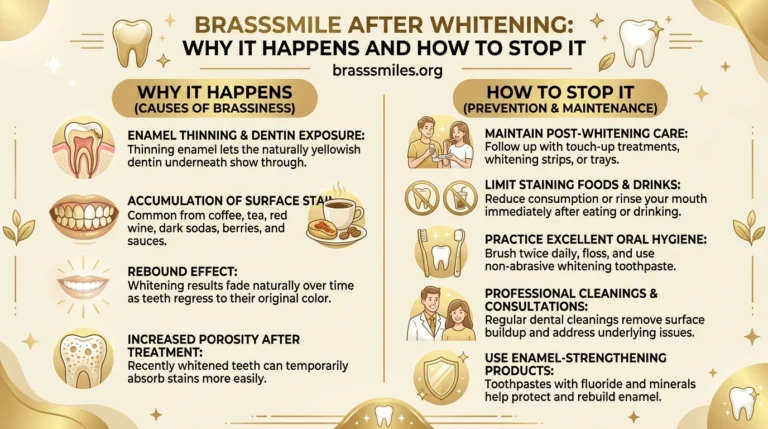
Colour rebound after whitening — also called shade relapse — refers to the partial return of tooth discolouration in the days and weeks following a bleaching treatment. For brasssmile, rebound typically involves the return of the warm, golden tone rather than flat yellowing. It is caused by two distinct mechanisms: enamel rehydration after the temporary dehydration caused by peroxide, and the gradual re-accumulation of surface staining as the enamel enters a temporarily more porous state post-treatment.
Understanding colour rebound requires understanding what peroxide whitening actually does to tooth enamel during treatment. When hydrogen peroxide or carbamide peroxide is applied to the tooth surface, it penetrates the enamel and breaks down chromogen molecules — the pigmented compounds responsible for tooth discolouration — through an oxidation reaction. This process also temporarily draws water out of the enamel matrix, causing a degree of dehydration in the enamel tissue itself.
Dehydrated enamel has different optical properties from hydrated enamel. It appears more opaque — which means it reflects more light from its surface and shows less of the yellow dentin beneath. This is part of why teeth look exceptionally white immediately after a whitening treatment: the optical change from enamel dehydration adds to the genuine colour change from chromogen breakdown, producing a result that appears more dramatic than the underlying bleaching alone would produce.
Over the 24 to 72 hours following treatment, the enamel gradually rehydrates as water molecules return to the enamel matrix. As this happens, the enamel’s optical properties shift back toward their baseline. Studies published in the Journal of Dentistry confirm that measurable colour regression occurs during this first rehydration week — not because the whitening effect has been undone, but because the dehydration-enhanced optical effect is resolving. The teeth are still lighter than before treatment, but the dramatic immediate result has settled to a more realistic post-treatment baseline.
A randomised clinical trial published in PubMed compared at-home and in-office bleaching techniques and found that both produced identical degrees of whitening and equivalent colour regression rates, confirming that rebound is not a product quality issue but a fundamental property of the whitening process itself.
Why Brasssmile Rebound Is Different From General Whitening Rebound
General whitening rebound affects everyone who whitens their teeth to some degree — it is a normal consequence of enamel rehydration. Brasssmile rebound is more pronounced and often more frustrating because brasssmile frequently has a structural component — enamel thinning and dentin exposure — that peroxide whitening cannot address. As the dehydration effect resolves, the structural warmth from underlying dentin reasserts, making brasssmile appear to rebound more completely than flat surface yellowing would.
The distinction between general whitening rebound and brasssmile-specific rebound is clinically important. For someone with primarily extrinsic yellowing, the rebound experience typically involves a partial return to the pre-treatment shade over several weeks — their teeth remain noticeably whiter than before treatment for months, with a gradual fade. For someone with brasssmile that has a significant structural dimension, the rebound experience is more rapid and more complete — the brassy warmth returns quickly because it was always partly driven by structural factors that whitening never touched.
This is the critical insight that changes how brasssmile rebound should be managed. If the rebound is driven primarily by enamel rehydration and re-accumulation of surface staining, the solution is post-whitening care — avoiding staining inputs during the vulnerable post-treatment window and using maintenance products to slow re-staining. If the rebound is driven primarily by structural enamel thinning, the solution requires addressing that structural component directly — through optical correction products or, ultimately, professional cosmetic intervention.
Most people with brasssmile experience a mixed rebound: some from enamel rehydration, some from the vulnerable post-whitening period allowing rapid chromogen re-absorption, and some from the structural dentin colour reasserting as the dehydration effect resolves. A post-whitening strategy that addresses all three dimensions simultaneously is the most effective approach.
💡 The post-whitening 24 to 72 hour window is the most critical period for brasssmile management. Enamel is temporarily more porous during this period, making it significantly more susceptible to re-staining. What you consume and apply to your teeth during this window has a disproportionate impact on how long your whitening result lasts.
The 5 Phases of Post-Whitening Brasssmile: A Timeline
The post-whitening journey for brasssmile follows a predictable pattern across five phases: immediate brightening during enamel dehydration, the rehydration window where rebound begins, the stabilisation phase where a new baseline settles, the gradual re-staining phase from dietary and lifestyle inputs, and the long-term maintenance phase. Understanding which phase you are in shapes the correct response at each stage.
Phase 1: Immediate Post-Whitening — Hours 0–24
What Happens: Teeth appear at their whitest. The peroxide is still active in the enamel, continuing to break down chromogens. Enamel is dehydrated and optically opaque.
Why It Happens: Hydrogen peroxide has residual activity for 24 to 48 hours after application. Enamel dehydration is at its peak. The dehydration-enhanced optical effect makes teeth look more white than the chemical bleaching alone would produce.
What to Do: Avoid all staining foods and drinks — no coffee, tea, red wine, dark sauces. Drink through a straw for any beverage. Rinse with water immediately after eating.
Phase 2: The Rehydration Window — Hours 24–72
What Happens: The most vivid whiteness begins to soften as enamel rehydrates. The dehydration-enhanced optical brightness reduces. For brasssmile users, the structural warmth may begin to reassert as enamel becomes more translucent again.
Why It Happens: Enamel rehydration changes its optical properties from opaque (whiter-looking) back toward translucent (allowing more dentin colour through). This is not a product failure — it is normal enamel physiology. For brasssmile specifically, translucent enamel over yellow dentin is where structural warmth originates.
What to Do: Apply blue covarine toothpaste morning and evening to optically counteract the returning warmth. Continue the white diet. Avoid abrasive toothpastes during this window — enamel is more vulnerable to micro-abrasion while rehydrating.
Phase 3: Stabilisation — New Baseline — Days 3–7
What Happens: The teeth settle at their genuine post-treatment shade. For extrinsic brasssmile this is typically noticeably lighter than pre-treatment. For mixed or structural brasssmile the improvement may be more modest than the immediate post-treatment appearance suggested.
Why It Happens: Enamel is now fully rehydrated and the genuine whitening result from chromogen breakdown is visible. The dramatic immediate brightness has resolved. This settled shade is the accurate measure of what the treatment achieved — not the Day 1 appearance.
What to Do: Assess the result honestly at Day 5–7. If the settled result is good but fading faster than expected, introduce whitening maintenance products. If the result is disappointing despite correct product use, the structural dimension of your brasssmile may be the limiting factor.
Phase 4: Gradual Re-Staining — Weeks 1–8
What Happens: Surface chromogens from dietary and lifestyle sources begin to accumulate on the newly cleaned enamel. The rate of re-staining is faster than pre-treatment because the enamel remains more porous for several weeks post-bleaching.
Why It Happens: Post-whitening enamel has temporarily increased porosity — micro-channels created by the peroxide process remain open for several weeks, allowing chromogens from coffee, tea, and wine to penetrate more readily than usual. This accelerated staining window is one of the primary reasons brasssmile appears to return faster than general yellowing after whitening.
What to Do: Use maintenance whitening toothpaste (peroxide-containing or blue covarine) consistently. Maintain rinsing habits after staining drinks. Consider a whitening pen for targeted top-up on days with higher staining inputs.
Phase 5: Long-Term Maintenance — Weeks 8+
What Happens: The post-treatment enamel has stabilised. Re-staining continues at the pre-treatment rate. For brasssmile with a structural component, the baseline warmth from thinned enamel and dentin exposure remains the permanent floor of any whitening result.
Why It Happens: Without active maintenance, brasssmile returns to approximately its pre-treatment shade within three to six months for most people. The rate depends on dietary habits, rinsing practice, and the proportion of structural versus extrinsic discolouration driving the condition.
What to Do: Schedule the next treatment cycle before the result has fully regressed — re-treating at the 8 to 10 week mark maintains a consistently better baseline than waiting for full rebound before re-treating.
7 Reasons Brasssmile Returns After Whitening — And How to Address Each
Brasssmile returns after whitening for seven main reasons: enamel rehydration revealing structural warmth, the vulnerable post-whitening porous phase allowing rapid chromogen reabsorption, dietary staining inputs during the critical 48-hour window, continued lifestyle habits that caused the original staining, structural dentin exposure that whitening cannot address, lack of optical maintenance between treatment cycles, and excessively long gaps between maintenance cycles. Each reason has a specific corresponding strategy.
Reason 1: Enamel Rehydration Revealing Structural Warmth
As enamel rehydrates in the 24 to 72 hours following whitening, it transitions from the optically opaque dehydrated state back to its natural semi-translucent state. For brasssmile with a structural component, this increased translucency allows more of the naturally yellow dentin to show through — directly contributing to the returning warmth. This mechanism is unavoidable through whitening alone because it is rooted in tooth structure, not surface staining.
Fix: Use blue covarine toothpaste during the rehydration window to optically counteract the warmth as it reasserts. For significant structural brasssmile, consider consulting a dentist about whether veneers or bonding would address the structural dimension more permanently.
Reason 2: Post-Whitening Enamel Porosity and Rapid Chromogen Reabsorption
For several weeks after a bleaching treatment, enamel is more porous than usual. The peroxide process temporarily enlarges micro-channels in the enamel surface, allowing chromogen molecules from staining foods and drinks to penetrate more readily than before treatment. This means that a coffee or glass of red wine in the days immediately after whitening deposits staining compounds more deeply and rapidly than the same drink would have before treatment. The result can feel like dramatic brasssmile rebound — but the mechanism is accelerated re-staining, not product failure.
Fix: Maintain a white diet for at least 48 hours after each whitening session. For the following two weeks, rinse with water immediately after any staining drink and use a maintenance whitening toothpaste daily.
Reason 3: Dietary Staining Inputs During the Critical Window
The 48 hours immediately following whitening treatment are the highest-risk window for brasssmile re-staining. During this period, enamel is both more porous and more susceptible due to residual surface sensitivity and the absence of the protective chromogen layer that had previously been oxidised away. Consuming coffee, tea, red wine, tomato sauce, or any deeply pigmented food or drink during this window can deposit staining that is both rapid and stubborn.
Fix: Commit to the 48-hour white diet after every whitening session. This means plain water, clear broths, white rice, chicken, fish, plain dairy, and white vegetables. It is a short, manageable restriction that has a disproportionately large impact on how long whitening results last for brasssmile.
Reason 4: Unchanged Lifestyle Habits Post-Treatment
Whitening removes existing staining but does nothing to change the habits that created it. If daily coffee consumption, regular wine with dinner, and no post-drink rinsing habit characterised the period before whitening, the same habits will reproduce the same staining at the same rate after treatment. For many people, brasssmile appears to return more quickly after each successive whitening cycle not because whitening is becoming less effective but because the underlying inputs have not been modified.
Fix: Use the post-whitening period as an opportunity to establish the rinsing habits that slow re-staining — water immediately after coffee or tea, a straw for cold staining drinks, and a daily maintenance toothpaste with peroxide or blue covarine.
Reason 5: Structural Dentin Exposure That Whitening Cannot Change
For brasssmile driven by enamel thinning and increased dentin visibility, whitening treats the surface staining component but cannot change the structural warmth from dentin showing through translucent enamel. As the surface staining is removed and then gradually rebuilt by dietary inputs, the structural warmth reasserts and blends with the new surface staining to reproduce the pre-treatment appearance. This is the most frustrating form of brasssmile rebound because it is not fully addressable through whitening alone.
✅ Fix: Acknowledge the structural dimension and adjust expectations of whitening accordingly. Use optical correction products (blue covarine) as a daily management tool. For lasting resolution of structural brasssmile, consult a cosmetic dentist about bonding or veneers.
Reason 6: Lack of Optical Maintenance Between Treatment Cycles
Peroxide whitening produces a genuine chemical improvement in the surface staining of brasssmile — but the tonal quality of brasssmile (the warm, golden character) reasserts between cycles unless it is actively managed. Without a daily blue covarine or tonal-correction toothpaste in the maintenance routine, the perceived brasssmile returns more quickly than the actual surface staining does — because the structural warmth has no daily optical counteraction.
Fix: Use a blue covarine-containing toothpaste as your standard daily toothpaste between whitening cycles. This does not replace peroxide whitening — it manages the tonal appearance of brasssmile on a daily basis so that results look better for longer between treatment cycles.
Reason 7: Excessively Long Gaps Between Maintenance Cycles
Many people whiten their teeth reactively — when the result has fully regressed and they feel dissatisfied again — rather than proactively, before the result has fully faded. Waiting for full regression before re-treating means each cycle starts from a fully stained baseline, requires the full treatment duration, and produces results that take longer to become visible. Re-treating at the 8 to 10 week mark — before the result has fully regressed — maintains a consistently better baseline with the same treatment effort.
Fix: Schedule your next whitening cycle at 8 to 10 weeks after the previous one, regardless of how the current result looks. Proactive maintenance consistently outperforms reactive re-treatment for long-term brasssmile management.
The Complete Post-Whitening Protocol for Brasssmile: Hour-by-Hour and Week-by-Week
An effective post-whitening protocol for brasssmile has three stages: a strict 48-hour window of dietary restriction and gentle care, a two-week consolidation phase with maintenance products and rinsing habits, and an ongoing long-term routine that combines optical correction, enamel support, and periodic treatment cycles. Following this protocol consistently extends the duration of whitening results by weeks and reduces the severity of rebound significantly.
Hours 0–48: The Critical Window
- Drink only water, milk, or clear liquids — no coffee, tea, juice, wine, or dark sodas
- Eat only white or pale foods — chicken, fish, rice, pasta, plain dairy, white vegetables
- Rinse with plain water after every meal or drink
- Apply blue covarine toothpaste in the morning to optically counteract the rehydration warmth
- Use sensitivity toothpaste (potassium nitrate or arginine) if sensitivity is present — do not use abrasive whitening toothpaste during this window
- Avoid mouthwash containing alcohol, strong antiseptics, or colouring agents
- Do not brush with any abrasive product — enamel is temporarily more vulnerable
Days 3–14: Consolidation Phase
- Continue rinsing immediately after staining drinks — establish this as a permanent habit
- Reintroduce blue covarine toothpaste as your standard morning toothpaste
- Begin using hydroxyapatite or fluoride toothpaste in the evening for enamel remineralisation
- Reintroduce staining foods and drinks gradually, prioritising rinsing every time
- Use a whitening pen for targeted top-up if any specific teeth begin to show faster re-staining
- Take a photograph at Day 7 and Day 14 in natural daylight — this gives you an accurate record of your settled post-treatment baseline
Weeks 3–8: Long-Term Maintenance
- Maintain daily combined blue covarine and peroxide toothpaste routine
- Continue evening hydroxyapatite remineralisation support
- Assess the settled result at Week 4 — if the result is holding well, continue maintenance; if significant rebound has occurred, investigate whether structural factors require professional consultation
- Schedule the next treatment cycle for Week 8–10 to maintain a proactive rather than reactive whitening schedule
Post-Whitening Timeline for Brasssmile Management
| Phase | Timeframe | Enamel State | Priority Action | Product to Use |
| Immediate | 0–24 hrs | Dehydrated, porous | White diet strictly | Blue covarine toothpaste |
| Rehydration | 24–72 hrs | Rehydrating | Tonal correction | Blue covarine, water rinse |
| Stabilisation | Days 3–7 | Stabilising | Gentle maintenance | Peroxide + covarine toothpaste |
| Consolidation | Weeks 1–2 | Near-normal | Build rinsing habits | Dual toothpaste + HAp evening |
| Maintenance | Weeks 3–8 | Normal | Proactive care | Full maintenance routine |
| Re-treatment | Weeks 8–10 | Normal | Next cycle | Whitening strips |
The table shows that the post-whitening window is not a single moment but a six-stage process. Each stage has a different enamel state and therefore a different priority action. Managing brasssmile rebound well means responding to each stage appropriately rather than treating the post-whitening period as uniform.
Common Mistakes That Make Brasssmile Rebound Worse
The most damaging post-whitening mistake is consuming staining foods or drinks within 48 hours of treatment. The second is applying abrasive whitening products during the enamel rehydration window, which damages temporarily vulnerable enamel and accelerates structural wear. The third is concluding that brasssmile rebound means whitening has failed and abandoning the routine — when in most cases the right response is adjusting the maintenance strategy, not stopping treatment.
Mistake 1: Eating or Drinking Staining Foods Within 48 Hours
The post-whitening diet restriction is the single most commonly ignored piece of aftercare guidance, and it is also the one with the most direct impact on how long results last. The enamel in the 48 hours following whitening is temporarily more porous and more susceptible to chromogen penetration. A single cup of coffee consumed within this window can deposit staining compounds more deeply than multiple cups would in a normal week — because the temporary porosity allows the chromogens to reach parts of the enamel matrix that are normally protected. Treating the 48-hour window as a minor suggestion rather than a critical protocol is the most direct route to accelerated brasssmile rebound.
Mistake 2: Using Abrasive Products During Rehydration
Some people respond to the post-whitening rehydration rebound — the warmth returning as enamel rehydrates — by applying stronger abrasive whitening products, believing this will arrest the return of brasssmile. This is counterproductive. During rehydration, enamel is temporarily more vulnerable to physical abrasion because the matrix is in a state of structural flux. Applying abrasive products during this window accelerates enamel wear, thinning the outer layer that masks dentin colour — which directly worsens the structural component of brasssmile over time. The correct response to rehydration rebound is optical correction (blue covarine), not abrasion.
Mistake 3: Treating Rebound as Evidence That Whitening Does Not Work
The experience of watching results fade and the familiar warmth return leads many people to conclude that whitening simply does not work for their teeth. In most cases, this conclusion is incorrect. Whitening did work — it removed the surface staining and temporarily addressed the optical appearance of brasssmile. What the rebound reveals is either the structural dimension of the condition or the absence of an effective maintenance routine, or both. The correct interpretation of rebound is diagnostic, not discouraging: it tells you what more needs to be addressed in your routine.
⚠️ Never increase whitening frequency in response to brasssmile rebound. The correct response to rebound is better post-whitening care and maintenance — not more frequent peroxide application. Overuse of peroxide products accelerates enamel dehydration cycles and can increase enamel wear over time.
Experience Perspective: The Emotional Reality of Brasssmile Rebound
Brasssmile rebound after whitening is one of the most demoralising experiences in smile care — not because the situation is hopeless, but because the gap between the immediately post-whitening result and the two-week-later reality can feel like a betrayal. Understanding that this gap has a clear scientific explanation, and a manageable solution, transforms that frustration into purposeful action.
There is a specific moment that many people with brasssmile describe clearly. It usually happens around Day 3 or Day 4 after a whitening session. They woke up on Day 1 with a noticeably brighter smile — genuinely pleased. By Day 3 they are standing at the bathroom mirror and feeling that something has shifted. The vivid brightness has softened. The warmth is beginning to return. By Day 10 they are back to something uncomfortably close to where they started, and the feeling of having wasted both time and money is real and discouraging.
What makes this experience particularly frustrating for brasssmile is the comparison with what friends or family members report from whitening. Someone with primarily extrinsic yellowing may whiten their teeth and find the result holds for two months or more with minimal maintenance. For them, whitening feels like a clear success. For the brasssmile sufferer who whitened at the same time and watched the result reverse within a week, the same product feels like a failure. The difference is not the product — it is the structural dimension of brasssmile that makes post-whitening management fundamentally more important.
The shift that makes the experience manageable — and eventually rewarding — is understanding the rehydration process clearly and accepting that the Day 1 result is not the real result. The real result is the settled shade at Day 5 to 7, after rehydration has completed and before significant re-staining has begun. That settled shade, maintained actively with the right post-whitening protocol, is what a sustainable brasssmile management routine produces over time. Not the dramatic immediate brightness of Day 1. Not the disheartening rebound of Day 10 without maintenance. The steady, gradually improving baseline that comes from managing brasssmile with consistency and understanding.
The most empowering thing you can say to yourself after whitening is not ‘this result needs to last forever’ but ‘this result needs to be managed.’ Brasssmile is an ongoing condition with an ongoing management requirement. Approaching it that way changes how rebound feels — from failure to feedback.
Brasssmile After Whitening — Frequently Asked Questions
These FAQs address the most commonly searched questions about brasssmile rebound and post-whitening care, structured for featured snippet and AEO targeting. Each answer is direct, evidence-based, and designed to resolve the most common sources of confusion and frustration in the post-whitening experience.
Is it normal for brasssmile to return after whitening?
Yes, some degree of colour rebound is normal and expected after any whitening treatment. Studies published in the Journal of Dentistry confirm measurable colour regression in the first week following bleaching, primarily due to enamel rehydration rather than new staining. For brasssmile specifically, rebound may be more pronounced if the condition has a structural component — but the rebound itself is a normal physiological process, not evidence that the product failed or that the condition is untreatable.
How long do whitening results last for brasssmile before rebound occurs?
For extrinsic brasssmile managed with good post-whitening care, a treatment cycle typically produces results that hold for six to twelve weeks before requiring re-treatment. For brasssmile with a structural component, the visible result may fade more quickly — within two to four weeks — because the structural warmth reasserts as enamel rehydrates. Consistent post-whitening maintenance with blue covarine toothpaste and rinsing habits significantly extends the perceived result duration regardless of the underlying discolouration type.
Should I whiten more often to prevent brasssmile from returning?
No. Increasing whitening frequency in response to rapid rebound is one of the most common and counterproductive responses. Overuse of peroxide whitening products leads to enamel dehydration cycles, increased sensitivity, and potential enamel wear over time. The correct response to rapid rebound is better post-whitening care and maintenance, not more frequent bleaching. If brasssmile continues to return rapidly despite proper post-whitening protocol, the structural dimension is likely significant and professional consultation is the most efficient next step.
Does blue covarine toothpaste help prevent brasssmile rebound?
Blue covarine toothpaste does not prevent the enamel rehydration process that causes initial rebound — no topical product can slow the enamel’s physiological return to its hydrated state. However, blue covarine counteracts the visual warmth of brasssmile optically on a daily basis, meaning that even as the structural and surface warmth reasserts post-whitening, the daily tonal correction from blue covarine maintains a visibly cooler, cleaner-looking smile. It is best thought of as managing the appearance of rebound rather than preventing the underlying process.
When should I consider professional treatment if brasssmile keeps rebounding after whitening?
Three consistent signals indicate that professional treatment will be more effective than continued home whitening for brasssmile rebound: first, if the settled result at Day 5 to 7 post-whitening is minimal despite correct product use and full treatment cycles; second, if the result fades within two weeks consistently across multiple treatment cycles; third, if the brasssmile has a visible structural quality — depth, translucency, and warmth that looks like it comes from within the tooth rather than sitting on the surface. In all three cases, a cosmetic dentist can identify the structural component and recommend bonding, veneers, or professional bleaching that addresses it more directly.
Taking Control: From Rebound Frustration to Brasssmile Management
Brasssmile rebound after whitening is manageable — not with more whitening, but with a smarter post-whitening strategy. The 48-hour critical window, the daily maintenance routine, the proactive re-treatment schedule, and where needed the optical correction from blue covarine together create a framework that keeps whitening results lasting longer and makes each successive treatment cycle more rewarding than the last.
Colour rebound is not your enemy — it is a process you can manage once you understand it. The enamel rehydration that softens the post-whitening brightness is normal physiology. The rapid re-staining that occurs in the vulnerable post-treatment window is preventable with dietary discipline and rinsing habits. The structural warmth that reasserts in brasssmile with a dentin component is optically manageable with daily covarine correction and, ultimately, addressable through professional cosmetic options when the time is right.
The most important shift in mindset is from treating whitening as a one-time event to treating it as a cyclical routine with defined phases — each phase with its own appropriate response. That shift transforms the brasssmile journey from a cycle of disappointment and retreat into a steady, improving trajectory where each treatment cycle builds on the last and results hold longer as the maintenance routine becomes habitual.
BrassSmiles.org covers every element of this journey — from the products that work best at each stage of the post-whitening protocol, through to the professional treatment options that provide more permanent solutions for structural brasssmile. Use the links throughout this guide to find the resources most relevant to where you are right now in your own brasssmile management journey.
