

Two dental conditions. One search. If you have typed something like ‘why do my teeth look worn and brassy’ or ‘is my tooth discolouration from acid damage’, you are likely dealing with a situation where enamel erosion and brasssmile are both present — or where you need to know whether they are different things before you treat either of them.
Enamel erosion and brasssmile are closely related, frequently overlapping, and often confused with each other. Both involve enamel. Both are driven partly by dietary habits. Both produce visual changes to the teeth that look like discolouration or wear. And both are progressive — they worsen over time if the underlying causes are not addressed. But they are not identical conditions, they do not always occur together, and treating enamel erosion with the same approach as surface brasssmile consistently produces inadequate results.
This article draws a clear line between the two conditions — explaining what each is, how they relate to each other, where they overlap, and what that means practically for treatment. It also covers the specific scenario where both are present simultaneously, which requires a carefully ordered approach that stabilises the erosion before addressing the brasssmile appearance it produces.
Defining Each Condition: What Enamel Erosion and Brasssmile Actually Mean
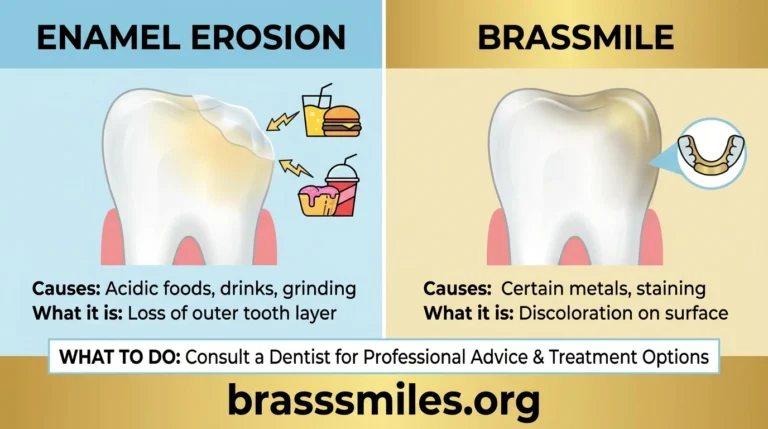
Enamel erosion is a structural condition — the progressive loss of tooth enamel through chemical dissolution by dietary or intrinsic acids, independent of bacteria. Brasssmile is a visual condition — the warm, golden, brassy tooth tone produced by surface staining and the structural exposure of yellow dentin through thinned enamel. Enamel erosion is one of the causes of structural brasssmile, but brasssmile can exist without erosion, and erosion can exist without visible brasssmile if the enamel loss is uniform rather than concentrated where dentin colour change is most visible.
Enamel erosion — also known as dental erosion or erosive tooth wear — is defined clinically as the irreversible loss of dental hard tissue by a chemical process not involving bacteria. This distinguishes it from dental caries (tooth decay, which involves bacterial acid production) and from mechanical wear (attrition and abrasion, which involve physical force). The agents responsible for erosion are acids — either from dietary sources (extrinsic erosion) or from internal sources such as gastric reflux (intrinsic erosion). The acid dissolves the mineral matrix of enamel through a process called demineralisation, progressively thinning the enamel layer.
Brasssmile, as defined across the BrassSmiles.org library, is the warm, golden, brassy tooth tone produced by the combination of surface chromogen staining and — in structural cases — the thinned or eroded enamel that allows the naturally yellow dentin beneath to show through. Brasssmile driven by dietary staining alone (extrinsic brasssmile) can occur with healthy, full-thickness enamel. Brasssmile driven by enamel thinning (structural brasssmile) is directly connected to erosion — because enamel thinning from acid erosion is one of the primary structural causes of brasssmile.
The key diagnostic question: is your brasssmile caused by staining sitting on the tooth surface, or by the tooth structure itself becoming more visible through thinned enamel? The answer determines whether whitening addresses the root cause or only the surface symptom. And if enamel erosion is driving the thinning, stabilising the erosion must come before whitening is appropriate.
Section Summary: Enamel erosion is the irreversible chemical loss of enamel through acid dissolution. Brasssmile is the visual warm tooth tone from surface staining and structural dentin exposure. Erosion is one of the primary structural causes of brasssmile. The relationship is directional: erosion produces structural brasssmile, but brasssmile from surface staining can exist without erosion.
How to Tell Them Apart: Visual Characteristics of Each Condition
Enamel erosion and brasssmile produce different visual patterns that allow them to be distinguished on careful inspection. Enamel erosion produces characteristic structural changes — cupped cusps, flattened occlusal surfaces, incisal edge translucency, and smooth glossy surfaces where surface texture has been dissolved. Brasssmile from surface staining produces warm discolouration without surface texture changes. When both are present, the discolouration sits alongside or over the structural changes — a combination that signals both conditions need addressing.
Visual Signs of Enamel Erosion
Enamel erosion produces several characteristic changes that distinguish it from simple discolouration. On the biting surfaces of back teeth (molars and premolars), erosion creates ‘cupped’ or concave depressions where enamel has dissolved away — dental professionals call these cupping lesions. The normally textured, slightly irregular surface of healthy enamel becomes smooth and glassy as acid dissolves the surface matrix. At the incisal (biting) edges of front teeth, erosion produces a characteristic translucency — the edge appears semi-transparent rather than opaque white, because the enamel has thinned to the point where light passes through it. Over time, the front teeth may appear shorter as incisal edges dissolve.
The colour changes from erosion are also characteristic. As enamel thins at the incisal edges and biting surfaces, the yellow dentin beneath becomes visible — producing a discolouration that has depth and warmth. This is the structural brasssmile that erosion causes. It is most visible at the thinnest parts of the tooth — the incisal edges of front teeth and the cusp tips of back teeth — which creates a characteristic pattern where the teeth look most yellow or brassy at their edges rather than uniformly across the surface.
Visual Signs of Brasssmile Without Erosion
Brasssmile from surface staining alone — without significant enamel erosion — has a different visual profile. The tooth surfaces retain their normal texture and contour. The warm, brassy discolouration is more uniformly distributed across the facial surface rather than concentrated at incisal edges. There is no cupping on occlusal surfaces, no translucency at incisal edges, and no visible shortening of tooth structure. In natural daylight, the colour has warmth but the shape and surface integrity of the teeth is normal. This is the extrinsic form of brasssmile that responds most reliably to whitening treatment.
Visual Characteristics — Enamel Erosion vs Brasssmile
| Visual Feature | Enamel Erosion | Brasssmile (Surface) | Both Present |
| Surface texture | Smooth, glossy, dissolved | Normal tooth texture | Smooth + discoloured |
| Incisal edge | Translucent, thinned | Normal opacity | Translucent + warm colour |
| Colour distribution | Edges and cusps most affected | Uniform facial surface | Edges warmest, uniform warmth |
| Cupping on molars | Characteristic — present | Absent | Present + staining |
| Tooth length | May appear shorter over time | Normal | May be shorter + brassy |
| Surface staining layer | Minimal (acid dissolves it) | Prominent | Variable |
| Responds to whitening | Partially — surface only | Well — surface staining | Requires sequential approach |
Section Summary: The visual differences allow the two conditions to be distinguished on careful inspection. Erosion produces structural changes — cupping, translucency, smooth surface. Surface brasssmile produces discolouration without structural changes. When both are present, the structural changes appear alongside or beneath the discolouration — requiring sequential rather than simultaneous treatment.
The table confirms that enamel erosion and surface brasssmile have distinct visual signatures. The critical overlap scenario is when both are present — where erosion has thinned enamel (structural brasssmile) and dietary staining has accumulated on the remaining surface. In this scenario, whitening can address the surface layer but cannot change the structural contribution from eroded enamel beneath.
The 4 Stages of Enamel Erosion and Their Brasssmile Connection
Enamel erosion progresses through four stages from minimal to severe. Each stage produces a progressively more pronounced structural brasssmile as enamel thinning increases dentin visibility. Understanding which stage applies to you determines the urgency of stabilisation, the appropriate treatment approach, and whether home management or professional intervention is the right starting point.
Stage 1: Minimal Erosion — Early Stage
Visual Signs: Slight gloss or smoothness on enamel surface. No visible cupping. Tooth colour essentially normal or just beginning to show warmth at incisal edges. Surface texture slightly reduced.
Brasssmile Connection: Minimal structural brasssmile contribution at this stage. Brasssmile if present is predominantly from surface staining rather than enamel thinning. Whitening is fully appropriate.
Action: Reduce dietary acid frequency. Use fluoride or hydroxyapatite toothpaste daily. Monitor at dental check-ups. Surface whitening for brasssmile is safe and appropriate at this stage.
Stage 2: Mild Erosion — Early Structural Change
Visual Signs: Cupping visible on occlusal surfaces of one or more teeth. Slight translucency beginning at incisal edges of front teeth. Surface texture noticeably smoother than healthy enamel.
Brasssmile Connection: Structural brasssmile beginning to develop as enamel thins at edges and cusps. Warm tone more visible in natural light. Whitening still appropriate but results may hold less long than for extrinsic-only cases.
Action: Significant dietary acid modification required. Hydroxyapatite or fluoride toothpaste twice daily. Dental assessment recommended to confirm extent and monitor progression. Whitening appropriate with modified protocol.
Stage 3: Moderate Erosion — Visible Dentin Exposure
Visual Signs: Visible dentin exposure at incisal edges and cusp tips. Characteristic yellow-amber colouration at thinned areas. Multiple cupping lesions on posterior teeth. Possible sensitivity.
Brasssmile Connection: Significant structural brasssmile from dentin exposure. Warm tone pronounced, particularly at incisal edges. Whitening addresses surface staining only — structural component requires professional cosmetic consideration.
Action: Professional dental assessment essential. Erosion stabilisation before any cosmetic treatment. Fluoride or hydroxyapatite remineralisation as daily standard. Dietary acid audit and modification. Composite bonding may be appropriate to protect exposed dentin.
Stage 4: Severe Erosion — Significant Structure Loss
Visual Signs: Extensive dentin exposure across multiple surfaces. Visible tooth shortening from incisal edge loss. Surface cupping on most posterior teeth. Significant sensitivity common.
Brasssmile Connection: Severe structural brasssmile driven almost entirely by dentin exposure. The warm brassy colour is the dentin’s natural colour showing through minimal remaining enamel. Standard whitening is inappropriate at this stage.
Action: Immediate dental assessment required. Restorative treatment — composite or ceramic restorations — to protect remaining tooth structure and restore colour. This is beyond the scope of home management alone.
Section Summary: The four erosion stages map directly onto brasssmile severity — as erosion progresses, structural brasssmile increases because more dentin becomes visible through thinning enamel. Stages 1 and 2 are manageable with home care and modified whitening. Stages 3 and 4 require professional dental assessment and intervention before any cosmetic treatment.
Causes They Share: Why Enamel Erosion and Brasssmile Often Appear Together
Enamel erosion and brasssmile share several dietary and lifestyle causes — most notably high-frequency consumption of acidic drinks, a high-tannin diet that combines chromogen staining with acid exposure, gastric reflux which produces intrinsic acid erosion alongside dietary staining, dry mouth which reduces salivary buffering and allows both acid damage and stain accumulation, and overuse of abrasive whitening products which mechanically accelerates surface loss alongside chemical dissolution.
Understanding why the two conditions so frequently coexist requires looking at the overlap between the conditions that cause erosion and the conditions that cause brasssmile. The most significant shared cause is the acidic diet — because acidic foods and drinks both erode enamel (producing structural brasssmile) and create conditions in which chromogen staining penetrates more readily (producing surface brasssmile). The acid softens enamel temporarily, making it more porous and more susceptible to chromogen absorption in the minutes following exposure.
Coffee: Both an Erosion Agent and a Staining Agent
Coffee is simultaneously mildly acidic (pH approximately 5.0) and rich in chromogens — the pigmented compounds that bind to enamel and produce surface discolouration. Its acidity contributes to gradual enamel softening and erosion with high-frequency daily consumption, while its chromogens deposit surface staining on the enamel surface during the same exposure. For someone who drinks three to four cups of coffee daily without rinsing, both conditions develop in parallel — enamel thinning through erosion and brasssmile through surface staining. Treating the surface staining without addressing the acid erosion means the structural brasssmile continues to worsen beneath whatever surface whitening achieves.
GERD and Intrinsic Acid Erosion
Gastroesophageal reflux disease (GERD) and other conditions involving chronic acid exposure from the stomach produce intrinsic erosion — acid damage that originates from within the body rather than from dietary sources. The gastric acid that reaches the oral cavity during reflux has a pH as low as 1.5 to 2.0 — far more erosive than any dietary acid. GERD-related erosion characteristically affects the palatal surfaces of upper front teeth (the side facing the palate) rather than the facial surfaces.
When GERD is a contributing factor to structural brasssmile, it is typically producing erosion from the inside of the tooth in addition to whatever dietary acid is contributing from the outside. Managing brasssmile in a GERD patient requires addressing the reflux condition medically alongside any cosmetic treatment.
Dry Mouth as a Shared Accelerator
Saliva is the mouth’s primary natural defence against both acid erosion and chromogen staining. Saliva buffers dietary acids, raising oral pH back above the erosion threshold, and dilutes and washes away both acids and chromogens from the tooth surface. In people with reduced saliva production — from medication side effects, autoimmune conditions such as Sjögren’s syndrome, or chronic dehydration — both erosion and brasssmile develop faster than in people with normal salivary flow. The same dry mouth that fails to buffer acids and allows enamel dissolution also fails to rinse chromogens and allows staining to deepen more rapidly.
Research published in the Journal of Clinical Dentistry found that salivary buffering capacity is one of the most significant individual-level variables in erosion susceptibility — people with lower salivary buffering showed significantly higher erosion scores at equivalent dietary acid intake. This finding has direct implications for brasssmile management: two people with identical diets may develop structural brasssmile at very different rates based on their salivary function.
Section Summary: The conditions that cause enamel erosion and brasssmile overlap substantially — particularly dietary acid, coffee consumption, GERD, and dry mouth. These shared causes mean the two conditions frequently coexist and worsen in parallel. Addressing shared causes (reducing acid frequency, improving salivary flow, treating GERD if present) benefits both conditions simultaneously.
Treatment Priority: Why Erosion Must Be Stabilised Before Brasssmile Is Treated
When enamel erosion and brasssmile coexist, erosion stabilisation must take priority over brasssmile cosmetic treatment. Applying whitening products to actively eroding enamel accelerates the structural damage that is driving the structural brasssmile — using peroxide on compromised enamel increases porosity and sensitivity without addressing the root cause. The correct sequence is: stabilise erosion, then treat brasssmile com within the parameters of the stabilised enamel condition.
This sequential priority is the most important practical implication of understanding the relationship between enamel erosion and brasssmile. It runs counter to the instinct of someone who notices a brassy, worn smile — the instinct is to whiten it. But whitening an actively eroding enamel is treating the visual consequence of a structural process that is still running. The surface improvement from whitening will be partial, short-lived, and potentially counterproductive if the peroxide further compromises already-vulnerable enamel.
Phase 1: Erosion Stabilisation
Erosion stabilisation focuses on removing or reducing the acid sources that are driving enamel dissolution and supporting the remineralisation processes that can partially compensate for mineral loss. The core interventions are: a dietary acid audit to identify the primary acid sources and reduce their frequency, pH-neutral substitutions where possible (still water instead of sparkling, for example), hydroxyapatite or high-fluoride toothpaste twice daily to support remineralisation, and addressing any intrinsic acid sources such as GERD with medical management. A dental professional can assess erosion severity using the Basic Erosive Wear Examination (BEWE) index and recommend appropriate clinical interventions including fluoride varnish applications.
Phase 2: Modified Brasssmile Treatment Within Stabilised Enamel
Once erosion has been stabilised — typically defined as no measurable progression over two to three dental check-up cycles — brasssmile treatment can begin within the parameters of the remaining enamel condition. For mild to moderate erosion, surface whitening with low-concentration peroxide strips using the modified sensitivity-safe protocol described in Article 13 is appropriate. For moderate to severe erosion where significant structural brasssmile remains from dentin exposure, professional cosmetic options — composite bonding or veneers — are more effective than whitening because they address the visual consequence of dentin exposure directly rather than attempting to lighten enamel that is structurally compromised.
The Remineralisation Bridge
Hydroxyapatite toothpaste plays a critical role in both phases of this sequential approach. During erosion stabilisation, it deposits mineral onto enamel surfaces and supports remineralisation of early erosion lesions. During brasssmile treatment, it provides enamel support between whitening sessions and reduces the sensitivity risk of applying peroxide to eroded enamel. Research published in Dental Materials found that nano-hydroxyapatite demonstrated significant protective effects against acid erosion in enamel specimens — outperforming fluoride alone in reducing acid-induced enamel surface hardness loss in controlled conditions. This positions hydroxyapatite as the most clinically relevant product for the erosion-brasssmile overlap scenario.
Never begin whitening strips, professional whitening, or any peroxide-based treatment while active enamel erosion is progressing. Active erosion means the enamel is being chemically dissolved faster than it can be supported by remineralisation. Adding peroxide to this environment accelerates sensitivity, compromises enamel integrity further, and may convert manageable erosion into a structural problem requiring restorative intervention.
Section Summary: Erosion stabilisation must precede brasssmile treatment when both conditions coexist. The sequence is: dietary acid reduction, hydroxyapatite or fluoride remineralisation, GERD management if relevant — then modified brasssmile whitening within the parameters of stabilised enamel. Treating the brasssmile first worsens the structural condition driving it.
Prevention Strategies That Protect Against Both Erosion and Brasssmile Simultaneously
Because enamel erosion and brasssmile share several common causes and the shared root of enamel integrity, the most impactful prevention strategies address both conditions simultaneously. Reducing dietary acid frequency, rinsing with water after every acid or staining exposure, using hydroxyapatite remineralisation toothpaste daily, stimulating salivary flow, and never brushing immediately after acidic foods or drinks are the five habits that most directly protect against both conditions developing or worsening.
Habit 1: Reduce Dietary Acid Frequency
The number of times per day enamel is exposed to acid matters more than the total volume of acid consumed. Three acidic drinks consumed rapidly in sequence cause less erosion than the same drinks sipped slowly throughout the day — because the extended contact time of slow sipping prevents salivary buffering from restoring pH between exposures. Consolidating acidic drink consumption to mealtimes, when saliva production is elevated, significantly reduces the erosion-driving acid load without eliminating the drinks entirely. This same consolidation also reduces the chromogen exposure time that drives surface brasssmile.
Habit 2: Rinse Immediately After Every Acid or Staining Exposure
Rinsing with plain water immediately after acidic or staining foods and drinks is the single most impactful daily habit for protecting against both erosion and brasssmile simultaneously. Water dilutes and removes the acids before they complete the demineralisation process, and removes chromogens before they bind to the enamel pellicle. For erosion specifically, even a brief water rinse within 30 seconds of finishing an acidic drink meaningfully reduces the subsequent pH drop in the mouth and allows salivary buffering to restore pH more quickly.
Habit 3: Never Brush Immediately After Acid Exposure
This is one of the most important and counterintuitive oral health habits for people dealing with both erosion and brasssmile. After consuming acidic food or drink, enamel is temporarily softened through acid demineralisation. Brushing during this window physically removes softened enamel particles, accelerating both erosion and the structural enamel thinning that drives brasssmile. The correct response to acid exposure is to rinse with water immediately, then wait 30 to 60 minutes before brushing to allow salivary buffering and partial remineralisation to restore enamel hardness.
Habit 4: Stimulate and Support Salivary Flow
Saliva is the most powerful natural protection against both erosion and brasssmile. It buffers acids, remineralises early erosion lesions, dilutes chromogens, and maintains the enamel pellicle that provides the first line of surface protection. Foods and habits that stimulate salivary flow — chewing sugar-free gum, eating crunchy vegetables, drinking water consistently — directly support enamel protection against both conditions. People with chronically low saliva flow should discuss salivary substitutes or stimulants with their dentist.
Habit 5: Use Hydroxyapatite or Fluoride Toothpaste Twice Daily
Daily remineralisation support through hydroxyapatite or fluoride toothpaste provides the enamel repair environment that counters the progressive mineral loss from dietary acid exposure. Hydroxyapatite deposits mineral directly onto enamel surfaces and has demonstrated protective effects against acid erosion in published research. Fluoride promotes remineralisation by creating a more acid-resistant fluorapatite mineral layer on enamel surfaces. Both provide daily maintenance of enamel integrity that directly slows the progression of both erosion and structural brasssmile.
Section Summary: Five prevention habits protect against both enamel erosion and brasssmile simultaneously: reducing dietary acid frequency, rinsing immediately after every acid or staining exposure, waiting 30 minutes before brushing after acid exposure, stimulating salivary flow, and using hydroxyapatite or fluoride toothpaste daily. These are the highest-impact daily habits available for enamel protection.
Experience Perspective: Recognising the Overlap in Real Life
The experience of discovering that what looks like brasssmile is partly caused by enamel erosion — rather than just surface staining — typically arrives when whitening products produce disappointing results on a smile that has a worn, almost glassy appearance alongside the warm tone. That specific combination — glossy surfaces, translucent edges, warm colour deepest at the thinnest parts — is the signature of erosion-driven structural brasssmile, and recognising it changes the entire treatment approach.
People often describe first noticing erosion-related brasssmile not by looking at their teeth but by feeling them. The incisal edge of a front tooth that used to feel crisp now feels slightly thin, almost delicate. Or the biting surface of a back tooth that felt textured now feels smooth and slightly glassy. The colour changes come later — or rather, they were always there, but the person only connects them to the structural changes when they look more carefully.
The discovery that enamel erosion is contributing to brasssmile is often accompanied by a review of dietary habits that produces a moment of recognition. The three glasses of sparkling water per day. The daily lemon in the morning glass of water. The high-frequency coffee consumption. The years of post-dinner red wine sipping over an hour rather than a glass with a meal. None of these habits seemed problematic in isolation. Together, as a pattern of near-continuous acid exposure throughout the day, they created an oral environment in which enamel never fully recovered from one acid exposure before the next one began.
What changes after this recognition is not always dramatic — it is mostly about spacing and timing. The sparkling water consolidated to mealtimes. The morning lemon drunk through a straw and followed immediately by a water rinse. The coffee finished in ten minutes rather than nursed over an hour. The wine with dinner rather than after. None of these changes require significant sacrifice. But they shift the enamel’s acid balance from consistently negative to occasionally negative — which is exactly the difference that allows remineralisation to catch up with demineralisation and stabilise the erosion that was driving the structural brasssmile.
The most useful thing any person with both erosion and brasssmile can do before their next dental appointment is keep a one-week diet diary that records every acid or staining input — not to count calories but to map the frequency of acid exposure throughout the day. That diary, shown to a dentist, communicates more about the erosion risk pattern than any clinical measurement alone and enables genuinely targeted dietary advice.
Section Summary: Erosion-driven brasssmile is often first noticed through feel — smooth, glassy surfaces, thin incisal edges — before the colour pattern is recognised. The discovery typically prompts a dietary review that identifies patterns of near-continuous acid exposure. Modest timing and spacing adjustments to acidic drink consumption produce meaningful erosion stabilisation without significant dietary restriction.
Enamel Erosion vs Brasssmile — Frequently Asked Questions
These FAQs address the most commonly searched questions about the relationship between enamel erosion and brasssmile. Each answer is direct, evidence-based, and structured for AEO and featured snippet targeting.
Is enamel erosion the same as brasssmile?
No — they are related but distinct. Enamel erosion is a structural condition involving progressive chemical loss of tooth enamel through acid dissolution. Brasssmile is a visual condition describing the warm, golden tooth tone produced by surface staining and, in structural cases, by the dentin becoming visible through thinned enamel. Erosion is one of the causes of structural brasssmile, but brasssmile from surface staining can exist without significant erosion, and mild erosion can exist before visible brasssmile has developed.
Can whitening strips fix brasssmile caused by enamel erosion?
Partially. Whitening strips address the surface staining component of erosion-related brasssmile by breaking down the chromogen deposits on the enamel surface. However, they cannot restore eroded enamel or change the colour of dentin that is now visible through thinned enamel. For mild erosion, whitening produces meaningful improvement. For moderate to severe erosion where significant structural brasssmile is present, composite bonding or veneers are more effective because they address the visual consequence of dentin exposure directly. Whitening should not be used on actively eroding enamel — erosion stabilisation must come first.
What does enamel erosion look like compared to brasssmile?
Enamel erosion produces structural visual changes: smooth, glassy tooth surfaces where normal texture has dissolved; cupped or concave depressions on the biting surfaces of back teeth; translucency at the incisal edges of front teeth; and possible shortening of front tooth edges over years of progression. Brasssmile from surface staining appears as warm, golden discolouration without these structural changes — normal surface texture with a different colour. When both are present, the discolouration accompanies or overlies the structural changes, most visibly at the incisal edges where enamel is thinnest.
Can I reverse enamel erosion and fix the brasssmile it causes?
Enamel erosion is irreversible in the sense that dissolved enamel cannot regenerate. However, early erosion can be stabilised through dietary modification and remineralisation support, preventing further progression. Hydroxyapatite toothpaste can deposit mineral onto enamel surfaces and partially compensate for early mineral loss. The brasssmile caused by the erosion can be managed — surface staining through whitening where enamel is stable enough, and dentin exposure through composite bonding or veneers for more significant structural cases. The goal is stabilisation and management, not full reversal.
How do I know if I need to see a dentist for enamel erosion and brasssmile?
Professional dental assessment is warranted if you notice visible cupping on your back teeth, translucency at your front tooth edges, increasing sensitivity alongside worsening brasssmile, visible shortening of front teeth over time, or if your brasssmile appears to be driven by the incisal edge and cusp area rather than uniformly across tooth surfaces. A dentist can use the BEWE (Basic Erosive Wear Examination) index to assess erosion severity, provide targeted dietary advice, apply fluoride varnish as professional remineralisation support, and recommend the appropriate cosmetic treatment for the brasssmile pattern your specific erosion stage produce.
The Right Sequence: Stabilise First, Treat Second, Maintain Always
Managing enamel erosion and brasssmile together requires the right sequence: stabilise the erosion through dietary modification and remineralisation support, then treat the brasssmile within the parameters of the stabilised enamel condition, then maintain both through daily protective habits. This sequence produces durable outcomes. Reversing it — treating the brasssmile first while erosion continues — produces temporary cosmetic improvement over a structural problem that keeps worsening.
Enamel erosion and brasssmile are two of the most common dental concerns that appear together, worsen together, and improve together when the underlying shared cause — enamel integrity — is addressed. The dietary habits, remineralisation practices, and modified whitening protocols that protect enamel from acid dissolution are the same habits that slow and manage brasssmile from structural dentin exposure. Managing them as a connected pair produces better results than treating each in isolation.
BrassSmiles.org covers the full landscape of brasssmile causes, treatment options, and lifestyle management across the complete article library. The foods that drive both erosion and brasssmile are covered in detail in our Foods guide. The products that support enamel remineralisation alongside brasssmile management are reviewed in our Best Products guide. The sensitivity connection explored in Article 13 of this series extends the picture of how enamel health connects multiple dental concerns that are better addressed together than separately.
