
A small uneven edge, a slightly long tooth, a pointed canine, or a tiny chip can change how your entire smile looks. For many people in Wyomissing, Reading, West Reading, and nearby Berks County areas, enameloplasty is one of the simplest ways to smooth and refine the shape of teeth without committing to veneers, crowns, or a full smile makeover.
Enameloplasty, also called tooth reshaping, odontoplasty, dental contouring, or enamel recontouring, is a cosmetic dental procedure where a dentist removes a very small amount of tooth enamel to improve tooth shape, length, edge smoothness, or smile symmetry. Some people search for this treatment as “enamelplasty Wyomissing,” but the correct dental term is enameloplasty.
The key thing to understand is this: enameloplasty is best for minor cosmetic adjustments, not major tooth damage or dramatic smile changes. It can smooth a rough edge, soften a sharp point, even out small irregularities, or improve the appearance of a slightly chipped tooth. But because enamel does not grow back after it is removed, the procedure should always be conservative and performed by a qualified dentist. Cleveland Clinic describes enameloplasty as a cosmetic treatment where a dentist removes small amounts of enamel to change the size, shape, or appearance of a tooth, and it warns that teeth filing should not be attempted at home.
Quick Answer: What Is Enameloplasty?
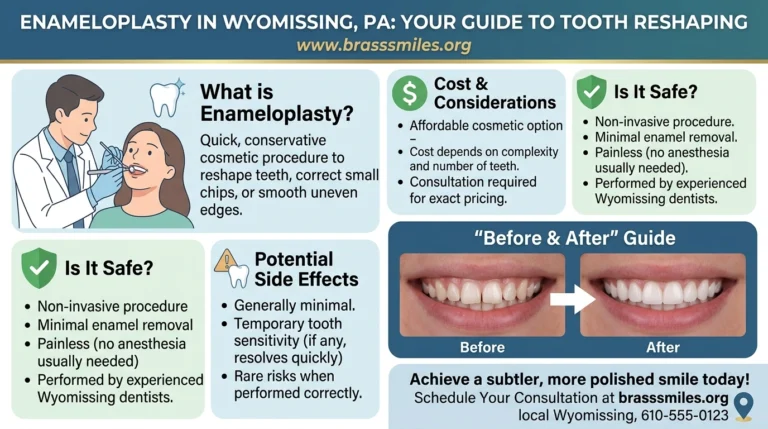
Enameloplasty is a conservative cosmetic dental procedure that reshapes teeth by removing tiny amounts of enamel from the outer surface. It is commonly used for uneven teeth, small chips, rough edges, slightly long teeth, and pointed canines. In many cases, it can be completed in one visit with little to no recovery time.
Enameloplasty may also be called:
- Tooth reshaping
- Odontoplasty
- Dental contouring
- Enamel shaping
- Teeth filing
- Tooth contouring
- Enamel recontouring
The procedure is usually faster and less invasive than veneers or crowns, but it is also more limited. It cannot whiten teeth, close large gaps, fix major cracks, replace missing enamel, or correct serious bite problems.
What Problems Can Enameloplasty Fix?
Enameloplasty is designed for small cosmetic imperfections. It works best when the tooth is healthy, the enamel is thick enough, and the change needed is very minor.
| Concern | Can enameloplasty help? | Notes |
|---|---|---|
| Small chip on front tooth | Yes | Best for shallow edge chips |
| Rough or sharp tooth edge | Yes | Common reason for tooth reshaping |
| Slightly uneven front teeth | Yes | Can improve smile symmetry |
| Pointed canine teeth | Yes | Can soften the appearance |
| Tooth looks slightly too long | Sometimes | Only if a tiny amount needs reduction |
| Large crack | No | May need bonding, crown, or veneer |
| Deep cavity | No | Needs restorative dental care |
| Major discoloration | No | Whitening, bonding, or veneers may work better |
| Crooked teeth | No | Braces or aligners may be needed |
| Enamel hypoplasia | Usually no | May need fluoride, bonding, sealants, veneers, or crowns |
A good way to think about enameloplasty is that it is a fine-tuning treatment. It is not meant to rebuild a tooth. It is meant to polish, smooth, and balance small irregularities.
Enameloplasty Cost in Wyomissing and the USA
The average enameloplasty cost in the United States is commonly estimated at around $50 to $300 per tooth, depending on the tooth, the amount of reshaping needed, the dental office, and whether the treatment is combined with bonding, whitening, braces, or veneers. Colgate’s cost guide states that teeth reshaping or contouring typically ranges from $50 to $300 per tooth before insurance, while CareCredit’s 2024 cost study places the national average for teeth contouring at $215, with a range of $142 to $435 per tooth.
For someone searching “enameloplasty cost near me” or “tooth reshaping cost in Wyomissing,” the final price can vary based on several factors:
| Cost factor | How it affects price |
|---|---|
| Number of teeth treated | More teeth usually means a higher total cost |
| Amount of reshaping needed | Minor smoothing costs less than detailed contouring |
| X-rays or exam fees | Some offices charge separately |
| Dentist experience | Cosmetic-focused providers may charge more |
| Location | Local market pricing affects cost |
| Combined treatments | Bonding, whitening, or veneers increase total cost |
| Insurance coverage | Cosmetic cases are often not covered |
If enameloplasty is done only for appearance, insurance may not cover it. If it is related to trauma, an accident, or a functional dental issue, partial coverage may be possible depending on the plan and documentation.
Is Enameloplasty Covered by Insurance?
Enameloplasty is often considered cosmetic, so many dental insurance plans do not cover it when it is done only to improve appearance. However, there may be exceptions if the reshaping is medically necessary, related to trauma, or needed to correct a tooth edge that is damaging the bite, tongue, cheek, or another tooth.
The dental billing code often associated with odontoplasty is D9971, which refers to odontoplasty for 1–2 teeth, including the removal of enamel projections. AAPD documentation notes that D9971 is reported once for adjusting up to two teeth and that dental plans may deny it as cosmetic, though some carriers may pay in certain trauma or accident-related situations.
Before scheduling enameloplasty in Wyomissing or nearby areas, ask the dental office these questions:
- What is the cost per tooth?
- Is the exam included?
- Are X-rays included?
- Will the procedure be billed under D9971?
- Is this considered cosmetic or medically necessary?
- Can the office provide a pre-treatment estimate?
- Will bonding or polishing cost extra?
Enameloplasty Procedure: Step-by-Step
Enameloplasty is usually a simple dental visit, but it should still be planned carefully. The dentist needs to make sure the tooth has enough enamel, the bite is safe, and the cosmetic change will not weaken the tooth.
1. Dental Exam
The dentist first examines your teeth, enamel thickness, bite alignment, tooth edges, and overall oral health. If the tooth has decay, a deep crack, severe enamel loss, or gum disease, enameloplasty may not be the right first treatment.
2. X-Rays or Digital Scan
Some dentists may take X-rays or use digital imaging to check tooth structure. This helps confirm that reshaping will not expose sensitive dentin or create bite problems.
3. Tooth Marking and Planning
The dentist may mark the areas that need smoothing or reshaping. This step is especially important for front teeth because even a tiny change can affect smile symmetry.
4. Enamel Reshaping
The dentist uses a fine dental instrument such as a burr, dental drill, sanding disc, or abrasive strip to remove a very small amount of enamel. The goal is to smooth or reshape the tooth without over-contouring it.
5. Bite Check
After reshaping, the dentist checks how your upper and lower teeth meet. This matters because an uneven bite can create pressure, sensitivity, or tooth wear.
6. Polishing
The tooth is polished so the surface feels smooth. Polishing also helps remove roughness that could attract plaque.
Most enameloplasty appointments are completed in one visit. Because enamel does not contain nerves, the procedure is often painless and may not require anesthesia. However, people with sensitivity, anxiety, thin enamel, or more complex cases should discuss comfort options with their dentist.
Is Enameloplasty Safe for Teeth?
Enameloplasty is generally safe when performed conservatively by a dentist on healthy teeth. The safety depends on how much enamel is removed, where it is removed, and whether the tooth already has thin enamel, decay, cracks, or bite stress.
The main safety concern is that enamel does not regenerate. Cleveland Clinic’s tooth enamel resource explains that enamel protects the inner layers of the tooth and does not grow back once it is gone. Damaged or lost enamel can make teeth more vulnerable to sensitivity, cavities, and other problems.
Enameloplasty is safer when:
- Only a tiny amount of enamel is removed
- The tooth is healthy
- The enamel is thick enough
- The bite is checked afterward
- The dentist avoids over-shaping
- The procedure is not done at home
Enameloplasty may not be safe or appropriate if you have:
- Thin enamel
- Active cavities
- Gum disease
- Severe tooth sensitivity
- Deep cracks
- Large chips
- Enamel hypoplasia
- Significant tooth wear from grinding
- Untreated bite problems
Enameloplasty Side Effects
Most people have little to no recovery after enameloplasty, but side effects are possible. The risk increases if too much enamel is removed or if the tooth was already weak.
| Possible side effect | Why it happens | What to do |
|---|---|---|
| Temporary sensitivity | Enamel surface was adjusted | Use sensitivity toothpaste and ask your dentist |
| Rough feeling | Surface may need extra polishing | Return for smoothing |
| Bite discomfort | Tooth contact changed | Dentist may need to adjust bite |
| Increased sensitivity | Too much enamel removed | Needs dental evaluation |
| Higher decay risk | Thin enamel protects less effectively | Fluoride and regular checkups help |
| Cosmetic dissatisfaction | Too much or uneven reshaping | May need bonding or veneers |
Cleveland Clinic notes that removing too much enamel can increase the risk of tooth sensitivity, tooth decay, cracking, and infection, which is why professional planning matters.
Why You Should Never File Your Teeth at Home
DIY tooth filing is dangerous. Even if a tooth only looks slightly uneven, trying to fix it with a nail file, emery board, metal tool, or online dental kit can permanently damage enamel.
At-home filing can cause:
- Permanent enamel loss
- Tooth sensitivity
- Rough tooth surfaces
- Cracks
- Uneven bite pressure
- Higher cavity risk
- Exposed dentin
- Need for bonding, veneers, or crowns
Cleveland Clinic specifically warns that you should never attempt teeth filing on your own.
Enameloplasty Before and After: What Results Can You Expect?
Enameloplasty before and after results are usually subtle but noticeable. The goal is not to create a completely new smile. The goal is to make small improvements that help the teeth look smoother, more balanced, and more natural.
Good before-and-after results may include:
- A chipped front edge looks smoother
- A pointed canine looks softer
- Uneven front teeth look more balanced
- A rough edge no longer catches the tongue
- A tooth that looked slightly too long blends better
- Smile symmetry improves without veneers
Enameloplasty cannot create:
- A whiter tooth shade
- A full smile makeover
- Major straightening
- Large gap closure
- Replacement for missing enamel
- Repair for deep cracks
- Dramatic shape changes
For bigger cosmetic concerns, a dentist may recommend composite bonding, porcelain veneers, clear aligners, crowns, or teeth whitening instead.
Enameloplasty vs Veneers vs Bonding
Many people searching for enameloplasty near me are also comparing it with veneers and bonding. The right option depends on how much change you want.
| Treatment | Best for | Enamel removal | Reversible? | Typical cost level | Visit time |
|---|---|---|---|---|---|
| Enameloplasty | Minor chips, rough edges, slight unevenness | Very small amount | No | Lower | Often one visit |
| Dental bonding | Chips, gaps, shape changes, small repairs | Minimal or none in some cases | Repairable | Medium | Often one visit |
| Veneers | Bigger color, shape, and symmetry changes | Usually more enamel removal | Usually no | Higher | Multiple visits |
| Crowns | Weak, broken, heavily damaged teeth | Significant tooth reduction | No | Higher | Multiple visits |
| Whitening | Stains and yellowing | No enamel reshaping | Yes | Lower to medium | Varies |
Is enameloplasty better than veneers?
Enameloplasty is better than veneers only when the problem is minor. If your tooth just needs smoothing or slight reshaping, enameloplasty may be faster, less invasive, and more affordable. If you want to change tooth color, hide deep stains, cover large chips, close gaps, or redesign several teeth, veneers may be more effective.
Verywell Health notes that veneers are generally cosmetic and often not covered by insurance, while porcelain veneers tend to require more enamel removal than other veneer types.
Enameloplasty Code: What Is D9971?
The common enameloplasty code or odontoplasty code is D9971. This code refers to odontoplasty for 1–2 teeth, including removal of enamel projections. If more than two teeth are treated, the code may be reported more than once depending on the case and billing rules.
This matters because many people search for:
- enameloplasty code
- odontoplasty code
- D9971 dental code
- enameloplasty insurance coverage
- tooth reshaping insurance
However, a code does not guarantee coverage. Insurance companies may still classify enameloplasty as cosmetic unless there is a functional or trauma-related reason. The AAPD document explains that dental plans may deny D9971 as cosmetic but may pay in some trauma or accident-related situations.
Enameloplasty and Enamel Hypoplasia: Are They the Same?
No. Enameloplasty and enamel hypoplasia are different.
Enameloplasty is a cosmetic procedure that removes a small amount of enamel to reshape a tooth.
Enamel hypoplasia is a developmental enamel condition where there is not enough enamel or the enamel did not form properly. Cleveland Clinic explains that enamel hypoplasia can make teeth more vulnerable to cavities, erosion, and other issues, and treatment focuses on protecting teeth and improving appearance.
| Term | Meaning |
|---|---|
| Enameloplasty | A dental procedure that reshapes enamel |
| Enamel hypoplasia | A condition where enamel is underdeveloped |
| Odontoplasty | Another term for tooth reshaping |
| Dental contouring | Cosmetic smoothing or reshaping |
| Tooth enamel | Protective outer layer of the tooth |
Is enamel hypoplasia serious?
It can be. Mild enamel hypoplasia may only cause white spots, grooves, or cosmetic changes. More serious cases can increase the risk of tooth sensitivity, tooth decay, enamel breakdown, and tooth wear.
Can enamel hypoplasia be reversed?
The missing enamel itself cannot naturally grow back. Treatment usually focuses on protecting the tooth with fluoride, sealants, bonding, veneers, or crowns depending on severity.
What is the best toothpaste for enamel hypoplasia?
A fluoride toothpaste is usually recommended for enamel protection. The ADA states that toothpastes with a cavity protection claim and the ADA Seal of Acceptance must contain fluoride, and fluoride toothpaste helps support cavity prevention.
People with sensitivity may also benefit from a sensitivity toothpaste, but a dentist should recommend the best option based on enamel condition, age, cavity risk, and sensitivity level.
Aftercare: How to Protect Teeth After Enameloplasty
After enameloplasty, most people can return to normal activities right away. Still, aftercare matters because the reshaped enamel surface should be protected from unnecessary wear, acid, and plaque.
Follow these aftercare tips:
- Brush twice daily with fluoride toothpaste.
- Floss once daily.
- Avoid biting nails, pens, ice, or hard objects.
- Do not use teeth as tools.
- Limit highly acidic drinks if you have sensitivity.
- Wear a nightguard if you grind your teeth.
- Visit your dentist for regular checkups.
- Report lingering sensitivity or bite discomfort.
The ADA recommends brushing twice a day for two minutes with fluoride toothpaste, which supports daily cavity and gum disease prevention.
Who Is a Good Candidate for Enameloplasty?
You may be a good candidate for enameloplasty if:
- Your teeth are healthy
- You have minor cosmetic concerns
- Your enamel is thick enough
- You have a small chip or uneven edge
- You want a subtle change
- You do not need major straightening
- Your bite is stable
- You understand the change is permanent
You may not be a good candidate if:
- You have active tooth decay
- Your enamel is thin
- You have severe sensitivity
- You grind your teeth heavily
- You have large cracks or fractures
- You want dramatic cosmetic changes
- You have untreated gum disease
- You have enamel hypoplasia that requires protection rather than reshaping
Questions to Ask a Wyomissing Dentist Before Enameloplasty
Before booking enameloplasty in Wyomissing, ask:
- Am I a good candidate for tooth reshaping?
- How much enamel would need to be removed?
- Is my enamel thick enough?
- Will this affect my bite?
- What will the final shape look like?
- Is bonding a better option?
- Is enameloplasty better than veneers for my case?
- What is the cost per tooth?
- Will this be billed as D9971?
- Is there any chance insurance may cover it?
- What side effects should I expect?
- Can I see enameloplasty before and after examples?
These questions help protect you from over-treatment and make the consultation more useful.
FAQ About Enameloplasty in Wyomissing
How expensive is enameloplasty?
In the United States, enameloplasty commonly costs around u003cstrongu003e$50 to $300 per toothu003c/strongu003e, though some cost studies show a wider range depending on location and complexity. The final enameloplasty cost near you depends on the number of teeth treated, whether X-rays are needed, and whether bonding or polishing is included.
Is enameloplasty better than veneers?
u003cbru003eEnameloplasty is better for small changes, such as smoothing a chip or evening a tooth edge. Veneers are better for larger cosmetic changes involving color, size, shape, or multiple front teeth. Veneers usually cost more and often require more enamel removal.
What is the 2-2-2 rule for teeth?
The 2-2-2 rule usually means brushing u003cstrongu003etwo times per dayu003c/strongu003e, for u003cstrongu003etwo minutes each timeu003c/strongu003e, and visiting the dentist u003cstrongu003etwo times per yearu003c/strongu003e. The ADA specifically recommends brushing twice daily for two minutes with fluoride toothpaste.
Is enameloplasty safe for teeth?
Yes, enameloplasty is generally safe when done conservatively by a dentist on healthy teeth. It becomes risky if too much enamel is removed, if the tooth already has thin enamel, or if someone tries to file teeth at home.
What does enameloplasty mean?
Enameloplasty means reshaping a tooth by removing a small amount of enamel. It is also called tooth reshaping, odontoplasty, dental contouring, enamel shaping, or tooth contouring.
Can enameloplasty be reversed?
No. Enameloplasty cannot truly be reversed because enamel does not grow back. If too much is removed or the result needs correction, a dentist may use bonding, veneers, or another restoration.
What are enameloplasty side effects?
u003cbru003ePossible enameloplasty side effects include temporary sensitivity, roughness, bite discomfort, increased sensitivity, or higher decay risk if too much enamel is removed. Most side effects are mild when the procedure is conservative.
Does enameloplasty hurt?
Usually, enameloplasty does not hurt because enamel has no nerves. Many cases do not require anesthesia. However, patients with sensitivity or anxiety should discuss comfort options with their dentist.
How long does enameloplasty take?
Many enameloplasty appointments take less than an hour, depending on the number of teeth being reshaped and whether polishing, X-rays, or bonding are included.
Can enameloplasty fix crooked teeth?
No. Enameloplasty can make very small shape adjustments, but it cannot properly straighten crooked teeth. Braces or clear aligners are usually better for tooth alignment.
Is enameloplasty the same as tooth reshaping?
Yes. Enameloplasty, tooth reshaping, odontoplasty, dental contouring, and enamel recontouring are often used to describe the same or very similar procedures.
Can enameloplasty be done after braces or Invisalign?
Yes, in some cases. Dentists may use enameloplasty after orthodontic treatment to refine uneven edges or improve smile symmetry. The dentist should check enamel thickness and bite before reshaping.
What is the best toothpaste for enamel hypoplasia?
A fluoride toothpaste is often recommended to help protect enamel and reduce cavity risk. If sensitivity is present, a dentist may suggest sensitivity toothpaste or professional fluoride treatment. The right choice depends on the severity of enamel hypoplasia.
Is enamel hypoplasia serious?
It can be serious if the enamel is very thin or weak. Enamel hypoplasia can increase the risk of cavities, tooth erosion, sensitivity, and enamel breakdown. Mild cases may need monitoring and fluoride, while more severe cases may need bonding, sealants, veneers, or crowns.
Final Verdict: Is Enameloplasty Worth It?
Enameloplasty can be worth it if you want a small, natural-looking improvement to tooth shape without veneers, crowns, or a major cosmetic treatment. It is usually best for minor chips, rough edges, slightly uneven teeth, and pointed canines.
But it is not the right choice for every smile. Because enamel does not grow back, the procedure should be done carefully and only after a dentist checks your enamel thickness, bite, and overall tooth health.
For people in Wyomissing researching tooth reshaping, the smartest next step is not to ask only, “How much does enameloplasty cost?” The better question is:
“Can my tooth be safely reshaped without weakening the enamel or creating sensitivity?”
If the answer is yes, enameloplasty may be a fast, conservative, and affordable way to refine your smile. If the answer is no, dental bonding, veneers, whitening, orthodontics, or restorative treatment may be safer and more effective.
Now, let’s shift gears and talk about how to spend your evening. If you’re looking for a way to unwind after a day of focusing on your smile, consider exploring the world of online gaming. At games-eshop.com, you’ll find a variety of slots and casino games that provide a perfect blend of relaxation and excitement. It’s a great way to end your day on a high note.
