

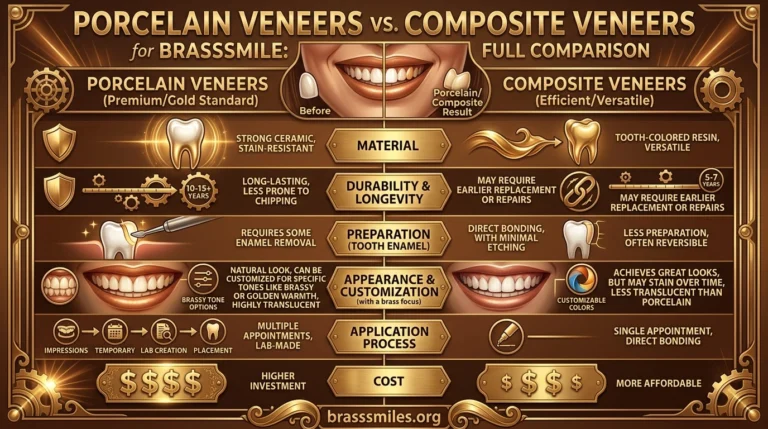
At some point in the brasssmile journey, the question shifts from products to procedures. Whitening strips have done their work. Toothpaste routines are established. Blue covarine handles the daily tonal management. And yet the settled baseline — the way the smile looks on an ordinary Tuesday in natural light, in a photograph, in a confident moment — is still not what it could be. The structural warmth from thinned enamel or dentin exposure persists beneath whatever surface improvement the products deliver.
That is the moment when veneers enter the conversation. And almost immediately, a second question follows the first: porcelain or composite? Both are veneer options. Both cover the tooth surface and mask brasssmile. Both are placed by cosmetic dentists. But they are manufactured from different materials, through different processes, with different longevity profiles, different cost structures, and different implications for the teeth beneath them. Choosing between them without understanding those differences is how people make a £3,000 to £9,000 decision based on incomplete information.
This guide provides the complete, honest comparison — built on published dental research, clinical practice realities, and the specific characteristics of brasssmile com as a condition. By the end, you will understand exactly what each option delivers, which one suits which type of brasssmile, and how to approach the decision with the confidence of someone who has done the work rather than someone following a sales recommendation.
What Veneers Actually Do for Brasssmile — The Mechanism That Makes Them Definitive
Veneers address brasssmile through a fundamentally different mechanism than whitening products. Where whitening removes and lightens existing staining, veneers physically cover the tooth surface with a custom-shaded material — rendering the underlying brasssmile invisible regardless of its cause or severity. This makes veneers the only cosmetic option that definitively resolves structural brasssmile driven by enamel thinning and dentin exposure, not just the surface staining component.
Understanding why veneers represent a different category of brasssmile solution — not just a more expensive version of the same approach — requires understanding what makes structural brasssmile resistant to whitening. When enamel thins through ageing, acid erosion, or genetic predisposition, it becomes more translucent. More translucent enamel allows more of the naturally yellow dentin beneath to show through. Peroxide whitening can lighten surface chromogens and even penetrate enamel to bleach some deeper staining, but it cannot change the fundamental colour of dentin or restore enamel thickness. The structural warmth from thinned enamel is permanent — and veneers are permanent in response to it.
A veneer — whether porcelain or composite — creates a new facial surface for the tooth. The brasssmile that existed beneath the veneer still exists, but it is now covered by a precisely shaded, custom-fabricated layer that the patient and dentist have chosen together. The veneer’s colour is not affected by dietary staining (particularly for porcelain), not subject to the enamel rehydration rebound that limits whitening results, and not dependent on the underlying tooth’s dentin colour. It simply covers it.
This is why veneers are described as a definitive solution for brasssmile rather than a treatment — they do not resolve the condition’s cause, but they permanently address its visual consequence. For many people with structural brasssmile that has not responded adequately to whitening, that distinction is not a limitation. It is the point.
Section Summary: Veneers work by covering the tooth surface with a custom-shaded material, making brasssmile invisible regardless of its cause. Unlike whitening which addresses staining, veneers address the visual consequence of structural enamel thinning permanently. This makes them the definitive option when whitening alone has reached its limit.
Porcelain Veneers for Brasssmile: Material, Process and What to Expect
Porcelain veneers for brasssmile are custom-fabricated ceramic shells manufactured in a dental laboratory from a digital scan or physical impression of the prepared teeth. They are permanently bonded to teeth from which a small amount of enamel has been removed and last 10 to 20 years with proper care. They are highly stain-resistant, mimic natural enamel’s light-reflecting properties precisely, and represent the gold standard for definitive structural brasssmile correction.
The Material: Why Porcelain Performs as It Does
Dental porcelain — more precisely, lithium disilicate or feldspathic ceramic in most contemporary veneer applications — is chosen for two specific properties that make it ideal for brasssmile correction. First, its translucency closely mimics that of natural tooth enamel. Where composite resin appears slightly more opaque, high-quality dental ceramic has a depth and light-reflecting quality that makes it indistinguishable from natural teeth under most lighting conditions, including the natural daylight where brasssmile is most visible. Second, the glazed surface of fired porcelain is highly resistant to chromogen staining — the same tannins and chromogens from coffee, tea, and wine that deposit on natural enamel find minimal purchase on the smooth, dense ceramic surface.
The Process: What Happens at Each Appointment
A typical porcelain veneer process for brasssmile involves two to three appointments over two to four weeks. At the first appointment, the dentist conducts shade selection — using the VITA shade guide alongside digital imaging in some practices — and prepares the tooth surface by removing 0.3 to 0.5mm of enamel from the facial aspect. This enamel removal is the irreversible step that makes the veneer commitment permanent: once this preparation is complete, the tooth requires a veneer or other restoration for life. Impressions or digital scans are taken and sent to a dental laboratory where the porcelain shells are custom-fabricated. Temporary veneers are placed to protect the prepared teeth.
At the second appointment — typically two to three weeks later — the completed porcelain veneers are tried in for fit, colour, and shape before permanent bonding. The dentist uses a resin cement matched to the veneer shade, etches the prepared enamel surface to enhance adhesion, applies a bonding agent, and seats the veneer under controlled conditions. Each veneer is light-cured to harden the cement. The result is immediately visible — and for most brasssmile patients, immediately transformative.
Longevity: What the Research Shows
Published research on porcelain veneer survival rates is among the most robust in cosmetic dentistry. A study published in the Journal of Prosthodontics reported survival rates exceeding 90% at ten years for porcelain veneers placed by experienced cosmetic dentists. Longevity is primarily influenced by the patient’s bite, the presence of bruxism, oral hygiene practices, and whether a protective night guard is worn if clenching is identified. With proper care, porcelain veneers routinely last 15 to 20 years before requiring replacement.
Section Summary: Porcelain veneers involve a two-to-three-appointment process including irreversible enamel preparation, laboratory fabrication, and permanent bonding. Research confirms 90%+ survival at ten years. Their ceramic material closely mimics natural enamel’s light properties and resists staining — making them the most durable and aesthetically precise option for brasssmile.
Composite Veneers for Brasssmile: Direct, Indirect and What to Expect
Composite veneers apply tooth-coloured resin material to the tooth surface — either built up directly by the dentist in a single appointment or fabricated as thin shells in a lab and bonded in a second appointment. They cost 50 to 70 percent less than porcelain, typically require minimal enamel preparation, and are reversible in most cases. They last five to eight years before needing replacement or refinishing and are the most practical entry point for professional brasssmile correction.
Direct vs Indirect Composite Veneers
Composite veneers come in two formats with meaningfully different outcomes. Direct composite veneers are built up on the tooth surface in the dental chair by the dentist — layer by layer — using a resin material matched to the desired shade. The result depends significantly on the dentist’s artistry and experience with composite layering technique. A highly skilled cosmetic dentist can produce results indistinguishable from porcelain in natural lighting; a less experienced practitioner may produce results that look slightly opaque or flat. Direct veneers are completed in a single appointment.
Indirect composite veneers are fabricated outside the mouth — either in a dental laboratory or using CAD/CAM technology — from digital impressions or physical moulds. The fabricated shells are then bonded to the prepared tooth surface at a second appointment, similar to the porcelain process. The external fabrication produces a better marginal fit, a more refined surface finish, and a more consistent shade than most direct applications can achieve. Indirect composites represent the higher end of the composite veneer category and produce results closer to porcelain in quality, while still remaining more affordable and reversible.
Enamel Preparation: Less Is Removed
One of composite veneers’ most significant practical advantages over porcelain for brasssmile patients is the amount of enamel preparation required. Porcelain veneers typically require 0.3 to 0.5mm of enamel removal to accommodate the thickness of the ceramic shell. Many composite veneer applications — particularly direct veneers — require little to no enamel preparation at all, with the composite applied directly over existing enamel. This means composite veneers are reversible in most cases: the composite can be removed without having permanently altered the underlying tooth structure. For brasssmile patients who want to trial a colour before committing to irreversible porcelain preparation, this reversibility is a significant advantage.
Longevity and Stain Resistance: The Trade-offs
Composite resin does not have the surface hardness or density of dental ceramic. It is more susceptible to surface staining from coffee, tea, and wine than porcelain — gradually taking on a yellower or brassier appearance over years of use that mirrors the original brasssmile it was applied to correct. Regular professional polishing can restore surface brightness, and minor chips or surface wear can be repaired by adding more composite — unlike porcelain, which must be replaced entirely if damaged. The typical lifespan of composite veneers is five to eight years before replacement is needed, though this varies significantly with the patient’s dietary habits, oral hygiene, and bite characteristics.
A clinical review in the International Journal of Esthetic Dentistry confirmed that composite veneers showed a higher incidence of discolouration and surface degradation over time compared to ceramic veneers — but also highlighted that their reparability, reversibility, and cost accessibility make them a clinically appropriate choice for a significant proportion of patients, particularly those with moderate brasssmile seeking professional correction within a constrained budget.
Section Summary: Composite veneers offer single-appointment correction with minimal enamel removal and full reversibility. Direct composite depends on dentist artistry; indirect composite (lab-fabricated) produces higher precision. At 50–70% less than porcelain and lasting five to eight years, they are the most accessible professional brasssmile correction option.
Porcelain Veneers vs Composite Veneers for Brasssmile: Side-by-Side Comparison
Across the key decision criteria — aesthetics, longevity, stain resistance, cost, reversibility, and process — porcelain and composite veneers each have clear areas of superiority. Porcelain wins on longevity, stain resistance, and aesthetic precision. Composite wins on cost, reversibility, and accessibility. Neither is universally better — the right choice depends entirely on the patient’s specific brasssmile severity, budget, and how long they want the result to last.
| Porcelain Veneers • Custom ceramic — mimics natural enamel translucency • Highly stain-resistant glazed surface • Longevity: 10–20 years with proper care • Two to three appointments over 2–4 weeks • Irreversible — 0.3–0.5mm enamel permanently removed • Fabricated in dental laboratory • Cost: £600–£1,500 per tooth (UK) • Cannot be repaired — must be replaced if damaged • Most precise shade matching and aesthetics • Best for severe or permanent structural brasssmile | Composite Veneers • Composite resin — slightly more opaque than ceramic • More susceptible to staining over 3–5 years • Longevity: 5–8 years before replacement needed • Direct: single appointment. Indirect: two appointments • Mostly reversible — minimal or no enamel removed • Direct: chairside. Indirect: lab or CAD/CAM • Cost: £300–£700 per tooth (UK) • Repairable — chips and wear can be added to • Good aesthetics, skill-dependent for direct veneers • Best for moderate brasssmile or budget-conscious patients |
Section Summary: The side-by-side confirms porcelain’s advantage on durability and stain resistance, composite’s advantage on cost and reversibility. For brasssmile patients, the choice is not about which is better in absolute terms but which is most appropriate given the severity of the condition, available budget, and desired longevity.
The Complete Decision Table: Every Criteria That Matters for Brasssmile
The table below maps twelve decision-relevant criteria across both veneer types to give brasssmile patients a single comprehensive reference before their consultation. Cost-per-year calculations are included to show the genuine long-term value comparison that unit cost alone obscures.
Porcelain vs Composite Veneers — Full Decision Reference for Brasssmile
| Criterion | Porcelain Veneers | Composite Veneers |
| Material | Lithium disilicate or feldspathic ceramic | Composite resin (direct or indirect) |
| Aesthetic Quality | mimics enamel translucency | good, skill-dependent |
| Stain Resistance | highly resistant | moderate, polishable |
| Longevity | 10–20 years | 5–8 years |
| Cost Per Tooth (UK) | £600–£1,500 | £300–£700 |
| Cost Per Year (avg) | £50–£100/year | £50–£110/year |
| Enamel Removal | 0.3–0.5mm — irreversible | Minimal to none — mostly reversible |
| Reversibility | No — permanent commitment | Yes (most cases) |
| Repairability | No — full replacement needed | Yes — repairable in chair |
| Number of Appointments | 2–3 over 2–4 weeks | 1 (direct) or 2 (indirect) |
| Fabrication Method | Dental laboratory | Chairside or lab/CAD-CAM |
| Best Brasssmile Type | Severe, structural, permanent | Moderate, budget-conscious, reversibility preferred |
The cost-per-year calculation reveals an important truth: porcelain veneers, despite higher upfront cost, deliver comparable annual value to composite veneers when longevity is factored in. A £1,000 porcelain veneer lasting 15 years costs £67 per year. A £500 composite veneer lasting 6 years costs £83 per year. For brasssmile patients evaluating long-term value rather than upfront cost, porcelain often emerges as the more economical choice over a decade.
Section Summary: The cost-per-year analysis changes the financial comparison significantly. Over their respective lifespans, porcelain and composite veneers often deliver similar annual costs — making the choice genuinely about longevity preference, reversibility requirements, and brasssmile severity rather than simple budget.
Which Veneer Is Right for Your Brasssmile? 6 Decision Scenarios
The right veneer choice for brasssmile is determined by six key factors: the severity and permanence of the structural discolouration, the patient’s budget and timeline, whether reversibility matters, how long the patient wants results to last, the condition of the underlying teeth, and whether simultaneous shape or size correction is also desired. Most brasssmile patients fall clearly into one of six decision scenarios — each with a clear recommendation.
Severe structural brasssmile — whitening has failed consistently
Recommended: Porcelain Veneers
Why: When whitening results fade within weeks and the brassy warmth is clearly structural — visible translucency, worse in daylight, consistent with enamel thinning — porcelain provides the only definitive resolution. Its stain resistance and longevity make it the best long-term investment for this profile.
Moderate brasssmile — budget is the primary constraint
Recommended: Composite Veneers (Indirect where possible)
Why: For moderate structural brasssmile where professional correction is needed but full porcelain investment is not currently viable, indirect composite veneers from a skilled cosmetic dentist produce results that are genuinely impressive and significantly more affordable. Plan for replacement at five to eight years.
Brasssmile affecting two to four front teeth only
Recommended: Either — depending on budget and severity
Why: For a smaller treatment area, both options are financially accessible. Porcelain is preferred for severe or permanent brasssmile in this zone because the front teeth are the most visible and highest-scrutiny area of the smile. Composite is preferred if reversibility matters or budget is limited.
Patient wants to trial a shade before committing permanently
Recommended: Composite Veneers
Why: Composite’s reversibility makes it the ideal option for patients who want to experience how a specific shade looks on their smile before committing to irreversible enamel preparation for porcelain. A composite trial period of one to two years is a well-established pathway to eventual porcelain.
Brasssmile alongside shape or size correction needs
Recommended: Porcelain Veneers
Why: When brasssmile correction needs to be combined with correction of chipped, worn, or differently-shaped teeth — a full smile makeover — porcelain is the superior choice. The laboratory fabrication process allows precise customisation of shape, size, and colour simultaneously in a way that chairside composite cannot match.
Brasssmile in a patient with active bruxism (grinding)
Recommended: Composite Veneers initially + Night Guard
Why: Bruxism significantly shortens veneer lifespan regardless of material, but porcelain chips rather than compresses under grinding force — requiring full replacement when damaged. Composite, while not immune to wear, is repairable. A night guard is non-negotiable before any veneer placement in bruxism cases.
Section Summary: The six decision scenarios confirm that neither veneer type is universally superior for brasssmile. Severity, budget, reversibility preference, and clinical context each tip the decision differently. The cosmetic dental consultation exists specifically to map these factors to the appropriate recommendation for each individual patient.
Before Getting Veneers for Brasssmile: Essential Prerequisites Every Patient Must Know
Before any veneer placement for brasssmile, three clinical prerequisites must be satisfied: gum health must be stable with no active periodontal disease, all cavities must be treated and restored, and the bite must be assessed for any significant malocclusion. Cosmetic veneers placed over unhealthy foundations fail faster, look worse, and may require premature replacement. A responsible cosmetic dentist will not proceed without confirming these prerequisites.
The excitement of planning veneers for brasssmile can make the prerequisite conversation feel like an obstacle — an administrative hurdle between the patient and their desired result. It is not. These prerequisites exist because veneers are bonded to teeth and sit at the gum margin, and both the bond and the margin are directly affected by the health of the underlying structures.
Gum Health
Active gum disease causes gum tissue to recede, inflame, and change position over time. Veneers placed over inflamed gum tissue will sit at a margin that shifts as the gum changes — producing visible gaps at the veneer edge, potential bacterial infiltration at the margin, and an aesthetic outcome that degrades faster than the veneer’s inherent longevity would suggest. Periodontal treatment, professional cleaning, and stabilisation of gum health are non-negotiable prerequisites that must precede cosmetic work.
Cavity-Free Teeth
A veneer bonded to a tooth with active decay is bonded to a structurally compromised surface. The bond interface is undermined by the ongoing bacterial activity, and the veneer may loosen, de-bond, or fail to achieve its full expected lifespan. Any active decay must be treated and restored before veneer placement — and the restoration material chosen must be compatible with the veneer bonding protocol.
Bite Assessment
Significant bite issues — deep overbites, crossbites, or heavy end-to-end contact in the anterior region — create mechanical forces on veneers that exceed their design limits. Porcelain veneers in particular are highly resistant to compressive force but vulnerable to shear and tensile forces that bite problems can introduce. A cosmetic dental consultation for brasssmile veneers should always include a bite assessment and, where significant issues are identified, an orthodontic consultation before veneer placement is planned.
Any cosmetic dental provider who offers same-day veneer placement without first conducting a comprehensive oral health assessment — checking gum health, confirming cavity-free status, and assessing the bite — is not providing responsible care. The quality of the assessment before treatment determines the quality and longevity of the outcome after it.
Section Summary: Stable gum health, cavity-free teeth, and a completed bite assessment are non-negotiable prerequisites before veneers for brasssmile. These prerequisites protect both the health of the underlying teeth and the longevity of the veneer investment. A responsible cosmetic dentist confirms all three before any preparation begins.
Experience Perspective: The Journey From Brasssmile to Veneers
The decision to pursue veneers for brasssmile is almost always the result of a journey rather than an impulse. Most people who reach this decision have tried home treatment thoroughly, understood its limits, and arrived at a cosmetic consultation with a specific and earned clarity about what they want. That context shapes the experience of veneer treatment significantly — in ways that make it more rewarding than it might be for someone who has not done that groundwork.
People who get veneers for brasssmile after a period of home management tend to describe the consultation experience differently from people approaching cosmetic dentistry cold. They arrive knowing what whitening has and has not achieved for them. They can describe exactly where and how their brasssmile looks in photographs versus mirrors. They have a realistic mental image of what improvement looks like rather than an unrealistic expectation of perfection. And they have usually decided — consciously or not — that they want a result that holds rather than one that requires weekly maintenance.
The shade selection process is often described as the most emotionally resonant moment in the veneer journey. Sitting in the dental chair with a shade guide, moving through the spectrum from warm ivory to cool bright white, finding the shade that looks genuinely right rather than dramatically different — that process requires a clear head and honest communication with the dentist. People who have lived with brasssmile for years often find themselves drawn to cooler, whiter shades than the dentist recommends, because the contrast with their baseline is so strong. A good cosmetic dentist will show mock-ups or temporary composite tests of different shades before committing.
The result itself — seeing the temporary veneers at the preparation appointment, or the final porcelain at the seating appointment — is described by most patients as a moment of genuine surprise at how natural a significant change can look. The warmth that characterised every photograph for years simply is not there. Not because the smile looks false, but because it looks like the version of themselves they wanted to see. That experience is what makes the veneer investment feel worthwhile for people who have made it for the right reasons.
The most common regret expressed by brasssmile patients who get veneers is not that they got them — it is that they waited longer than they needed to. The second most common is that they chose based on price rather than expertise. The combination of those two insights suggests a clear approach: research cosmetic dentists by portfolio and reputation rather than quote, commit when the decision feels right rather than waiting for a better moment, and trust the consultation process to find the right option for your specific case.
Section Summary: The veneer journey for brasssmile patients is most rewarding when entered after thorough home treatment experience and a clear understanding of what professional correction offers. Shade selection is the pivotal emotional moment. The final result consistently exceeds expectations for patients who have made the decision with clear information and realistic expectations.
Common Mistakes When Choosing Veneers for Brasssmile
The three most damaging mistakes when choosing veneers for brasssmile are selecting based on upfront cost rather than long-term value, skipping the consultation and requesting a specific treatment before the cause has been professionally assessed, and choosing a provider based on the lowest quote rather than demonstrated expertise and portfolio quality. Each of these errors consistently produces outcomes that require earlier replacement and higher cumulative cost than the right decision made correctly the first time.
Mistake 1: Choosing Composite Purely on Price Without Considering Longevity
The upfront cost difference between composite and porcelain veneers is real and significant. But the cost-per-year calculation presented in this guide demonstrates that over their respective lifespans, the annual cost difference is often smaller than the upfront difference suggests. Choosing composite for a severe or permanent structural brasssmile because it is cheaper — when the patient actually needs porcelain for an adequate long-term result — means replacing the composite in five to eight years and eventually investing in porcelain anyway, at a higher cumulative cost than if porcelain had been chosen initially.
Mistake 2: Not Asking About Enamel Removal Before Agreeing to Preparation
The irreversibility of enamel preparation for porcelain veneers is the most significant commitment in any veneer process. Some patients discover this only after preparation has begun — because they did not ask the right questions at the consultation. Before agreeing to any tooth preparation, patients should explicitly ask: ‘How much enamel will be removed? Can this tooth ever go without a veneer after preparation? Are no-prep or minimal-prep options available for my brasssmile case?’ These questions ensure informed consent rather than retrospective surprise.
Mistake 3: Choosing a Cosmetic Dentist Based on Price
Veneer placement — particularly porcelain veneer placement — is among the most skill-dependent procedures in cosmetic dentistry. The difference between an excellent and a mediocre result lies almost entirely in the dentist’s shade selection skill, preparation precision, and understanding of how light interacts with ceramic at the margins. A £800 per tooth quote from an experienced cosmetic dentist with a strong portfolio may produce a result that lasts 18 years and looks entirely natural. A £500 quote from a less experienced provider may produce a result that looks flat, mismatched, or fails within three years. The consultation, the portfolio review, and verified patient outcomes are the relevant selection criteria — not the price per unit.
Section Summary: The three key mistakes — choosing composite on price alone without longevity analysis, not asking about enamel removal before consenting, and selecting on price rather than expertise — consistently produce the most regret among veneer patients. Avoiding them requires informed questions at consultation rather than passive agreement with the first recommendation offered.
Porcelain vs Composite Veneers for Brasssmile — Frequently Asked Questions
These FAQs address the most commonly searched decision-making questions about porcelain versus composite veneers for brasssmile. Each answer is direct and evidence-based, designed to resolve the specific concerns that arise when evaluating these options.
How long do porcelain veneers last for brasssmile?
Research published in the Journal of Prosthodontics confirms survival rates exceeding 90 percent at ten years for porcelain veneers placed by experienced cosmetic dentists. With proper care — including a night guard if bruxism is present, regular professional cleaning, and avoiding using teeth as tools — porcelain veneers routinely last 15 to 20 years. The longevity is primarily determined by the patient’s bite, oral hygiene habits, and whether any grinding activity is protected against.
Can composite veneers be repaired if they chip?
Yes — repairability is one of composite veneers’ most practical advantages over porcelain. If a composite veneer chips, cracks, or develops surface wear, the damaged area can be repaired by adding more composite resin in the dental chair without replacing the entire veneer. The repair material is matched to the existing composite shade and polished to blend with the surrounding surface. This repairability significantly reduces the long-term maintenance cost of composite veneers compared to porcelain, which must be fully replaced if damaged.
Do veneers fix brasssmile permanently?
Veneers provide a permanent cover over the structural brasssmile beneath them — the underlying tooth’s dentin colour and enamel condition do not change, but both become invisible under the veneer. The veneer’s own colour does not change over time for porcelain (highly stain-resistant) and changes modestly over time for composite (susceptible to gradual surface staining, restored by polishing). In practical terms, porcelain veneers produce a permanent visual resolution of brasssmile for their lifespan of 10 to 20 years. Composite veneers produce a five to eight year resolution requiring replacement.
How many veneers do I need for brasssmile?
The number of veneers needed for brasssmile depends on which teeth are visibly affected and how much of the smile is visible when you speak or laugh. For most people, the upper six front teeth — the two central incisors, two lateral incisors, and two canines — are the primary aesthetic zone. Some patients require only the four to six most prominent front teeth. A small number of cases with visible brasssmile on the premolars may extend to eight or ten teeth. Your cosmetic dentist will identify the precise treatment zone at the consultation based on your smile line and the distribution of the brasssmile.
Is it worth getting porcelain veneers for brasssmile?
For brasssmile with a significant structural component that has not responded adequately to home treatment — particularly where whitening results fade rapidly and the brassy warmth persists regardless of product use — porcelain veneers provide the most durable, natural-looking, and ultimately cost-effective resolution available. The investment is significant but, when calculated as a per-year cost over a 15-year lifespan, is comparable to or lower than the cumulative cost of repeated composite replacement. For patients where home treatment has delivered satisfying and maintainable results, veneers may be unnecessary — the consultation is where this is best assessed.
Making the Right Decision: Veneers as the Definitive Brasssmile Solution
The choice between porcelain and composite veneers for brasssmile is not a choice between good and better — it is a choice between two genuinely appropriate options for different circumstances. Porcelain for severity, permanence, and long-term value. Composite for accessibility, reversibility, and moderate cases. The consultation makes this clear. Going into it informed makes the outcome better.
Veneers represent the point in the brasssmile journey where home management transitions to professional resolution. For people who have done the work — who understand their brasssmile, who have tried home treatment thoroughly, who know the structural nature of what they are dealing with — the veneer conversation is not a leap into the unknown. It is the next logical step, taken with clear information and realistic expectations.
BrassSmiles.org covers the complete professional treatment landscape across our article library. For the full overview of all five professional brasssmile options — including in-office whitening, bonding, veneers, and microabrasion — read our Professional Treatments guide. For the home treatment baseline that should precede any professional decision, our Home Fix guide and Best Products guide provide the complete framework. The links throughout this article connect you to every relevant resource.
