
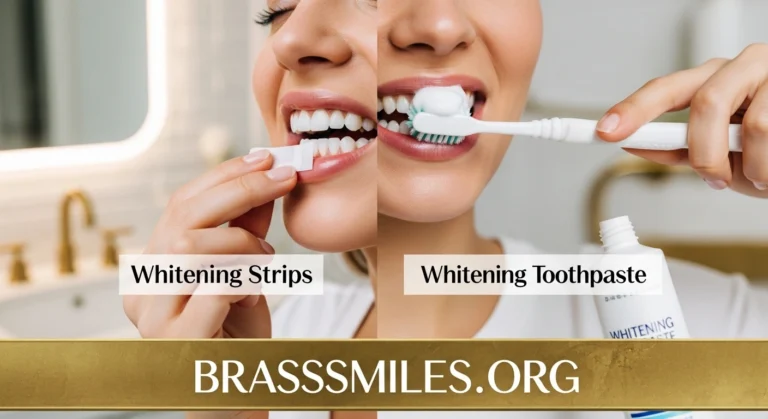
It is one of the most common moments in the brasssmile management journey. You are standing in the pharmacy aisle, or hovering over a product page online, and you face the same fundamental question: whitening strips or whitening toothpaste? Both promise a brighter smile. Both contain whitening agents on the label. Both are priced within a range that feels accessible. And both have enough confident marketing copy to make the choice feel equally valid either way.
The problem is that for brasssmile specifically — the warm, golden, brassy tooth tone with its surface staining and structural dimensions — they are not equally valid choices. They work through different mechanisms, at different depths, over different timescales, and with meaningfully different levels of clinical evidence behind their effectiveness. Choosing between them without understanding those differences is how people end up spending months using a product that was never going to deliver the result they needed.
This guide cuts through the marketing and makes the comparison on the only terms that matter: mechanism, clinical evidence, real-world results for brasssmile specifically, enamel safety, cost efficiency, and which scenarios call for which approach. The research cited here includes published randomised clinical trials and peer-reviewed dental literature — not product claims. By the end of this article, you will know exactly which product belongs in your routine, and why.
The Core Difference: Why Mechanism Matters More Than Marketing
Whitening strips and whitening toothpaste differ fundamentally in one dimension that determines their effectiveness for brasssmile: contact time. Strips hold a peroxide gel against tooth enamel for 30 to 45 minutes per session, allowing sustained oxidation of chromogen molecules deep into the enamel surface. Toothpaste contacts teeth for two minutes before being rinsed away. That contact time difference is the primary reason strips consistently outperform toothpaste for brasssmile treatment in clinical research.
Understanding why contact time is so critical requires understanding what peroxide actually needs to do inside tooth enamel. Hydrogen peroxide — the active whitening agent in both products — works through oxidation. When it contacts tooth enamel, it penetrates the enamel pellicle and micro-pores of the enamel surface, where it breaks down chromogen molecules through a chemical reaction that converts coloured pigment compounds into colourless or lighter ones.
This oxidation process takes time. The peroxide molecule needs to penetrate the enamel surface, reach the chromogen deposits, and complete the chemical reaction that produces the lightening effect. A two-minute toothbrushing session delivers some peroxide to the enamel surface, but the majority of it is diluted by saliva, washed away by brushing motion, and rinsed off before it can penetrate to the depth where most brasssmile-causing chromogens are embedded. The peroxide in a whitening strip, by contrast, is held in a viscous gel that maintains consistent contact with the enamel surface for up to 45 minutes — enough time for meaningful penetration and sustained oxidation.
This is not a theoretical distinction. A peer-reviewed clinical trial published in PubMed evaluated whitening strips against a 2% hydrogen peroxide pre-rinse and found that whitening strips produced significant colour improvement from day three onward. The rinse — which provided the same active ingredient but without sustained contact — showed no significant change and even increased yellowness by day eight. Same ingredient, different contact time, completely different result.
A literature review of seven published whitening strip studies found that strips were as effective as carbamide peroxide trays in four studies, and in one study a 6% hydrogen peroxide strip outperformed 10% carbamide peroxide tray systems. Today’s RDH’s review of the evidence base concluded that whitening toothpastes were less effective than strips across comparative studies. The evidence base is consistent: contact time determines outcome more than concentration alone.
Section Summary: The fundamental advantage of whitening strips over toothpaste for brasssmile is sustained contact time — 30 to 45 minutes versus two minutes. This difference allows peroxide to penetrate enamel deeply enough to break down the chromogen deposits that cause brasssmile. Clinical trials confirm the performance gap is significant and consistent.
How Whitening Toothpaste Actually Works — and What It Cannot Do for Brasssmile
Whitening toothpaste works through two distinct mechanisms: mild abrasion that physically polishes surface deposits from enamel, and in peroxide-containing formulas, a limited chemical oxidation of surface chromogens during the two-minute contact window. For brasssmile, toothpaste delivers genuine daily maintenance benefits but cannot produce the treatment-level stain removal that strips achieve. Its most valuable role is preventing re-accumulation between strip cycles, not replacing them.
The whitening toothpaste category is broader and more varied than most people realise. Not all whitening toothpastes work the same way, and the differences matter significantly for brasssmile management.
Abrasive-Only Whitening Toothpastes
The majority of whitening toothpastes sold globally achieve their whitening effect primarily through abrasive silica particles that physically polish surface deposits from the enamel pellicle. This produces a visible surface-cleaning effect — removing the loose chromogen layer that accumulates from coffee, tea, and dietary staining. For brasssmile, this is partially useful: it keeps the enamel surface cleaner on a daily basis and prevents the most superficial layer of staining from deepening.
However, it has no mechanism for reaching chromogens embedded in the enamel matrix below the pellicle surface, and no mechanism for addressing the structural warmth from thinned enamel and dentin exposure. An in vitro comparative study published in PMC assessed multiple whitening toothpaste formulations and found meaningful variation in outcomes based on active ingredient — with abrasive-only formulas performing significantly worse than peroxide-containing ones.
Peroxide-Containing Whitening Toothpastes
Toothpastes containing hydrogen peroxide or carbamide peroxide as active ingredients represent a genuine step up from abrasive-only formulas. The peroxide provides chemical oxidation of chromogens in addition to the mechanical cleaning of abrasion. A 2020 randomised double-blinded clinical trial published in the Journal of Dentistry confirmed measurable whitening effects from hydrogen peroxide-containing toothpaste over a study period. However, the same research highlighted that carbamide peroxide in toothpaste underperforms relative to expectations because the two-minute contact time is insufficient for carbamide peroxide to break down into its active form and complete the oxidation reaction — making hydrogen peroxide the more efficient active ingredient for toothpaste format.
Blue Covarine Whitening Toothpastes
A third category of whitening toothpaste uses blue covarine — a synthetic compound that deposits a blue-tinted film on enamel surfaces during brushing, creating an optical counteraction to the warm yellow tone of brasssmile. This works immediately and visibly from the first use, but produces an optical effect rather than chemical stain removal. For brasssmile, blue covarine toothpaste is arguably the most immediately relevant toothpaste format because it directly addresses the tonal quality that defines brasssmile — not just the surface staining. It does not whiten in the chemical sense, but it makes brasssmile look meaningfully less brassy on a daily basis.
The most effective whitening toothpaste strategy for brasssmile is not picking one formula — it is combining two. Use a blue covarine toothpaste in the morning for immediate tonal correction before the day begins. Use a peroxide-containing toothpaste in the evening for chemical maintenance between strip treatment cycles. These two products serve different mechanisms and compound in their daily impact on brasssmile appearance.
Section Summary: Whitening toothpaste works through abrasion, peroxide chemistry, or optical correction depending on its formula. Abrasive-only versions have limited brasssmile value. Peroxide versions deliver maintenance-level chemical whitening. Blue covarine provides the best daily tonal benefit for brasssmile specifically. None of these replace strip treatment cycles.
How Whitening Strips Work — and Why They Outperform Toothpaste for Brasssmile
Whitening strips deliver a concentrated hydrogen peroxide gel in sustained contact with tooth enamel for 30 to 45 minutes per session. This contact window allows peroxide to penetrate enamel micro-pores, reach chromogen deposits embedded in the enamel matrix, and complete the oxidation reactions that produce genuine, measurable tooth lightening. For brasssmile with significant extrinsic staining, strips are the most clinically effective at-home treatment option available without a dental prescription.
Whitening strips are essentially a delivery system designed to solve the contact-time problem that limits toothpaste. The adhesive polymer strip holds the peroxide gel flat against the tooth surface, maintaining even contact from gumline to incisal edge, resisting dilution by saliva, and preventing the rinsing-away that ends toothpaste’s whitening window. The result is a sustained peroxide exposure that reaches depths of enamel staining that toothpaste cannot access.
The Concentration Question: What Percentage Actually Works for Brasssmile?
The peroxide concentration in whitening strips varies widely and has a direct impact on their effectiveness for brasssmile. In the EU and UK, over-the-counter whitening products are legally capped at 0.1% hydrogen peroxide — a concentration that produces minimal whitening and is widely regarded by dental professionals as insufficient for meaningful brasssmile treatment. Products available through dental professionals or via non-EU markets can contain 5.3% to 14% hydrogen peroxide, and it is at these concentrations that clinical research demonstrates significant whitening outcomes.
A randomised clinical trial published in PubMed evaluated a novel 5.3% hydrogen peroxide whitening strip against 10%, 15%, and 20% carbamide peroxide tray systems over a 14-day treatment period. The strips produced highly significant colour improvement versus baseline — comparable to the tray systems — demonstrating that strip format at appropriate concentrations is genuinely competitive with dentist-supplied tray treatments. For brasssmile users in the EU seeking higher-concentration strips, dental professional supply is the most appropriate route.
Contact Time and Application Technique
The effectiveness of whitening strips for brasssmile depends significantly on application technique. Strips must be applied to clean, dry teeth — saliva on the tooth surface dilutes the peroxide gel and reduces contact efficiency. The strip should be pressed firmly against the enamel from the gumline to the incisal edge, folded over the gum margin if provided with a gum-tuck design, and left undisturbed for the full recommended contact time. Removing strips prematurely, applying to wet teeth, or eating or drinking during the application period all reduce the treatment’s effectiveness significantly.
The Rehydration Window After Strip Use
An important characteristic of whitening strips for brasssmile management is the enamel dehydration effect. Peroxide in whitening strips temporarily draws water out of enamel tissue, making enamel more opaque and teeth appear whiter immediately after treatment than the genuine chemical whitening alone would produce. As enamel rehydrates in the 24 to 72 hours following treatment, some of this optical enhancement resolves. For brasssmile with a structural component, this rehydration can reveal the underlying dentin warmth as enamel becomes more translucent again. Using blue covarine toothpaste during the rehydration window helps maintain the improved appearance while the enamel stabilises.
Section Summary: Whitening strips outperform toothpaste by maintaining peroxide contact with enamel for up to 45 minutes per session. Clinical trials confirm significant whitening at concentrations of 5% to 14% hydrogen peroxide. Technique matters — dry teeth, correct placement, and full contact time are all required for maximum effectiveness on brasssmile.
Whitening Strips vs Toothpaste for Brasssmile: Head-to-Head Comparison
Across every clinically relevant measure — speed of results, depth of whitening, suitability for brasssmile’s structural dimension, and longevity of results — whitening strips consistently outperform whitening toothpaste. Toothpaste’s advantage is daily accessibility, lower cost per use, and the optical correction available through blue covarine formulas. The strongest approach for brasssmile combines both: strips for treatment cycles, toothpaste for daily maintenance and tonal management.
| Whitening Strips • Sustained 30–45 min peroxide contact per session • Penetrates enamel matrix to reach deep chromogens • Clinically proven significant whitening at 5–14% HP • Visible improvement in 3–5 days of consistent use • Treatment cycle: 14–21 days, 2–3x per year • Effective for moderate to significant extrinsic brasssmile • Partial effect on structural brasssmile component • Higher per-use cost, lower frequency of use • Requires 30+ mins commitment per session • Can cause temporary sensitivity if overused | Whitening Toothpaste • 2 min contact time — limits peroxide penetration depth • Reaches surface and near-surface enamel only • Peroxide versions: modest chemical whitening over weeks • Blue covarine: immediate optical tonal correction • Daily use — integrates into existing brushing routine • Best for maintenance between strip cycles • Limited effectiveness on moderate extrinsic brasssmile alone • Low cost per use, high frequency of use • Zero additional time commitment beyond brushing • Very low sensitivity risk at recommended use |
Section Summary: The head-to-head shows strips winning on treatment power and clinical evidence, toothpaste winning on daily accessibility and tonal management through blue covarine. For brasssmile, neither alone is the optimal strategy — both together, serving different mechanisms, produce the best sustained outcome.
Real-World Results Timeline: What to Expect Week by Week With Each Product
Whitening strips produce visible brightening for most brasssmile users within three to five days of the first treatment cycle, reaching their settled result by day seven to ten. Whitening toothpaste with peroxide produces gradual improvement over four to six weeks of daily use. Blue covarine toothpaste produces immediate optical improvement from the first use. These timelines are complementary rather than competitive — strips address the treatment phase, toothpaste addresses the maintenance phase.
Days 1–3
Strips: Some users notice early brightening by day three. The enamel dehydration effect creates an opaque-white appearance immediately post-application. Continued daily application builds the treatment effect.
Toothpaste: No visible whitening yet from peroxide. Blue covarine produces immediate tonal correction visible from day one — not whitening but the brassy tone appears cooler and less warm.
Verdict: Strips: early visible effect. Toothpaste: optical improvement only (blue covarine) or no visible change yet (peroxide).
Days 4–7
Strips: Clear brightening visible for most users with extrinsic brasssmile. Studies confirm significant colour improvement (delta b* and delta L* measurements) by day seven. Post-application rehydration settling begins.
Toothpaste: Peroxide toothpaste: minimal visible change — too early for chemical whitening to produce visible outcome. Blue covarine: consistent daily tonal improvement continues.
Verdict: Strips deliver measurable treatment-level whitening. Toothpaste provides daily appearance management. Strips are definitively ahead on treatment progress.
Week 2 (Days 8–14)
Strips: Full treatment cycle completing. Settled shade is establishing. The genuine post-rehydration result is now measurable — typically two to four VITA shades lighter for extrinsic brasssmile. Structural brasssmile may show less dramatic but still meaningful improvement.
Toothpaste: Peroxide toothpaste: still gradual — some studies show measurable improvement at the four to six week mark, not the two-week mark. Blue covarine maintains daily tonal benefit throughout.
Verdict: Strips: treatment objective largely achieved. Toothpaste: still in early maintenance phase, not yet delivering measurable chemical whitening.
Weeks 3–6
Strips: Post-treatment maintenance phase. No active stripping on a standard schedule. Enamel is stable and results should be maintained with correct post-whitening care and daily toothpaste routine.
Toothpaste: Peroxide toothpaste: now beginning to show measurable chemical whitening improvement in regular users. Blue covarine continues daily tonal correction. This is the phase where toothpaste adds its independent contribution.
Verdict: Strips: maintenance mode. Toothpaste: now delivering its own chemical whitening contribution alongside the post-strip baseline.
Weeks 8–10
Strips: Re-treatment cycle appropriate — results from cycle one are settling and re-staining begins in most users. Strip cycle two reinforces and extends the improvement from cycle one.
🪥 Toothpaste: Peroxide toothpaste: established users now experiencing genuine cumulative maintenance benefit. Blue covarine: consistently managing daily tonal appearance throughout.
⚖️ Verdict: Strips cycle two: deepens and consolidates treatment. Toothpaste: maintains the inter-cycle baseline so the next strip cycle starts from a higher base than the first.
📌 Section Summary: The timeline shows strips and toothpaste operating in complementary phases — strips produce treatment-level results in the first two weeks, toothpaste maintains and gradually improves the baseline across the eight-to-ten-week inter-cycle period. Understanding this cycle prevents the mistake of abandoning one product because it is not doing the other’s job.
The Complete Comparison Table: Strips vs Toothpaste for Brasssmile
The table below maps the full comparison across ten decision-relevant criteria. For brasssmile driven primarily by extrinsic staining, strips win on every treatment metric. For daily management and tonal correction, blue covarine toothpaste is unmatched. The data supports a combined routine rather than an either-or choice for anyone serious about managing brasssmile effectively.
Whitening Strips vs Toothpaste — Complete Brasssmile Comparison
| Criterion | Whitening Strips | Whitening Toothpaste (Peroxide) | Blue Covarine Toothpaste |
| Mechanism | Peroxide oxidation, sustained contact | Peroxide oxidation, brief contact | Optical colour correction |
| Contact Time | 30–45 minutes | ~2 minutes | ~2 minutes |
| Depth of Action | Enamel matrix — medium depth | Enamel surface — shallow | Surface optical deposit |
| Speed of Results | 3–5 days | 4–6 weeks | Immediate (from day 1) |
| Clinical Evidence | Strong — multiple RCTs published | Moderate — growing evidence base | Confirmed — Journal of Dentistry |
| Extrinsic Brasssmile | ★★★★★ Highly effective | ★★★☆☆ Maintenance level | ★★★☆☆ Optical only |
| Structural Brasssmile | ★★★☆☆ Partial improvement | ★★☆☆☆ Limited | ★★★★☆ Best optical option |
| Longevity | 6–12 weeks per cycle | Daily — maintenance ongoing | Daily — effect temporary each use |
| Enamel Safety | Good if used as directed | Good — low RDA typically | Excellent — no abrasion |
| Cost | £20–£50 per cycle | £5–£20 per tube | £5–£15 per tube |
| Daily Commitment | 30–45 mins on treatment days | Zero extra time | Zero extra time |
| Best Role | Primary treatment cycles | Inter-cycle maintenance | Daily tonal management |
The table confirms that no single product wins on every criterion — which is exactly why the strongest brasssmile management routine uses both. Strips for the treatment phase every eight to ten weeks. Blue covarine toothpaste daily for tonal management. Peroxide toothpaste in the evening for chemical maintenance. Together they cost less than a single professional whitening session and address three different dimensions of brasssmile simultaneously.
Which Should You Choose? Matching Product to Your Brasssmile Type
The right product choice for brasssmile depends on the specific type and severity of your condition. For extrinsic brasssmile driven by surface staining, strips are the primary treatment with toothpaste as maintenance. For brasssmile with a significant structural component, strips help with the surface layer, blue covarine toothpaste manages the daily tonal appearance, and professional treatment addresses what neither product can resolve. For mild brasssmile or daily maintenance, peroxide toothpaste and blue covarine are sufficient without strips.
If Your Brasssmile Is Primarily Extrinsic (Surface Staining)
You are the ideal candidate for whitening strips as a primary treatment. Your brasssmile is caused mainly by the accumulation of chromogen staining from coffee, tea, wine, or tobacco on and in the enamel surface — precisely the type of discolouration that peroxide oxidation reaches and resolves most effectively. Run a full 14-day strip cycle at the highest appropriate concentration available to you, follow the post-whitening care protocol, and maintain with a daily peroxide toothpaste. Repeat every eight to ten weeks. Add blue covarine toothpaste in the morning for daily tonal management between cycles. This combination typically produces and maintains a two to four VITA shade improvement over three months of consistent management.
If Your Brasssmile Has a Structural Component
You need a more nuanced approach. Strips will address the surface staining component of your brasssmile and produce visible improvement — but results will rebound more quickly than for purely extrinsic cases because the structural warmth from thinned enamel and dentin exposure reasserts as enamel rehydrates. For structural brasssmile, strips remain valuable as a surface management tool but should be combined with blue covarine toothpaste (for daily tonal management), hydroxyapatite or fluoride toothpaste (for enamel remineralisation support), and an honest assessment of whether professional cosmetic treatment would address the structural dimension more permanently. If two complete strip cycles have produced results that fade within two weeks, that rapid rebound is the signal to investigate professional options.
If You Want Lowest-Effort Daily Management
If active strip treatment feels too time-intensive for your current routine and your brasssmile is mild, a daily combination of blue covarine toothpaste in the morning and peroxide toothpaste in the evening provides meaningful ongoing management without any additional time commitment beyond standard brushing. This approach will not deliver the treatment-level results of a strip cycle, but it keeps brasssmile progressively better managed on a daily basis and creates a better baseline for whenever you do run a strip cycle.
Never use whitening strips more frequently than the product’s recommended cycle in the belief that more will deliver faster results. Overuse of peroxide strips causes enamel dehydration cycles, temporary sensitivity, and can cause the rebound appearance of brasssmile to worsen. The clinical evidence consistently shows that consistent use within recommended frequency limits outperforms aggressive overuse in both immediate and long-term outcomes.
Section Summary: Extrinsic brasssmile: strips as primary treatment, toothpaste for maintenance. Structural brasssmile: strips for surface component, blue covarine for daily tonal management, professional treatment for definitive structural resolution. Mild brasssmile or pure maintenance: daily dual-toothpaste routine without strips. Match the product to the mechanism driving your specific condition.
Common Mistakes When Choosing Between Strips and Toothpaste for Brasssmile
The most damaging mistake is using whitening toothpaste as a substitute for strip treatment and expecting equivalent results — particularly for moderate to significant extrinsic brasssmile where the contact-time limitation of toothpaste makes treatment-level outcomes impossible. The second most common is purchasing strips without checking the peroxide concentration, inadvertently buying EU-regulated 0.1% products that produce negligible results despite correct application.
Mistake 1: Expecting Toothpaste to Do the Work of Strips
This is the most common source of brasssmile treatment disappointment in the at-home product category. People purchase a whitening toothpaste with clear marketing language about brightening results, use it faithfully for four weeks, and find that their brasssmile looks essentially the same. They conclude that whitening does not work for their teeth. What actually happened is that they used a maintenance product in a treatment role — and the two-minute contact time produced the expected maintenance-level outcome, not a treatment-level one. Whitening toothpaste is genuinely valuable in its correct role. In a treatment role it will consistently underperform.
Mistake 2: Purchasing Low-Concentration Strips Without Checking
EU-regulated over-the-counter whitening strips are capped at 0.1% hydrogen peroxide — a concentration that produces minimal whitening and is unlikely to have meaningful impact on brasssmile. Many people purchase these strips, use them correctly and consistently, and are disappointed by results that are far below what the packaging imagery suggests. The limitation is not technique — it is regulation. For effective strip treatment of brasssmile in the EU, products at higher concentrations must be obtained through dental professional supply channels. Always check the stated hydrogen peroxide percentage before purchasing any whitening strip.
Mistake 3: Using Charcoal Toothpaste as an Alternative to Both
Activated charcoal toothpaste continues to be marketed as a natural alternative to peroxide-based whitening products. For brasssmile, it offers neither the contact-time advantage of strips nor the peroxide chemistry of whitening toothpaste. An in vitro study from the University of Brescia published in 2025 compared activated charcoal toothpaste against a 6% hydrogen peroxide whitening pen and found that while charcoal produced gradual improvement over 30 days, the hydrogen peroxide treatment produced immediate and substantially greater whitening — with the peroxide’s superiority confirmed by statistical analysis using the Wilcoxon signed-rank test. Additionally, charcoal’s higher abrasivity risks accelerating the enamel wear that worsens the structural dimension of brasssmile over time.
Section Summary: Three consistent mistakes define why people feel brasssmile whitening products have failed them: using toothpaste as a substitute for strips, buying low-concentration EU-restricted strips without knowing, and choosing charcoal as a natural alternative. Avoiding these three errors produces dramatically better outcomes from the correct products used correctly.
Experience Perspective: What Using Both Products Actually Feels Like
The most common experience shift among people who move from using a single whitening product to a properly structured strips-plus-toothpaste combination routine is a sense of purposeful progress replacing circular frustration. When each product is understood to serve a specific mechanism in the overall approach, the results become predictable rather than random — and predictability is what builds both confidence in the routine and the motivation to maintain it.
There is a specific experience many people describe when they first try whitening strips after years of using only whitening toothpaste for their brasssmile. The first few days produce something they have not seen from the toothpaste — a visibly different, cooler-toned smile that feels genuinely different in photographs. It is sometimes almost surprising. Not because strips are magical, but because the contact-time difference produces an outcome that toothpaste simply could not.
What tends to follow, without good guidance, is over-reliance on strips — using them more and more frequently in the belief that the more strips the better. That is when the sensitivity creeps in, when the rebound effect starts to feel dramatic, and when the brasssmile seems to return as fast as the strips clear it. The missing piece is usually the post-whitening routine: the blue covarine toothpaste that manages the tonal rebound as enamel rehydrates, the peroxide toothpaste that maintains the surface baseline between cycles, the rinsing habit that slows re-staining from dietary inputs.
When all three elements are in place — strips on a cycle, blue covarine in the morning, peroxide toothpaste in the evening, rinsing after staining drinks — something different happens. The results from each strip cycle start from a better baseline than the last. The maintained appearance between cycles improves gradually rather than simply reverting. And the overall trajectory of the brasssmile — not just the day-after-strips snapshot but the consistent daily baseline — moves meaningfully in the right direction over months. That experience of cumulative, maintained improvement is what this approach, done correctly, actually delivers.
The single most important mindset shift for brasssmile home treatment is understanding that strips and toothpaste are not competitors — they are partners in a two-phase routine. Strips handle the treatment phase. Toothpaste handles the maintenance phase. When both phases are managed, the results from each strip cycle hold longer, and the daily baseline progressively improves. That compounding is what makes the routine genuinely effective rather than just temporarily impressive.
Section Summary: The experience of using strips alone versus strips combined with the right toothpaste routine is qualitatively different. Strips-only produces impressive but unstable results. Strips plus blue covarine and peroxide toothpaste produces results that hold, compound, and progressively improve. The difference lies entirely in managing the maintenance phase between treatment cycles.
Whitening Strips vs Toothpaste for Brasssmile — Frequently Asked Questions
These FAQs address the most commonly searched decision-making questions about whitening strips versus toothpaste for brasssmile. Each answer is direct, evidence-based, and structured to help readers make confident product choices.
Do whitening strips work faster than toothpaste for brasssmile?
Yes, significantly. Clinical research published in PubMed confirmed significant tooth colour improvement from whitening strips by day three of treatment. Whitening toothpaste typically requires four to six weeks of consistent daily use to produce measurable chemical whitening. The difference is contact time — strips hold peroxide against enamel for 30 to 45 minutes, toothpaste for approximately two minutes. For brasssmile treatment, strips are the clear choice when speed of results matters.
Can I fix brasssmile with toothpaste alone without using strips?
For mild extrinsic brasssmile, a combination of blue covarine toothpaste and peroxide toothpaste used consistently can produce gradual improvement over weeks and maintain that improvement over months. For moderate to significant extrinsic brasssmile, toothpaste alone will not deliver treatment-level results — the contact-time limitation means chemical whitening will be gradual and modest at best. For structural brasssmile with a significant dentin component, neither toothpaste alone nor toothpaste and strips together will produce complete resolution; professional treatment is the appropriate complementary step.
What percentage of hydrogen peroxide should I look for in whitening strips for brasssmile?
For meaningful whitening of brasssmile, strips containing 5% to 14% hydrogen peroxide produce the results confirmed in clinical research. EU-regulated over-the-counter strips are capped at 0.1% hydrogen peroxide, which is insufficient for treatment-level brasssmile whitening. In the EU, higher-concentration strips are available through dental professional supply channels. In the US and other markets, consumer products at 10% to 14% hydrogen peroxide are available OTC. Always check the stated concentration before purchasing.
Should I use whitening strips before or after brushing with whitening toothpaste?
Apply whitening strips to clean, dry teeth — so brush first, then apply strips after your teeth have dried for a few minutes. Do not apply toothpaste directly before strip application because residue on tooth surfaces can reduce the strip’s adhesion and the gel’s contact efficiency. After strips, use your blue covarine toothpaste in the morning to manage the tonal rebound as enamel rehydrates, and peroxide toothpaste in the evening as your standard maintenance brushing.
How often should I use whitening strips for brasssmile?
A standard treatment cycle is 14 to 21 days of daily strip application — applied once or twice daily per the product instructions. After completing a cycle, allow at least four weeks before repeating. Most practitioners recommend two to three full cycles per year for brasssmile maintenance, with daily toothpaste routine filling the inter-cycle gap. Using strips more frequently than recommended does not produce better results and increases the risk of enamel dehydration, sensitivity, and the rebound effect that makes brasssmile appear worse in the days after over-treated whitening.
The Verdict: Strips Win on Treatment, Toothpaste Wins on Daily Management — Use Both
For brasssmile treatment, whitening strips at appropriate concentration consistently outperform whitening toothpaste in clinical research and real-world outcomes. For daily maintenance and tonal management between treatment cycles, blue covarine toothpaste is the most effective daily-use product for brasssmile specifically. The strongest at-home approach uses both — strips for treatment cycles every eight to ten weeks, toothpaste for daily maintenance and optical management throughout.
The question of strips versus toothpaste for brasssmile does not have a simple winner — it has a simple answer: they serve different purposes and both belong in a well-structured brasssmile management routine. The mistake is framing it as an either-or decision. Strips deliver the treatment-level peroxide oxidation that produces visible, measurable whitening of extrinsic brasssmile. Toothpaste — particularly blue covarine formulas — delivers the daily tonal management that makes brasssmile look better on every day between treatment cycles.
If you have only been using toothpaste for your brasssmile and results have been disappointing, adding a properly-concentrated strip cycle is the highest-impact change you can make. If you have been using strips but not managing the inter-cycle period, adding blue covarine toothpaste in your morning routine is the change that will make your strip results last longer and your daily baseline look better.
For deeper exploration of the best whitening products for brasssmile across all categories, read our full product review guide on BrassSmiles.org. For guidance on what to do in the 48 hours after a strip cycle, see our post-whitening care guide. For the broader picture of which type of brasssmile you are dealing with and whether professional treatment should be in your plan, start with our brasssmile versus yellow teeth guide.
