
Ask most people whether their teeth are yellow or brassy and they will use the two words interchangeably, as if they describe the same thing. In casual conversation that is understandable — both conditions involve teeth that do not look white. But in terms of cause, visual characteristics, treatment response, and long-term management, brasssmile and yellow teeth are meaningfully different. Treating them as identical is one of the most common reasons people spend months using whitening products that deliver disappointing results.
The distinction matters practically, not just academically. If your teeth are yellow due to surface staining from dietary habits, a peroxide-based whitening routine will produce visible, lasting results within a few weeks. If your teeth have a brassy warmth driven by thinned enamel and exposed dentin, the same whitening routine may produce a brief improvement followed by rapid rebound — because the underlying mechanism has not been addressed. Understanding which condition you are dealing with is the diagnostic step that determines everything else.
This guide walks through the differences clearly and completely. By the end of it, you will be able to assess your own situation with confidence, understand why certain treatments work for one condition but not the other, and make smarter decisions about how to approach your smile care. It is the article that should come before any whitening product purchase.
Defining the Terms: What Yellow Teeth and Brasssmile Actually Mean
Yellow teeth is a broad, general term describing any teeth that appear flat and evenly yellowed, most commonly due to surface staining from food, drink, tobacco, or plaque accumulation. Brasssmile is a more specific condition describing a warm, golden-brassy tone that results from the combination of surface pigmentation and structural factors — primarily enamel thinning that reveals the naturally yellow dentin beneath. The two can overlap but they are driven by different primary mechanisms.
Language shapes how we think about problems — and the language around tooth discolouration is imprecise enough to cause genuine confusion. The term ‘yellow teeth’ is used as a catch-all for virtually any shade of tooth discolouration that deviates from white. It encompasses surface stains from coffee and tea, tobacco-related discolouration, plaque yellowing, and age-related dentin exposure. Because the term is so broad, treatments marketed at yellow teeth range from simple whitening toothpastes to professional bleaching — and the variation in results is enormous because the underlying causes vary so widely.
Brasssmile is a more precise descriptor. Borrowed from the hair colour world — where ‘brassy’ describes the warm orange-gold undertones that emerge in bleached or lightened hair — it captures something specific about tooth appearance that the word ‘yellow’ misses. A brasssmile has a characteristic warmth and golden quality that is distinct from the flat, even yellowing of surface staining. It often looks worse in natural light and photographs, and it tends to have a depth and richness to it that surface staining alone cannot fully explain. This is because brasssmile typically involves both a surface component and a structural component — making it, in most cases, a more complex condition to address than ordinary yellowing.
Think of yellow teeth as describing the colour. Think of brasssmile as describing the quality of that colour — warm, golden, translucent, with a depth that comes from both surface and structural factors. One is a symptom description. The other is a condition diagnosis.
The Science Behind Each Condition: Enamel, Dentin and Discolouration Types
Yellow teeth is primarily an extrinsic condition — staining sits on or near the enamel surface and responds well to bleaching agents. Brasssmile involves both extrinsic staining and intrinsic factors, particularly enamel thinning that exposes yellower dentin. Dentistry classifies discolouration into extrinsic (surface), intrinsic (within tooth structure), and age-related — and brasssmile typically spans at least two of these categories simultaneously.
To understand why brasssmile and yellow teeth differ, it helps to understand the three-layer architecture of a tooth. The outermost layer is enamel — a semi-translucent, mineralised tissue that is the hardest substance in the human body. Directly beneath it is dentin — a calcified but more porous material that is inherently yellow in tone. At the centre of the tooth is the pulp, containing nerves and blood vessels. The colour you perceive when you look at your teeth is largely a function of how much enamel you have and how stained its surface is.
Extrinsic Discolouration: The Primary Driver of Yellow Teeth
Extrinsic discolouration occurs on the outer surface of enamel and within the enamel pellicle — the thin protein film that naturally coats teeth. Foods and drinks rich in tannins and chromogens deposit pigment molecules that bind to this pellicle and embed into surface micro-pores. The result is a yellowing that sits primarily at or near the enamel surface. Because the staining is relatively superficial, it is accessible to the oxidative action of peroxide bleaching agents. This is why standard whitening treatments work reliably well on yellow teeth driven by dietary staining: the peroxide penetrates the pellicle and breaks down chromogen molecules through oxidation, progressively lightening the visible colour.
Intrinsic Discolouration: The Primary Driver of Structural Brasssmile
Intrinsic discolouration originates within the tooth structure itself — within the dentin or deep enamel layers. The most common cause in the context of brasssmile is simply enamel thinning through age, acid erosion, or genetic predisposition. As enamel becomes thinner and more translucent, it increasingly fails to mask the yellow dentin beneath. The resulting warm, brassy tone is not a surface stain — it is a structural reality of the tooth’s internal architecture showing through. Other causes of intrinsic discolouration include tetracycline antibiotic staining during tooth development, dental fluorosis, and dental trauma.
Age-Related Discolouration: Where Yellow Teeth Becomes Brasssmile
Age-related discolouration is a third category that bridges the other two. As enamel gradually thins over decades of normal wear, two things happen simultaneously: the underlying dentin becomes more visible and appears yellower, and the accumulated surface staining from years of dietary exposure deepens. For many people in their thirties and forties, what began as straightforward yellow teeth — primarily extrinsic and responsive to whitening — transitions into brasssmile, as the structural dimension of enamel thinning begins to contribute meaningfully to the overall tone. This is why whitening treatments that worked well in someone’s twenties may feel less effective a decade later: the problem has genuinely changed in character.
The clinical distinction between extrinsic and intrinsic discolouration is not just academic — it is the basis on which dentists select treatment. Extrinsic staining is treatable with bleaching. Intrinsic staining and structural brasssmile typically require restorative approaches — veneers, bonding, or microabrasion — for complete resolution.
How to Tell Them Apart: Visual Characteristics of Brasssmile vs Yellow Teeth
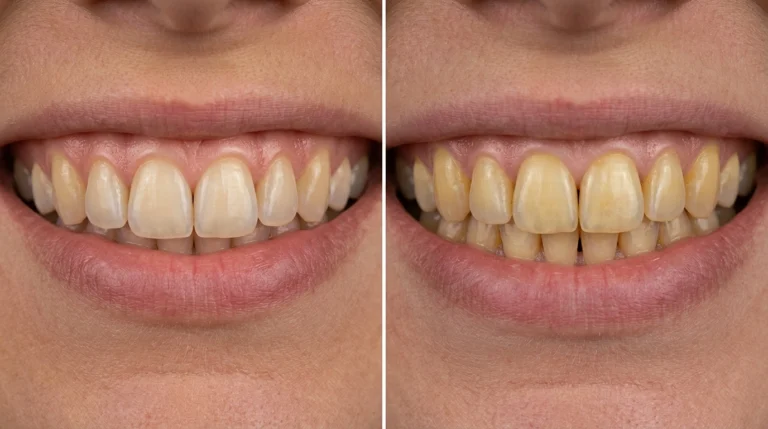
Yellow teeth typically appears as a flat, even, matte yellowing distributed uniformly across the tooth surface, most visible in photographs and fluorescent lighting. Brasssmile has a distinctly warm, golden, or brassy quality — it looks richer and more saturated than flat yellowing, often appears worse in natural daylight and outdoor photographs, and may have a translucent depth to it that reveals the underlying warmth is coming from within the tooth as well as its surface.
The visual difference between brasssmile and yellow teeth is real, perceptible, and meaningful — but it takes a deliberate look to identify it. Most people assess their smile under bathroom lighting, which tends to be warm and forgiving, making teeth look cleaner than they are. The most reliable self-assessment conditions are natural outdoor daylight or a bright, cool-toned light source.
Characteristics of Yellow Teeth
- Flat, even yellowing across the entire tooth surface
- Appears most prominently under fluorescent or bright artificial light
- Relatively uniform in distribution — same shade across all front teeth
- May feel slightly rough on the surface due to plaque or tartar accumulation
- Responds noticeably to whitening strips within one to two weeks
- Improvement after whitening tends to be stable for several weeks or months
Characteristics of Brasssmile
- Warm, golden, or brassy tone — more saturated than flat yellow
- Appears notably worse in natural daylight and outdoor photography
- May be more pronounced at the gumline or on older teeth where enamel is thinnest
- Has a depth or translucency to the warmth that suggests it is coming from within
- Responds to whitening but results may rebound within days or a few weeks
- Can look dramatically different between bathroom mirror and outdoor photographs
The most reliable self-test: take a smartphone photo of your smile outdoors in natural daylight, then compare it against a sheet of plain white paper in the same light. Yellow teeth will look uniformly pale yellow. Brasssmile will look noticeably golden or warm — richer than expected, with a depth that changes character between different lighting environments.
Causes Compared: What Drives Yellow Teeth vs What Drives Brasssmile
Yellow teeth is driven primarily by extrinsic causes — dietary staining from tannin-rich drinks, tobacco, plaque build-up, and poor rinsing habits. Brasssmile shares these extrinsic causes but adds a critical structural layer: enamel thinning through ageing or acid erosion, genetic predisposition to thinner or more translucent enamel, and in some cases intrinsic factors like medication history or fluorosis. The structural element is what differentiates brasssmile from straightforward yellowing.
Causes — Yellow Teeth vs Brasssmile
| Cause | Yellow Teeth | Brasssmile |
| Coffee & Tea tannins | Primary driver | Contributing factor |
| Red wine chromogens | Primary driver | Contributing factor |
| Tobacco staining | Primary driver | Contributing + intrinsic |
| Plaque & tartar | Primary driver | Contributing factor |
| Enamel thinning (ageing) | Secondary | Primary structural driver |
| Dentin exposure | Rare | Core mechanism |
| Genetic enamel thickness | Minimal | Significant |
| Tetracycline / Fluorosis | No | Intrinsic driver |
| Acid erosion | Contributing | Primary structural driver |
| Poor rinsing habits | Primary driver | Contributing factor |
The table shows that yellow teeth and brasssmile share most of the same extrinsic causes. The defining difference is that brasssmile has additional structural causes — enamel thinning, dentin exposure, and sometimes intrinsic pigmentation — that yellow teeth does not. This is why treating both conditions identically produces inconsistent results.
Side-by-Side: The Full Comparison at a Glance
Yellow teeth and brasssmile differ across every key dimension — from their underlying cause and visual character to their response to treatment and the most effective long-term management strategy. Understanding these differences side by side makes the right treatment path immediately clear.
| ⚪ Yellow Teeth • Flat, even yellow tone • Primarily extrinsic (surface staining) • Caused by diet, tobacco, poor hygiene • Responds well to peroxide whitening • Results stable for weeks to months • No structural enamel component required • Whitening strips are highly effective • Improvement visible in 1–2 weeks • Prevention through rinsing & diet change • Most common in all ages | 🟡 Brasssmile • Warm, golden, brassy saturation • Extrinsic + intrinsic / structural • Diet + enamel thinning + genetics • Partial response to peroxide whitening • Results may rebound within days • Structural enamel component often present • Blue covarine + peroxide most effective • Full resolution may need professional care • Prevention + enamel remineralisation • More prominent from 30s onward |
Treatment Differences: Why What Works for Yellow Teeth May Not Fix Brasssmile
Peroxide-based whitening treatments address extrinsic surface staining reliably and work well for yellow teeth. For brasssmile, peroxide whitening addresses the surface component but cannot change the structural warmth caused by enamel thinning and dentin exposure. Treating brasssmile effectively requires a layered approach — combining peroxide chemistry with optical colour correction, enamel remineralisation support, and in structural cases, professional cosmetic intervention.
This is where the distinction between brasssmile and yellow teeth has the most direct practical consequence. Many people invest significant time and money in whitening treatments and feel let down by the results — not because the treatment failed, but because they applied a yellow-teeth solution to a brasssmile problem.
What Works for Yellow Teeth
Yellow teeth driven by extrinsic staining responds predictably and reliably to peroxide-based whitening. Over-the-counter whitening strips at 10 to 14 percent hydrogen peroxide produce visible results within one to two weeks. Whitening toothpastes containing carbamide peroxide or hydrogen peroxide maintain those results between treatment cycles. Professional in-office whitening with higher peroxide concentrations produces faster, more dramatic results. In all cases, the treatment mechanism is the same: peroxide oxidises and breaks down the chromogen molecules that cause surface staining. When the primary cause is extrinsic, this approach works very well.
What Works for Brasssmile — And Why It Is Different
Brasssmile with a significant structural component requires a different primary strategy. Peroxide whitening still plays a role — it addresses the surface staining component of brasssmile — but it cannot change the fundamental colour of dentin or restore thinned enamel. For people whose brasssmile is primarily structural, the most effective approaches include:
- Blue covarine toothpaste — provides immediate optical colour correction by depositing blue-tinted molecules that neutralise the warm golden tone visually, without changing the underlying staining
- Enamel remineralisation products — fluoride and hydroxyapatite-containing toothpastes and serums that support enamel repair, slowing the progression of enamel thinning and the resulting increase in dentin visibility
- Composite or porcelain veneers — for structural brasssmile that does not respond adequately to whitening, veneers physically cover the tooth surface entirely and can be made to any chosen shade
- Dental bonding — a more affordable, reversible option that applies tooth-coloured resin to mask the brassy tone
- Enamel microabrasion — for specific cases of intrinsic surface discolouration such as mild fluorosis, this professional technique removes a thin layer of affected enamel
The key insight is not that whitening is useless for brasssmile — it is that whitening alone is insufficient when the structural dimension is significant. The smartest approach combines peroxide treatment for surface staining with optical correction for the warm tone and, where appropriate, professional intervention for the structural layer.
Treatment Effectiveness — Yellow Teeth vs Brasssmile
| Treatment | Yellow Teeth | Surface Brasssmile | Structural Brasssmile |
| Peroxide Whitening Strips | Excellent | Good | Limited |
| Whitening Toothpaste (peroxide) | Good | Moderate | Low |
| Blue Covarine Toothpaste | Moderate | Excellent (optical) | Excellent (optical) |
| Baking Soda (occasional) | Good | Moderate | Low |
| In-Office Bleaching | Excellent | Very Good | Partial |
| Dental Bonding | Not needed | Good | Excellent |
| Composite Veneers | Not needed | Good | Excellent |
| Porcelain Veneers | Not needed | Excellent | Definitive |
| Enamel Remineralisation | Supportive | Supportive | Important |
The table makes clear that yellow teeth and surface brasssmile share a strong treatment overlap at the peroxide whitening level. The significant divergence appears at the structural brasssmile row — where peroxide whitening shifts from excellent to limited, and restorative options like veneers and bonding become the most effective path. Identifying which category you fall into changes the entire treatment strategy.
Experience Perspective: Recognising the Difference in Real Life
For many people, the realisation that their brasssmile is not the same as ordinary yellow teeth comes through a specific lived experience — the frustration of whitening products that work briefly and then stop working, or a photograph that reveals a warmth their mirror never showed them. That experience is valuable diagnostic information, not just disappointment.
There is a particular kind of confusion that comes from looking in the bathroom mirror every morning and thinking your teeth look reasonably clean — maybe a little dull, but nothing dramatic — and then seeing a photograph taken outside in natural light and barely recognising your own smile. The camera caught something the mirror missed. That golden warmth. That depth of colour that does not look like what you imagined.
This is one of the most reliable early signs that what you are dealing with is brasssmile rather than ordinary yellow teeth. Brasssmile has a particular relationship with natural light that flat surface staining does not. Because the warmth comes partly from within the tooth — from dentin showing through translucent enamel — it responds to the quality and direction of light in a way that changes it. Bathroom lighting, typically warm-toned and diffused, masks this. Outdoor daylight, with its cooler, more directional quality, reveals it immediately.
The whitening experience is the other major diagnostic signal. People with yellow teeth driven by surface staining typically find that whitening strips work clearly and the results feel satisfying and stable. People with brasssmile often describe a different pattern: the strips produce a noticeable improvement, but within a week or two the warmth has largely returned, and they feel like they are fighting a battle they cannot win. This rebound is not a product failure — it is the enamel rehydrating after the temporary dehydration caused by peroxide, and revealing the structural warmth beneath that the surface lightening had briefly obscured.
The moment that turns this frustration into empowerment is understanding why the rebound happens and what it means. It means the brasssmile has a structural component. That is genuinely useful information. It does not mean whitening should be abandoned — it means whitening should be combined with optical correction, enamel support, and perhaps eventually a professional consultation to discuss whether restorative options are worth exploring. The problem has not changed. The understanding of it has. And with that understanding, the solution becomes clear.
The diagnostic value of your whitening history should not be underestimated. If results from strips last less than two to three weeks before the warmth returns, write that down before your next dental appointment. That single observation tells a dentist more about the structural character of your brasssmile than most visual assessments can.
Common Mistakes When Confusing Brasssmile With Yellow Teeth
The most damaging mistake is applying identical treatment to both conditions and concluding that whitening does not work when results disappoint. Brasssmile with a structural component does not fail to respond to whitening — it responds partially, and requires additional strategies that yellow teeth does not. Recognising the distinction prevents months of wasted effort and wrong-direction treatment.
Doubling Down on Whitening When Brasssmile Rebounds
When whitening strips produce disappointing results for brasssmile — either minimal initial improvement or rapid colour rebound — the instinctive response is to use them more frequently or for longer. This is counterproductive. Overuse of peroxide whitening leads to enamel dehydration, which creates a temporary opaque-white appearance followed by an exaggerated rebound when enamel rehydrates. For structural brasssmile, more peroxide does not address the root cause. The correct response to whitening that does not hold is to add complementary strategies — blue covarine for optical correction, enamel remineralisation support, and potentially professional consultation — rather than increase the whitening dose.
Assuming Brasssmile Is Just Old Yellow Staining
Yellow teeth builds up gradually through staining accumulation and can feel like it should respond to aggressive whitening. When that thinking is applied to brasssmile — particularly the kind driven by enamel thinning — the logic breaks down. Enamel that has thinned through ageing or acid erosion cannot be whitened back to its earlier thickness. The warmth from exposed dentin is structural, not staining. Treating it as staining leads to frustration; treating it as a structural reality leads to effective solutions.
Ignoring the Structural Prevention Opportunity
One of the most underused strategies for brasssmile is enamel remineralisation — actively supporting enamel repair and density to slow the rate of thinning. Fluoride and hydroxyapatite toothpastes, dietary calcium and phosphate, reduced acid exposure, and avoiding brushing immediately after acidic drinks are all evidence-based approaches to enamel protection. These do not reverse existing enamel loss, but they meaningfully slow its progression — which means the structural dimension of brasssmile develops more slowly. This is something people with yellow teeth never need to consider, but it is among the most valuable habits for anyone with structural brasssmile.
Do not assume your discolouration is one type without checking both conditions against your own experience. Yellow teeth and brasssmile can coexist. Many people have significant surface staining sitting on top of structurally thinner enamel. In those cases the complete approach addresses both simultaneously — peroxide for the surface, optical correction for the brassy tone, and remineralisation support for the enamel.
Brasssmile vs Yellow Teeth — Frequently Asked Questions
These FAQs address the most commonly searched questions comparing brasssmile and yellow teeth, structured for featured snippet and AEO targeting. Each answer is direct, accurate, and based on established dental knowledge.
Can I have both brasssmile and yellow teeth at the same time?
Yes, and many people do. Surface staining from dietary habits and tobacco sits on top of whatever the underlying tooth structure looks like. Someone with naturally thin enamel or age-related dentin exposure — both structural factors in brasssmile — will often also have a layer of surface staining from coffee, tea, or wine on top of that structural warmth. The result is a compounded discolouration that is both brassy and yellow. Treating both the surface staining and the structural tone simultaneously gives the best outcomes.
Does whitening fix brasssmile or just yellow teeth?
Whitening addresses the extrinsic surface staining component of both conditions reliably. For yellow teeth driven primarily by surface staining, whitening is often a complete solution. For brasssmile with a significant structural component, whitening improves the surface layer but does not change the underlying warmth from dentin showing through thinned enamel. That structural warmth requires either optical correction through blue covarine products or, for lasting definitive results, professional cosmetic intervention such as veneers or bonding.
How do dentists tell brasssmile and yellow teeth apart?
Dentists assess tooth discolouration using standardised tools including the VITA shade guide, which maps tooth colour across a spectrum. They also assess the distribution of discolouration (uniform versus patchy or gumline-concentrated), response to whitening in previous treatment history, enamel thickness through clinical examination, and patient history including diet, medication use, and family dental history. The distinction between extrinsic staining and structural discolouration is a standard part of cosmetic dental assessment.
Is brasssmile worse than yellow teeth?
Neither condition is medically worse than the other — both are primarily cosmetic concerns rather than health issues. However, brasssmile is generally more challenging to treat because it involves a structural dimension that yellow teeth does not. Yellow teeth responds reliably to whitening alone. Brasssmile typically requires a more layered approach, and in cases where structural enamel thinning is the primary driver, professional intervention may ultimately be needed for complete and lasting results.
Can brasssmile become yellow teeth over time, or vice versa?
Yellow teeth can transition into brasssmile as a person ages, if the surface staining is accompanied by progressive enamel thinning that adds a structural component to the discolouration. Someone whose yellow teeth responded well to whitening in their twenties may find that the same whitening produces less stable results in their forties — not because the treatment has changed, but because the condition has evolved from primarily extrinsic to mixed extrinsic and structural. This transition is one of the most useful things to understand about long-term smile management.
Making the Right Choice: Identifying Your Condition and Choosing the Right Path
Use the visual characteristics, whitening history, and personal risk factors described in this guide to identify whether you are dealing with yellow teeth, brasssmile, or a combination of both. Yellow teeth responds to standard whitening. Brasssmile requires a layered approach — peroxide for surface staining, optical correction for the brassy tone, and professional intervention if the structural dimension is significant. The right diagnosis makes all subsequent decisions more effective.
The fundamental message of this guide is simple: brasssmile and yellow teeth are not the same problem, and they do not deserve the same solution. Yellow teeth is a surface condition that responds predictably to the right whitening approach. Brasssmile is a more complex condition that involves both surface and structural factors, requires a more nuanced treatment strategy, and benefits from a clearer understanding of which component you are targeting at any given time.
The most valuable thing you can take from this comparison is a more accurate picture of your own situation. Do your teeth look flat and even yellow, or warm and brassy? Do whitening treatments produce stable results for weeks, or does the warmth return within days? Is the discolouration concentrated at the gumline or distributed evenly? Are other family members in the same situation despite good oral hygiene? Each of these questions moves you closer to a clear answer — and a clear answer is the foundation of an effective plan.
BrassSmiles.org is built to support every step of that plan — from initial condition identification through to treatment comparison, product selection, and professional guidance. The full range of our guides covers everything between today’s at-home routine and the professional treatment options that may be relevant further down the line. Use the links throughout this article to continue building your understanding — and your smile.
